Smart City Study: Sarasota's Tech Transformation
City plan uses AI traffic systems, environmental sensors, and expanded broadband to boost safety and access.
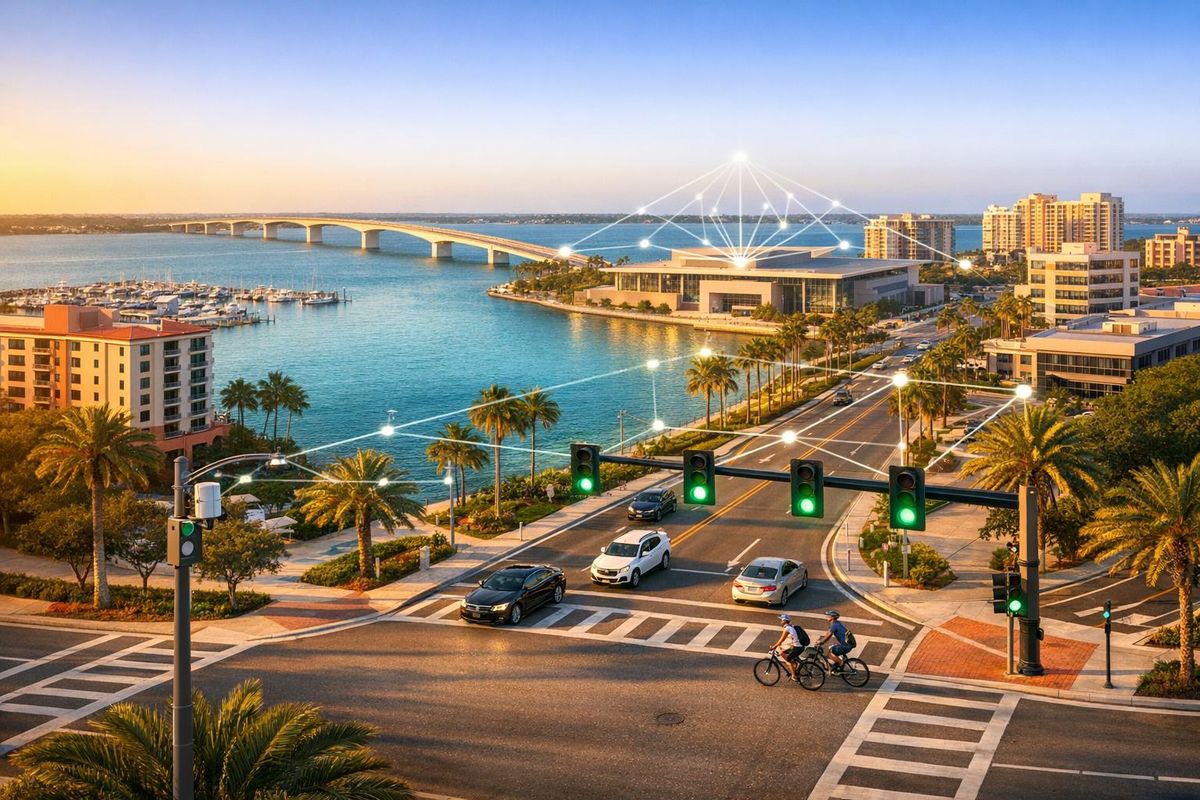
Sarasota is making waves with its Sarasota 2.0 Agenda, a plan that integrates technology into city operations to improve safety, efficiency, and quality of life. Highlights include:
- AI Traffic Systems: Cameras at 16 intersections track speed, near-misses, and lane departures to reduce accidents. Expansion to 90 intersections is planned.
- Environmental Sensors: Real-time monitoring of sea levels, water quality, and red tide helps manage coastal challenges.
- Broadband Access: Affordable internet and public Wi-Fi are expanding to bridge digital gaps across neighborhoods.
- Data Transparency: Public dashboards provide insights into city metrics and decision-making.
- Civic Innovation: Partnerships with startups and universities drive new tech solutions, like TENEX.ai's $27M funding boost.
These efforts earned Sarasota the 2025 Smart Cities Connect Award and have already improved traffic safety, connectivity, and public services. However, challenges like privacy concerns, uneven access, and scaling initiatives remain.
Sarasota’s journey shows how cities can use technology to address urban challenges while staying true to their community-focused values.
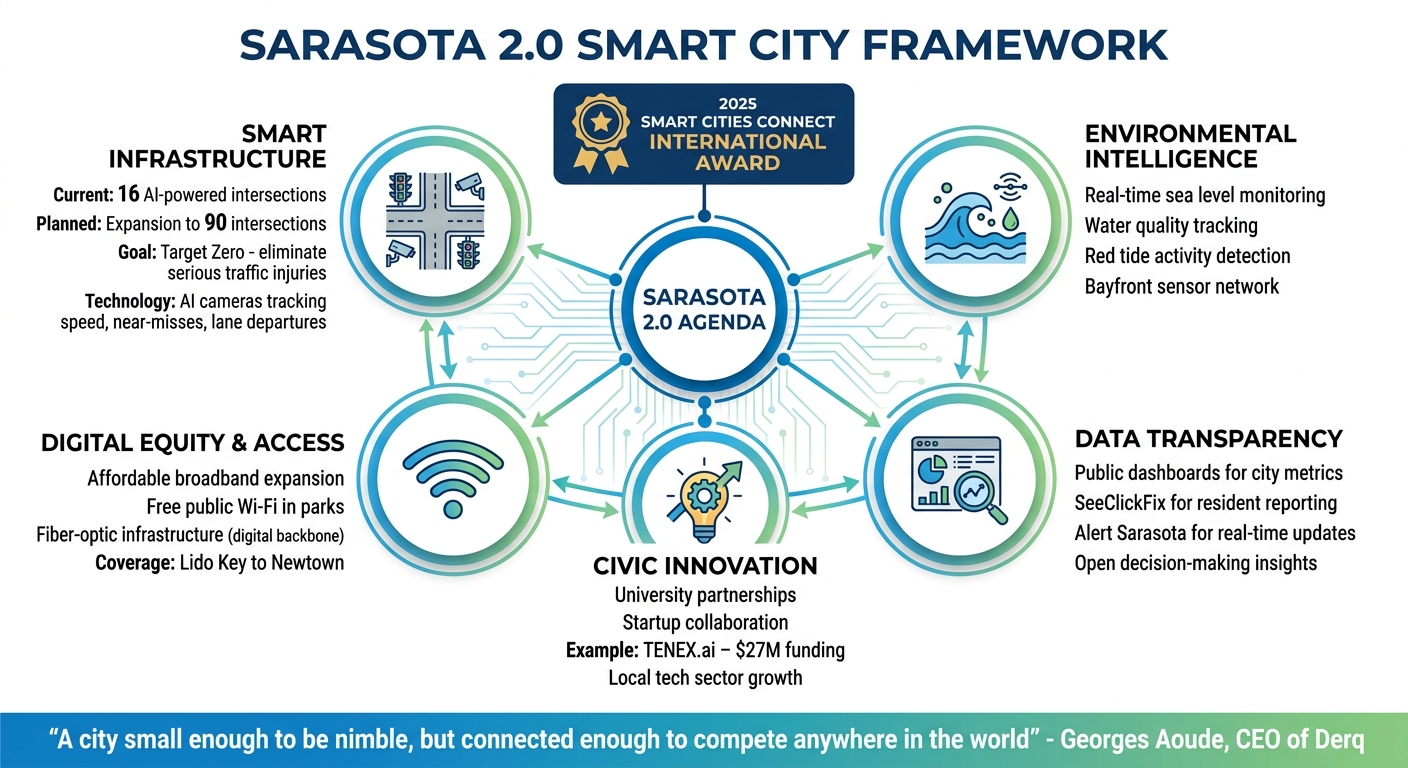
Sarasota 2.0 Smart City Framework: 5 Core Priorities and Key Initiatives
Smart Cities: How IoT is Transforming Urban Infrastructure | Internet of Things Explained
sbb-itb-354efe9
The Sarasota 2.0 Agenda: City Framework
The Sarasota 2.0 Agenda is the city's comprehensive plan for weaving technology into its operations. Instead of focusing on isolated upgrades, it takes a holistic approach, integrating digital tools to enhance city services while preserving Sarasota's unique neighborhood charm. This roadmap lays the foundation for the key priorities discussed below.
What makes Sarasota stand out is its ability to adapt and grow efficiently. Georges Aoude, CEO of Derq, puts it this way:
"The combination of civic infrastructure and private innovation puts Sarasota in a position unlike any other: a city small enough to be nimble, but connected enough to be able to compete anywhere in the world".
This flexibility allows Sarasota to test new technologies on a smaller scale before expanding them city-wide, from Lido Key to Newtown. The agenda also addresses critical concerns like privacy and transparency. For instance, AI-powered traffic systems at 16 intersections analyze patterns such as near-misses and lane departures without collecting personal data. This reflects Sarasota 2.0's commitment to using data responsibly while protecting residents' privacy.
5 Core Priorities of Sarasota 2.0
The agenda focuses on five key areas, each interconnected to create a smarter, more connected city:
- Smart Infrastructure: Modernizing traffic signals, lighting, and utilities with real-time data to support the "Target Zero" goal of eliminating serious traffic injuries. Currently, 16 intersections are equipped with this technology, with plans to expand to all 90 intersections.
- Environmental Intelligence: Using sensors to track sea levels, water quality, and red tide activity, helping the city better respond to environmental challenges.
- Digital Equity & Access: Expanding affordable broadband and Wi-Fi to ensure all residents have reliable internet access.
- Data Transparency: Developing open dashboards that allow residents to view city metrics and understand how decisions are made.
- Civic Innovation: Partnering with universities, startups, and local organizations to pilot new technologies before scaling them city-wide. A prime example is the growth of the local tech sector, highlighted by cybersecurity firm TENEX.ai's recent $27 million funding round.
This agenda positions Sarasota as a forward-thinking city that balances technological progress with community values. By addressing both current and future needs, Sarasota 2.0 aims to create a thriving, connected community.
Technology Implementations in Sarasota
Sarasota has been making strides in urban innovation through the Sarasota 2.0 Agenda, focusing on four major technology initiatives to improve city services and resilience.
AI-Powered Traffic Systems
The city has introduced AI-driven cameras at 16 intersections downtown, including areas like Fruitville Road and Lemon Avenue. These cameras operate around the clock, analyzing driver and pedestrian behavior as part of the "Target Zero" program, which aims to eliminate serious traffic accidents and injuries. Rather than focusing on enforcement, the system prioritizes tracking near-misses, speeds, lane departures, and illegal crossings - without recording personal data.
City Engineer Nikesh Patel explains:
"We get speed, near-misses, lane departures. We also get information on how many vehicles per day go through the area".
This data helps the city make targeted infrastructure changes. For instance, if excessive speeds are detected, traffic-calming measures can be introduced. Similarly, frequent jaywalking could lead to wider crosswalks or adjusted signal timing. Sarasota plans to extend this technology to all 90 intersections in the city soon.
Beyond traffic, Sarasota is also focusing on environmental resilience through advanced monitoring systems.
Environmental Monitoring Sensors
Sensors along Sarasota's bayfront track sea levels, water quality, and red-tide activity. This network, part of the city's Environmental Intelligence system, supports both long-term climate planning and immediate public alerts. The data collected helps the city prepare for environmental challenges and respond quickly to emergencies.
Broadband and Smart Connectivity
Sarasota has expanded its fiber-optic infrastructure, creating a "digital backbone" for city operations. This network supports smart traffic systems, emergency services, and free public Wi-Fi in city parks, addressing digital equity for residents across neighborhoods like Lido Key and Newtown. It also powers tools like SeeClickFix, which allows residents to report maintenance issues, and Alert Sarasota, which provides real-time updates on storms and closures.
Patel highlights the importance of these upgrades:
"It helps us make better decisions because we are tracking that information in real time and seeing what is going on out there".
This enhanced connectivity is also paving the way for advanced transportation technologies.
Electric and Automated Vehicles
To prepare for the future, Sarasota is upgrading its traffic signals and utility systems to support Connected and Automated Vehicles (CAV). At the same time, the city is expanding its electric vehicle charging network to promote sustainable transportation. These efforts aim to integrate autonomous vehicles into the city's transportation system while encouraging greener mobility solutions.
Measured Results and Recognition
Sarasota's tech initiatives are now backed by tangible data and accolades.
Awards and Achievements
Sarasota has gained international attention for its work in urban safety and technological innovation. In May 2025, the city received the Smart Cities Connect International Award, recognizing its advancements in resilience, connectivity, and community safety. Another notable honor was the 2025 Build a Better Mousetrap Award, celebrating Sarasota's creative use of technology to tackle urban challenges.
A key factor in these achievements was Sarasota's AI-powered traffic monitoring system, which has significantly improved safety for both drivers and pedestrians. The system's ability to track near-miss accidents, illegal crossings, speeding, and lane departures in real time earned high praise from evaluators.
Performance Metrics
These awards reflect measurable improvements in the city's operations. Under the Target Zero initiative, serious crashes and injuries downtown have steadily decreased. The AI system, deployed at 16 intersections, collects data around the clock. This allows city engineers to analyze historical trends, identify risky behaviors, and make proactive changes to enhance safety.
City Engineer Nikesh Patel highlighted the importance of this approach:
"It's to determine what the behaviors are happening and see what we can do to implement solutions that help us with target zero."
Beyond traffic safety, upgraded fiber infrastructure now plays a vital role in supporting municipal services, offering free Wi-Fi in parks, and bolstering emergency response systems. Environmental sensors also monitor sea levels, water quality, and red-tide activity, aiding climate adaptation efforts. On the economic front, the city's tech-friendly environment has attracted investment, such as local cybersecurity firm TENEX.ai securing $27 million in funding.
These results showcase Sarasota 2.0's dedication to building a safer and smarter city.
Community Impact: Benefits and Challenges
Sarasota's smart city projects have brought noticeable improvements to the lives of residents, visitors, and businesses, though certain hurdles still need to be addressed.
Community Benefits
The city has seen advancements in public safety and convenience. For example, expanded public Wi-Fi in parks has been a game-changer for remote workers and tourists alike. Platforms like SeeClickFix make it easy for residents to report local issues, such as potholes or broken streetlights, while Alert Sarasota delivers real-time updates on storm warnings and road closures.
AI-powered traffic systems have improved pedestrian safety significantly. By analyzing around-the-clock data, city engineers identified intersections where pedestrians avoided narrow crosswalks. This led to practical fixes like widening crosswalks and adjusting signal timings.
Environmental sensors along the bayfront add another layer of value. These sensors monitor sea levels, water quality, and red-tide activity, helping residents plan their beach outings and contributing to broader climate adaptation efforts. Additionally, upgraded fiber infrastructure has fueled growth for local businesses.
While these advancements are meaningful, not all residents have felt their full impact, as challenges remain.
Implementation Challenges
With progress comes obstacles, and Sarasota is no exception. Some of the same technologies that bring improvements also raise concerns.
One of the most pressing issues is privacy. Even though the AI cameras do not capture faces or license plates, many residents are still uneasy about how their data is accessed and stored. Another significant hurdle is the digital equity gap. The Sarasota 2.0 initiative aims to address this by expanding broadband access from Lido Key to Newtown, ensuring all neighborhoods benefit from improved connectivity.
There’s also the challenge of uneven distribution of benefits. Currently, only 16 intersections equipped with AI technology serve downtown and key corridors like Fruitville Road and Lemon Avenue. While the city plans to extend this system to all 90 intersections, residents in more remote areas haven’t yet experienced the same safety improvements. To make these tools as effective as possible, ongoing community involvement will be crucial.
Benefits vs. Challenges: Side-by-Side Analysis
Comparison Table
This breakdown highlights the advantages and challenges tied to Sarasota's technological initiatives, building on the earlier discussion about community impacts.
| Category | Advantages | Implementation Challenges |
|---|---|---|
| Public Safety | AI cameras installed at 16 intersections help detect near-misses and illegal crossings, aiding the "Target Zero" initiative to eliminate serious crashes. | Concerns from residents about constant surveillance and data access persist, even though the cameras don't record faces or license plates. |
| Traffic Management | Real-time data helps engineers fine-tune signal timing and design crosswalks based on actual user behavior. | Expanding the system from 16 intersections to all 90 citywide is costly and technically challenging. |
| Connectivity | Free Wi-Fi in parks and improved fiber infrastructure boost opportunities for remote work and digital entrepreneurship. | The digital divide remains an issue, with inconsistent broadband access across areas like Lido Key and Newtown. |
| Sustainability | Environmental sensors track sea levels, water quality, and red-tide activity along the bayfront. | Regular maintenance and ensuring transparency in environmental data present ongoing hurdles. |
| Civic Engagement | Tools like SeeClickFix allow residents to report issues like potholes, while Alert Sarasota provides real-time emergency updates. | There are concerns that increased technology might overshadow Sarasota's neighborhood charm and sense of community. |
Engineer Patel and CEO Georges Aoude emphasize that while real-time data empowers smarter decision-making, tackling privacy concerns and extending these benefits beyond downtown remain critical. This table illustrates the ongoing balancing act between innovation and preserving community values as the city evolves.
Conclusion
Sarasota has successfully blended cutting-edge technology with its community-centered values to create meaningful urban advancements. By combining AI-powered traffic cameras with environmental sensors, the city has developed a system that prioritizes both innovation and public welfare. This effort has even earned Sarasota international recognition through an award for its Smart City Initiative.
A standout feature of Sarasota's approach is its "Community Science" model, which merges data collection with active public involvement. Collaborations with organizations like the Mote Marine Laboratory & Aquarium highlight how environmental monitoring can serve dual purposes - technical improvements and educational outreach. As City Engineer Nikesh Patel puts it:
"It helps us make better decisions because we are tracking that information in real time and seeing what's going on out there".
This seamless integration of technology and community feedback offers a glimpse into the future of urban planning.
One of the city's biggest challenges and opportunities lies in scaling its initiatives. Expanding AI traffic technology from 16 to 90 intersections will demand both consistent investment and the trust of the community. Additionally, Sarasota's use of big data and Origin-Destination metrics to study movement patterns provides a modern alternative to outdated manual surveys, paving the way for more efficient and equitable city planning.
Looking ahead, Sarasota's journey demonstrates that the success of smart city projects hinges on balancing technological advancements with equitable access. Initiatives like free Wi-Fi in parks and improved broadband infrastructure have created new digital opportunities, but ensuring these benefits reach all residents remains a critical task. As one of Florida's early adopters of advanced smart city programs, Sarasota has positioned itself as a leader in integrating technology effectively. With its Public Works and Capital Projects framework and the "Target Zero" vision to eliminate serious crashes, the city shows how data-driven strategies can lead to real, everyday improvements.
FAQs
How does Sarasota’s AI traffic system protect privacy?
Sarasota's AI-driven traffic system is designed with privacy as a top priority. These AI-powered traffic cameras are used exclusively to monitor driver and pedestrian behavior to improve safety on the roads. The system is strictly focused on managing traffic flow and enhancing public safety, with no data sharing or surveillance activities beyond this purpose.
What proof shows these smart city upgrades are working?
Sarasota's efforts to modernize and innovate have been recognized globally, earning an international award for its Smart City Initiative. One standout feature of these upgrades is the use of AI-powered traffic cameras. These cameras monitor near-miss accidents and illegal crossings, providing valuable data to improve safety and inform better decision-making throughout the city.
How will Sarasota ensure every neighborhood benefits?
Sarasota is making sure its smart city projects reach every neighborhood by rolling out targeted programs focused on safety, resilience, and connectivity. These efforts include leveraging technology such as AI and traffic cameras to boost pedestrian and driver safety. The city is also keeping a close eye on sea level changes, working to reduce the impact of red tide, and expanding bike and pedestrian routes. By addressing the specific needs of each area, Sarasota aims to build a safer and more connected community for everyone.