The Truth About Hurricane Season in Florida (What Locals Want You to Know)
Hurricane season in Florida demands early prep: know your evacuation zone, build a 7–14 day kit, and expect storm surge inland.
Hurricane season in Florida runs from June 1 to November 30, with peak activity between August and October. Living in areas like Manasota means dealing with unique risks like storm surges, flooding, and extended recovery times. Here's what you need to know to stay safe:
- Preparation starts early: Stock up on supplies for 7–14 days, renew evacuation tags, and check your insurance policies before the season begins.
- Flood risks are real: Standard homeowners insurance doesn’t cover flood damage, and flood zones require specific responses.
- Evacuation zones matter: Know your zone, plan your route, and leave as soon as orders are issued to avoid gridlock.
- Storm surges go beyond the coast: Even inland areas can face severe flooding, as seen in past storms like Helene (2024) and Idalia (2023).
- Recovery takes time: Document damages, use local aid programs like Manatee County’s HRRP, and work with licensed contractors.
Storms are unpredictable, but being prepared can make all the difference. Start now to protect your family, home, and community.
Hurricane season warning: Florida officials urge residents to prepare now
sbb-itb-354efe9
Hurricane Season in Florida: Key Dates and Regional Risks
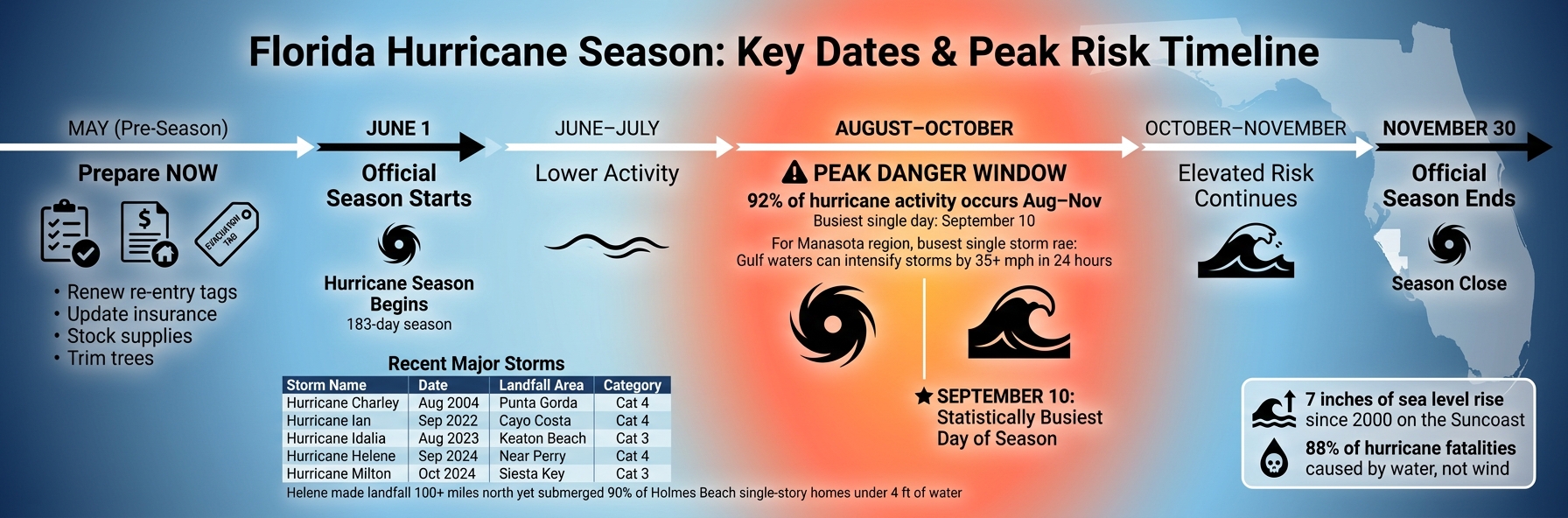
Florida Hurricane Season: Key Dates, Peak Risks & Preparedness Timeline
Official Hurricane Season Dates
The Atlantic hurricane season spans from June 1 through November 30. During this six-month stretch, residents across Florida, including those in Manatee and Sarasota counties, need to stay vigilant.
The highest risk period is from August to November, with 92% of hurricane activity occurring during these months. The busiest single day of the season typically falls on September 10. For the Manasota region, the peak danger window is mid-August to late October. During this time, the warm waters of the Gulf have been known to intensify storms, increasing wind speeds by over 35 mph in just 24 hours.
This timeline highlights the critical need for preparation, especially when considering the region's historical vulnerability to hurricanes.
Florida's Hurricane History and Its Impact on Manasota
Manasota, located along Florida's Gulf Coast, may not always experience direct hurricane landfalls, but it remains far from immune to their effects. Even storms that strike distant areas can deliver devastating storm surges to Manatee and Sarasota counties. Past events offer a sobering reminder of the risks tied to hurricane season. Below is a table summarizing some of the most impactful storms in recent decades:
| Storm | Date | Landfall Area | Category at Impact |
|---|---|---|---|
| Hurricane Charley | August 2004 | Punta Gorda | 4 |
| Hurricane Ian | September 2022 | Cayo Costa | 4 |
| Hurricane Idalia | August 2023 | Keaton Beach | 3 |
| Hurricane Helene | September 2024 | Near Perry | 4 |
| Hurricane Milton | October 2024 | Siesta Key | 3 |
One striking example is Hurricane Helene in September 2024. Although it made landfall near Perry, FL - well north of the Manasota area - it caused severe flooding in Holmes Beach, where 90% of single-story homes were submerged under up to 4 feet of water. In Bradenton Beach, approximately 80% of structures suffered damage. The Climate Adaptation Center explained the broader implications:
"Idalia and Helene were far off the coast but did millions to billions in damage. That is driven by the fact hurricanes are bigger, slower-moving and come on top of 7 inches of sea level rise since 2000 right here on the Suncoast."
The 7 inches of sea level rise since 2000 is a game-changer for the region. It means storm surges now reach further inland than older models had predicted, and the impact of this trend is expected to grow in the coming years.
Local Myths vs. Facts: What Manasota Residents Know
Myth: Hurricanes Only Affect Coastal Areas
A lot of people believe that living away from the beach means they're safe from hurricanes, but that's far from true. Hurricanes can wreak havoc well inland, bringing strong winds and even tornadoes. In Manatee County, areas far from the Gulf are still at risk for downed trees, damaged roofs, and flooding during a major storm.
Hurricane-force winds don’t just stick to the coast - they can stretch across areas up to 1,000 miles wide. Even if a storm doesn’t make direct landfall near you, the inland damage can still be significant.
Myth: Storm Surges Only Reach the Beach
Storm surge is one of the most dangerous aspects of a hurricane, and it doesn’t stop at the shoreline. It can push into bays, rivers, and waterways, flooding areas that many assume are safe.
Take Hurricane Helene in September 2024, for example. During that storm, a 28-inch surge flooded the garage of the Holmes Beach Police Department - a place that stayed dry even during Hurricane Idalia the year before. Officers were stranded, unable to assist residents who had chosen to ride out the storm.
"We were telling people they should turn off their power and get on top of their kitchen counter and just wait it out, because we couldn't get to them." - William Tokajer, Police Chief, Holmes Beach
It’s worth noting that water, not wind, is the leading cause of death during tropical storms, accounting for nearly 88% of fatalities. This makes storm surge and heavy rains the most lethal threats in a hurricane.
Why You Should Start Preparing Before Hurricane Season
These myths highlight why early preparation is so important. While hurricane season officially begins on June 1, locals know that May is the time to get ready. Waiting until a storm is on the radar leaves little time to trim trees, update insurance policies, or secure re-entry tags - contractors and supplies get booked up quickly.
For residents of Anna Maria Island, Holmes Beach, and Bradenton Beach, renewing re-entry tags before the season starts is a must. After Hurricanes Helene and Milton in 2024, the City of Anna Maria required all residents to update their tags for the 2025 season. According to officials, some people were still trying to use tags from 2005.
"We had people showing up with tags from 2005. This lets us draw a line in the sand. The new tags help us know exactly who's coming back." - Mark Short, Mayor, City of Anna Maria
Another often overlooked tip: move electric vehicles, golf carts, and e-bikes out of garages before a storm. Saltwater surge can corrode EV batteries, potentially causing house fires. With the rise in electric vehicles across Manatee and Sarasota counties, this is becoming a growing concern.
How to Build a Hurricane Kit for Manasota Residents
What Every Hurricane Kit Needs
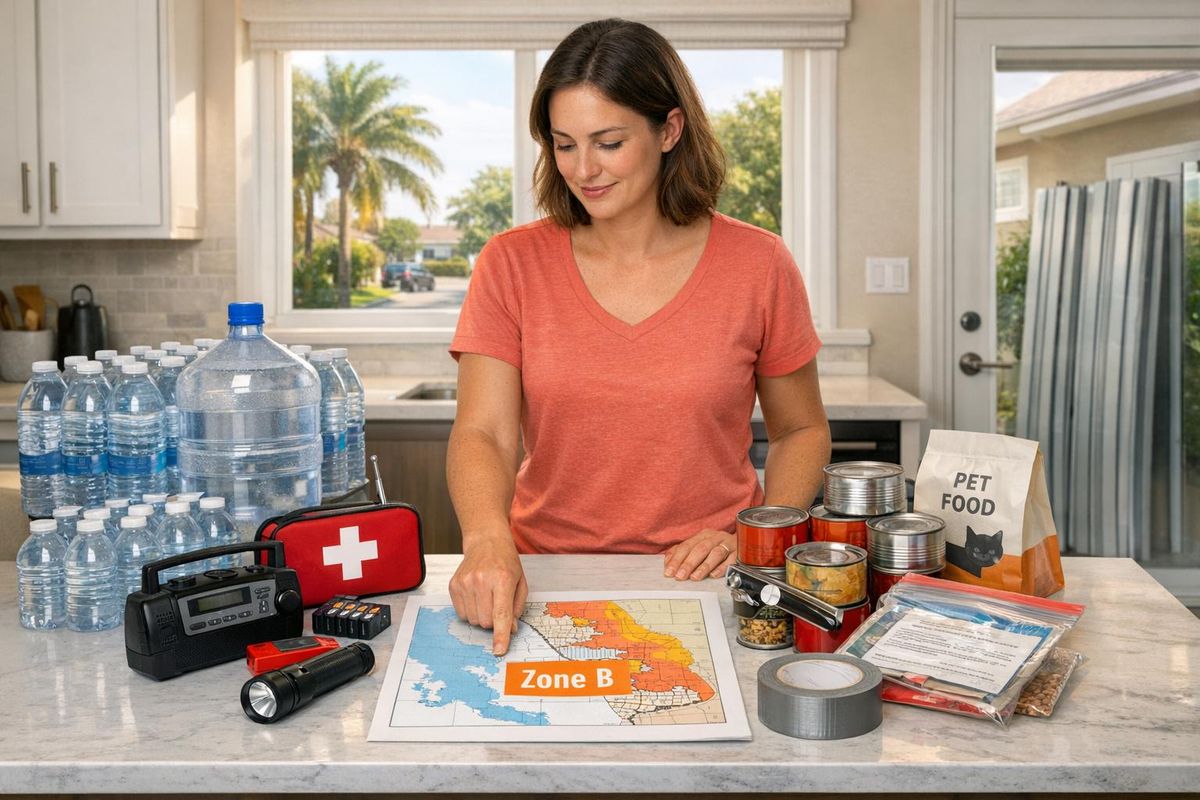
While many standard kits suggest a three-day supply, locals in Manasota recommend preparing for 7 to 14 days due to the extended recovery periods often seen after storms.
"Manatee County Emergency Management recommends your disaster kit contain water, food and supplies for seven to fourteen days." - Manatee County Emergency Management
Start with the basics: water - at least 1 gallon per person per day for a week or more. Add non-perishable food items, a manual can opener, a first-aid kit, and flashlights with extra batteries. A battery-powered or hand-crank radio is also crucial for staying informed. Don’t forget a two-week supply of any necessary medications. Florida law allows early refills during emergencies, so take advantage of this when a storm approaches. To keep devices charged during power outages, pack a portable power bank or a solar charger.
These essentials are critical, but Manasota residents should also include items that address challenges specific to the area.
Items Specific to Manasota Residents
In the aftermath of a hurricane, stagnant water and the Florida sun can create unique problems. For example, standing water becomes a breeding ground for mosquitoes, making bug spray a must-have. Sunscreen is equally important for anyone helping with outdoor cleanup.
Having cash in small bills is another local tip. Power outages can shut down ATMs and make card transactions impossible.
"With no power, banks may be closed; checks and credit cards may not be accepted, and ATMs may not be operational." - MyManatee.org
Additionally, pack heavy-duty tarps, nails, and basic tools to handle minor repairs quickly. Contractors often get booked up immediately following a storm. A water purification kit is also wise to have on hand, especially for boil-water advisories in coastal areas. If building a kit all at once feels overwhelming, consider spreading the cost over time with a 20-week preparedness plan.
| Category | What to Include |
|---|---|
| Water & Food | 1 gallon per person per day for 7–14 days, non-perishable food, manual can opener |
| Health | Two-week prescription supply, first-aid kit, dosage list, pharmacy contact info |
| Power & Comms | Flashlights, extra batteries, solar charger, battery- or hand-crank radio |
| Local Climate | Mosquito repellent, sunscreen, extra water for cooling and washing |
| Home Repair | Heavy-duty tarps, nails, basic tools, plastic screening |
| Sanitation | Bucket with lid, cat litter (for emergency toilet), disinfectant, trash bags |
| Financial & Docs | Cash in small bills, insurance policies, IDs, medical records in waterproof storage |
These recommendations are rooted in lessons learned from previous storms, helping residents prepare for the specific challenges hurricanes bring to the Manasota area.
Evacuation and Safety Tips for Manatee and Sarasota Counties
Having a hurricane kit is a smart first step, but knowing how and when to evacuate is just as important. Pair these evacuation tips with your kit to complete your safety plan tailored for Manatee and Sarasota Counties.
How to Find Your Evacuation Zone
Both counties provide tools to help you determine your evacuation zone. Manatee County uses an A–E system based on storm surge risk, while Sarasota County employs a color-coded system: Red indicates high danger (like flooding or structural risks), Yellow signals moderate hazards (such as downed trees or power outages), and Green means minimal danger. It’s a good idea to check your zone well before hurricane season begins.
In Manatee County, use the "Learn Your Level" map or the "Resident Information Tool" on the county website. Sarasota County offers the "Know Your Evacuation Level" tool, which simplifies the process with its color-coded system. Keep in mind, Sarasota County treats all evacuation notices - whether labeled voluntary or mandatory - as directives to leave.
Some general rules apply regardless of which county you live in:
- If your property spans two evacuation zones, always follow the instructions for the lower (more vulnerable) level.
- Residents in mobile homes, RVs, or manufactured homes must evacuate during any evacuation order - no exceptions.
- Evacuation zones can change annually as coastline data is updated, so make it a habit to verify your zone each year.
Once you know your evacuation zone, map out your route ahead of time to avoid last-minute chaos.
Evacuation Routes and How to Avoid Delays
The main evacuation routes out of the Manasota area are US-41 and I-75. These roads can become heavily congested during a mandatory evacuation, so leaving early is your best bet to avoid gridlock.
Here’s a tip seasoned locals swear by: keep your gas tank at least half full when a storm is on the horizon. Gas stations often run out quickly once an evacuation is ordered. If you drive an electric vehicle, fully charge it as soon as a storm is forecasted, and avoid letting the charge drop below 50%. Once fully charged, unplug your car to prevent damage from power surges.
Sign up for Alert Manatee or AlertSarasota County to receive real-time evacuation updates via phone, text, or email.
If you can’t evacuate by car, it’s essential to have a backup plan.
Shelters and Options for Those Without a Car
For those without access to a vehicle or a ride, Manatee County Emergency Management offers transportation assistance. You can reach them at 941-748-4501. Sarasota County residents should stay updated through the county’s Emergency Management website or AlertSarasota County for transportation options as they’re announced.
Public shelters in both counties operate on a first-come, first-served basis. There are no assigned shelters, so you can go to any open location. However, shelters should be your last resort. If possible, stay with family or friends outside the surge zone or book a hotel inland. Not all shelters allow pets, so check in advance and bring vaccination records and a crate if you’re bringing animals.
For residents with medical or functional needs, Special Needs shelters are available in both counties. Pre-registration is required to secure a spot and ensure transportation assistance if needed. If you haven’t registered and need help as a storm approaches, contact Emergency Management immediately.
"Emergency services (Fire, EMS, Law Enforcement) are suspended once sustained winds exceed 45 mph." - Sarasota County Emergency Management
This isn’t just a warning - it’s a firm rule. Once winds reach that speed, emergency responders can’t assist. Acting early isn’t just a good idea - it’s essential for your safety.
How to Track Hurricanes: Tools and Resources Locals Use
Once you've set your evacuation plan, the next step is staying informed as the storm develops. Having reliable resources at your fingertips before hurricane season begins can make all the difference when time is of the essence.
NOAA and County Resources
The National Hurricane Center (NHC) website (nhc.noaa.gov) is your go-to for tracking storm paths, wind speeds, and intensity forecasts. It's a good idea to bookmark it now, so you're not scrambling to find it when a storm is on the horizon.
For more localized information, Manatee County offers tools like the "Learn Your Level" interactive map and the Resident Information Tool on its website. These resources help confirm your evacuation zone and identify nearby emergency shelters. Keep in mind that evacuation boundaries can change yearly, so it’s smart to verify your zone at the start of each hurricane season. Sarasota residents can also subscribe to updates via the City of Sarasota website for timely alerts and preparedness information.
Once you've explored these resources, you'll want real-time updates during a storm - and that's where apps and alert systems come in handy.
Apps and Alert Systems for Real-Time Updates
For instant alerts, AlertManatee is the official emergency notification system for the county. It sends updates by text, phone, or email. Be sure to register through the MANATEEREADY portal before the season kicks off. For non-urgent storm information, you can call Manatee 311 at 941-748-4501, which is a great resource during emergencies.
The Red Cross Emergency app is another valuable tool, offering storm tracking, safety checklists, and shelter locations all in one place. When it comes to TV coverage, channels like WWSB Channel 40 (Sarasota), BayNews 9, and WFLA Channel 8 provide continuous updates on regional weather conditions during active storms.
For those times when the power goes out, a battery-powered radio can be a lifesaver. Tune in to stations like WFLA 970 AM, WWPR 1490 AM, or WJIS 88.1 FM for uninterrupted emergency updates. These tools ensure that residents in the Manatee and Sarasota areas can stay informed and act quickly when storms strike.
| Resource | Type | Best Used For |
|---|---|---|
| National Hurricane Center (NHC) | Website | Storm path and intensity forecasts |
| AlertManatee / MANATEEREADY | Alert system | Real-time county emergency notifications |
| Learn Your Level Map | Interactive map | Confirming evacuation zone (A–E) |
| Red Cross Emergency App | Mobile app | Shelter locations and safety checklists |
| WFLA 970 AM / WWPR 1490 AM | Radio | Emergency updates during power outages |
| WWSB Ch. 40 / BayNews 9 | Local TV | Regional storm tracking and impact reports |
After the Storm: Recovery and Community Support in Manasota
Make sure to document all damage thoroughly using photos, videos, and by keeping receipts for repairs, lodging, and supplies. This step is essential for accessing a variety of recovery resources.
Local Recovery Programs and Aid Resources
Once you’ve ensured your safety and recorded the damages, it’s time to tap into the recovery resources available. Manatee County has received $252.7 million in HUD disaster recovery funds, which are being used to support the Lasting Manatee Home Recovery Program (HRRP). This program, launched on May 1, 2026, helps homeowners repair, replace, or elevate homes damaged by storms. Applications can be submitted at lastingmanatee.org.
For immediate assistance, contact Suncoast 211 by dialing 211 or texting your zip code to 898-211. They provide guidance on housing, food, utility assistance, and more. Two additional local resources for financial relief are Catholic Charities at 941-244-9490 and the Salvation Army at 941-748-5110.
The State Housing Initiatives Partnership (SHIP) offers 0% interest, deferred-payment loans with a 20-year term. No payments are required unless the property is sold, rented, or vacated during the loan period. To remain eligible for most aid programs, always work with licensed contractors.
How Manasota Communities Build Long-Term Resilience
Manasota is not just focused on recovery but also on creating stronger, more resilient communities through various initiatives and policy changes. For example, Turning Points provides essential daily resources like showers, laundry, medical care, and rental assistance. They also have specialized programs for veterans. Meanwhile, Habitat for Humanity (941-748-9100) and Rebuilding Together Tampa Bay (rttb.org) focus on critical home repairs for those in financial need.
In 2025, Florida introduced a permanent, year-round sales tax exemption on disaster preparedness items, replacing the temporary tax holidays of the past. This change, effective August 1, 2025, helps residents stay prepared year-round. Staying informed is just as important - subscribe to AlertManatee and visit MyManatee.org/Storm for updates on garbage collection, road closures, and new recovery programs as they are announced.
Conclusion: How to Stay Safe During Hurricane Season in Florida
Throughout this guide, we've emphasized one crucial takeaway: preparation and prompt action are your best defenses during hurricane season. Spanning 183 days (June 1–November 30), this period demands readiness long before a storm appears on the radar. Waiting until a hurricane forms could leave you scrambling for supplies or without active flood insurance. This is why starting early is so important.
For residents of Manasota, there are a few non-negotiables: know your evacuation zone (this is not the same as your FEMA flood zone), stock up on at least 7 days' worth of essentials like food, water, and medications, and follow evacuation orders immediately. Holmes Beach Police Chief William Tokajer underscores this point:
"We will not be there to rescue people that did not take heed to the mandatory evacuations."
To act now, take these two essential steps:
- Text "ManateeReady" to 888-777 for real-time alerts.
- Register at mymanatee.org/needs if you or someone in your household requires medical or transportation assistance during an evacuation.
Additionally, safeguard your vital documents - such as birth certificates, insurance policies, and Social Security cards - by storing them in a waterproof, airtight bag that you can grab quickly if needed.
These actions align with the advice from Manatee County Emergency Management. Their message is simple but powerful: "Preparedness saves lives." This isn't just a saying - it’s a lesson learned from every hurricane season in our area.
FAQs
Do I need flood insurance if I’m not in a FEMA flood zone?
Even if your property is outside a FEMA-designated flood zone, flood insurance is still a smart choice. Flooding can occur in any area, not just in high-risk zones. Having this coverage offers an added layer of protection against unexpected water damage. For many homeowners, it’s a reliable way to gain peace of mind - especially during hurricane season when the risk of flooding increases.
What should I do if I can’t evacuate because I don’t have a car?
If you don’t own a car and need to evacuate, it’s crucial to contact your local emergency management team for assistance. In Manatee County, Emergency Management provides help to those enrolled in the Special Needs Program, offering transportation to shelters or hospitals. If you haven’t registered for this program, try to arrange a ride with friends or family, or connect with local authorities for support. Having a clear plan and staying in touch with emergency services can make all the difference in staying safe during a storm.
How can I protect my EV or e-bike from storm surge damage?
To keep your EV or e-bike safe from storm surge damage, make sure to relocate them to higher ground or a flood-protected area well before a storm hits. For EVs, unplug them from charging stations and any external power sources to reduce the risk of electrical issues. E-bikes should be stored indoors or in an elevated, secure garage. Taking these steps ahead of time can help reduce potential damage during hurricanes.