How Sarasota and Manatee County Residents Prepare for Hurricane Season
Region-specific checklist for evacuation zones, home prep, emergency kits, alerts, and recovery in Sarasota and Manatee counties.
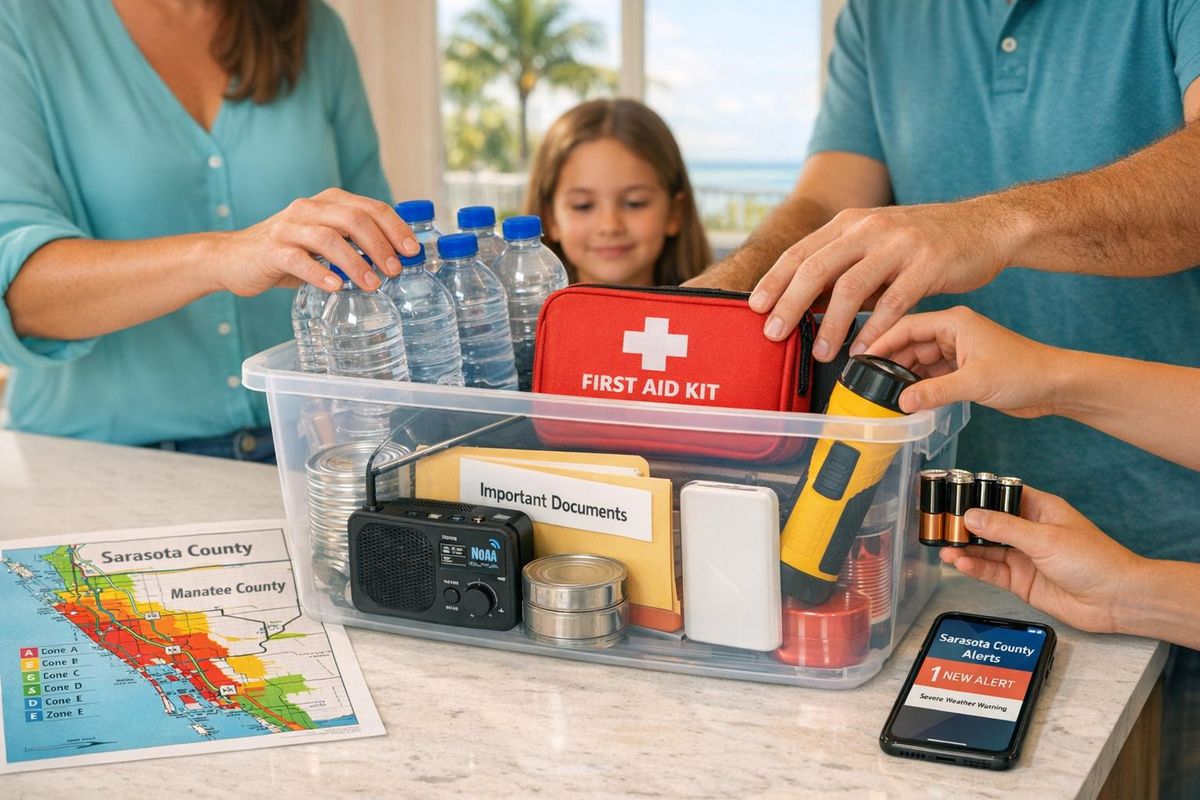
Hurricane season in Sarasota and Manatee counties runs from June 1 to November 30, bringing risks like storm surges, flooding, and wind damage. Preparing early can help protect your home, family, and community. Here's what you need to know:
- Evacuation Zones vs. Flood Zones: Know your evacuation zone (A–E in Manatee, color-coded in Sarasota) and FEMA flood zone. Use county tools like "Learn Your Level" or "Know Your Evacuation Level" for guidance.
- Home Preparation: Check hurricane shutters, secure outdoor items, and trim trees by mid-May. Update wind mitigation certificates and photograph your property for insurance purposes.
- Emergency Kits: Stock 7–14 days of water, non-perishable food, medications, and pet supplies. Include important documents in waterproof bags and cash in small bills.
- Evacuation Plans: Leave early if you're in a high-risk area or mobile home. Map routes, confirm pet-friendly shelters, and charge devices or electric vehicles in advance.
- Local Alerts: Sign up for Alert Sarasota County or Alert Manatee, and keep a NOAA weather radio for updates during power outages.
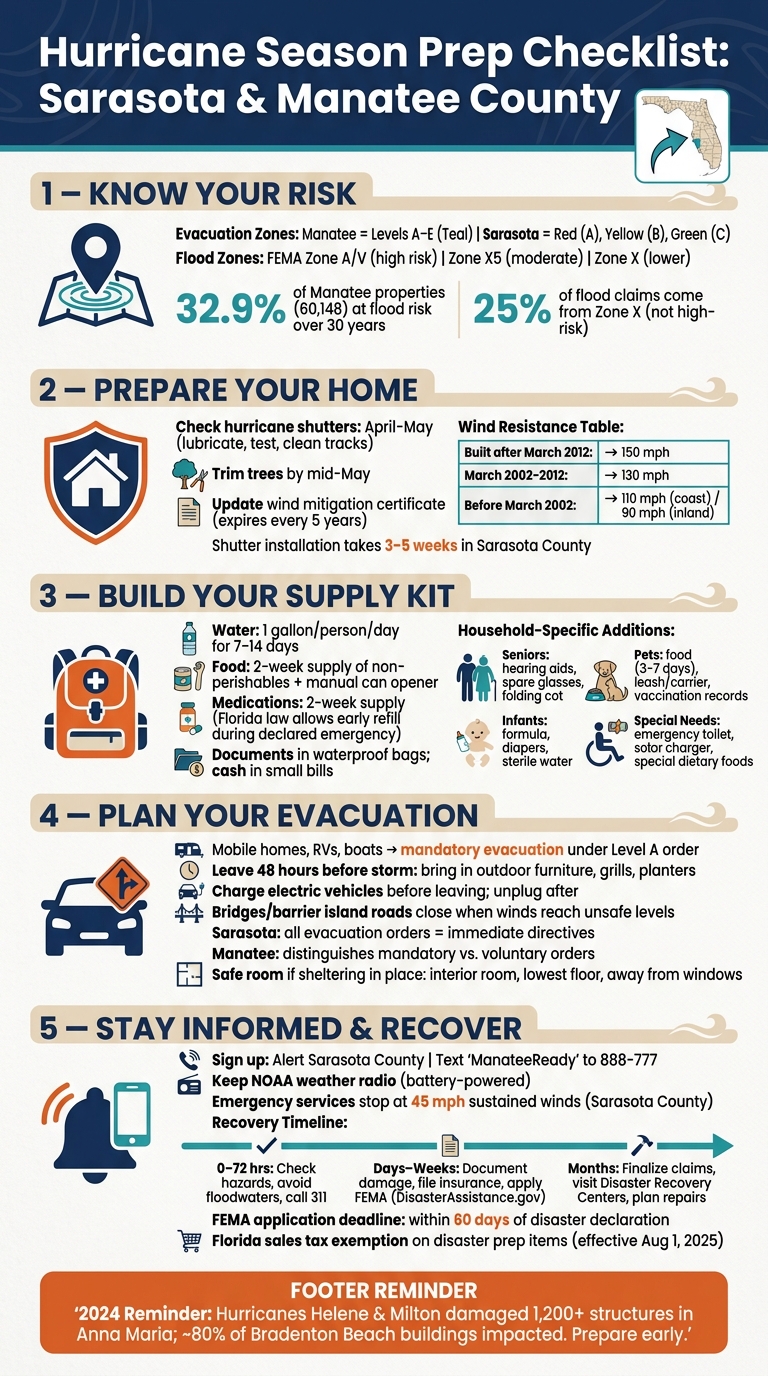
Hurricane Season Prep Checklist: Sarasota & Manatee County
Understanding Local Risks and Alerts
Local Hurricane and Flood Risks
Sarasota and Manatee counties face three major threats during hurricane season: storm surge, flooding, and wind damage. Each of these requires different safety measures.
Storm surge, often described as a wall of saltwater pushed inland by a hurricane, is the most dangerous and unpredictable threat for coastal areas. Flooding caused by rainfall, on the other hand, is a separate issue. It's important to note that evacuation zones - determined by storm surge risk - are distinct from FEMA flood zones, which are based on freshwater flooding risks from rainfall. For instance, a home outside a high-risk flood zone could still fall within a high-priority evacuation zone.
Wind damage risks also depend on when your home was built. In Manatee County, construction codes have evolved over time, requiring newer homes to withstand higher wind speeds:
| Home Build Date (Manatee County) | Required Wind Resistance |
|---|---|
| On or after March 2012 | 150 mph |
| March 2002 – March 2012 | 130 mph |
| Before March 2002 | 110 mph (coast) / 90 mph (inland) |
Flooding remains a significant concern across the region. In Manatee County alone, 32.9% of all properties - about 60,148 properties - are at risk of flooding over the next 30 years. Major sources of flooding include the Manatee River, Myakka River, Braden River, Phillippi Creek, Sarasota Bay, and the Intracoastal Waterway. Even properties in lower-risk areas aren't entirely safe; roughly 25% of all flood insurance claims come from Zone X, which is not classified as high risk.
To prepare, it's crucial to verify both your evacuation and flood zones using the tools provided by your county.
How to Find Your Evacuation and Flood Zones
Each county provides free online tools to help residents determine their risk levels. These tools are updated regularly to reflect new data and coastal changes.
- Manatee County residents: Use the "Learn Your Level" interactive map or the "Resident Information Tool" from the Manatee County Emergency Management Division. These resources show your evacuation level (A through E) and the nearest emergency shelters.
- Sarasota County residents: Access the "Know Your Evacuation Level" tool provided by Sarasota County Emergency Management.
After identifying your evacuation level, check your flood zone separately. By enabling the "FEMA Flood" layer on your county's map, you can see if your property is in a high-risk zone ("A" or "V"), a moderate-risk zone (Zone X5, shaded), or a lower-risk area (Zone X, unshaded). If you're in Zone A or V, flood insurance is often required by mortgage lenders - and it's a smart choice even if it's not mandatory.
"Hurricane levels represent the potential height of salt water inundation from storm surge (not freshwater or rainfall flooding)." - Manatee County Emergency Management Division
If your property sits on the boundary between two evacuation levels, always follow the guidance for the lower level - this is the level evacuated first. Residents living in mobile homes, manufactured homes, RVs, or boats must evacuate under a Level A order, regardless of their location or the storm's category.
How to Set Up Local Emergency Alerts
Signing up for emergency alerts is a simple but critical step to take before hurricane season begins. Each county has its own alert system:
- Sarasota County: Register for AlertSarasota County to receive notifications via phone, text, or email.
- Manatee County: Sign up for Alert Manatee, the county's official emergency notification system. Residents can also call 311 for real-time updates on shelter locations and status.
Both counties share updates and evacuation orders on social media platforms like X (formerly Twitter) and Instagram. These channels are especially useful if you're away from home during an emergency.
For added security, keep a NOAA weather radio on hand. These battery-powered devices provide critical weather updates when cell service or power is down - a common scenario during major storms. It's a small investment that could make a big difference when other communication channels fail.
One final note: In Sarasota County, emergency services stop responding once sustained winds exceed 45 mph. That means fire, EMS, and law enforcement won't be able to assist during severe conditions. Setting up alerts early and acting on them before the situation worsens is not just smart - it might be your only opportunity to stay safe.
sbb-itb-354efe9
Hurricane Preparedness Week: How to prepare for hurricane season
Getting Your Home Ready for a Hurricane
Here’s how residents in Sarasota and Manatee County can prepare their homes for hurricane season.
Checking Your Home's Structure
Start by inspecting your hurricane shutters in April and May, well before the season kicks off. Test each panel, check accordion slats for wear or damage, and run motorized systems through a full cycle. Don’t forget to lubricate tracks with silicone spray and clean out any debris from roll-down housings to ensure they’re in top shape.
Confirm that your wind mitigation certificate is up to date. In Florida, these certificates expire every five years, and an outdated one could impact your insurance coverage or discounts. If you’re considering new hurricane shutters or upgrades, act early. In Sarasota County, it typically takes 3–5 weeks to complete an installation, including permits and inspections.
"The window before hurricane season is the best time to get hurricane shutters installed - demand rises significantly as storms approach, and permit timelines can extend." - Total Shutter Technologies
Another smart move: take dated photos of your roof and exterior. These can serve as crucial evidence if you need to file an insurance claim later.
Once the structure is reinforced, it’s time to focus on securing your yard and exterior.
Securing Your Yard and Exterior
High winds can turn outdoor items into projectiles. Bring in anything that’s not anchored down - furniture, grills, planters, kayaks, and decorations. Ideally, move these items into your garage or home 48 hours before a storm hits.
Tree trimming is another priority. Cut back branches hanging over your roof or driveway by mid-May to avoid last-minute debris. For larger jobs, consider hiring a licensed arborist to ensure everything is cleared safely.
"Falling branches in 100mph wind cause more roof damage than wind itself." - Darren Dowling, Sarasota Broker, Beyond Realty
Check your gutters and downspouts, too. Clear them of debris and ensure water is directed away from your foundation to prevent localized flooding during heavy rains.
| Item Category | Action Required | Timing |
|---|---|---|
| Trees & Palms | Trim branches over roof/driveway | April – Mid-May |
| Gutters & Downspouts | Clear debris and check drainage | Before June 1 |
| Outdoor Furniture | Move to garage or house | 48 hours before storm |
| Grills & Planters | Store indoors; remove propane tanks | 48 hours before storm |
| Shutters & Screens | Lubricate tracks and test operation | April – May |
Once the yard is secure, turn your attention to safeguarding your home’s interior and utilities.
Protecting the Inside of Your Home and Utilities
As the storm approaches, take steps to protect what’s inside. Twenty-four hours before landfall, move important documents and valuables to interior closets or upper floors, preferably in waterproof bags. Fill your bathtubs with water so you can flush toilets if utilities fail.
Photograph or video every room in your home, then back up these files to cloud storage. Since hurricane deductibles in Florida often range between 2% and 10% of your home’s insured value, having this documentation can make a big difference when filing claims.
Prepare for power outages by testing your generator under load for 30 minutes before the season starts. Store at least 5 gallons of stabilized fresh fuel to keep it running when needed. Avoid candles during outages - they’re a fire hazard. Instead, rely on battery-powered flashlights or LED lanterns for light.
Building a Hurricane Supply Kit for Sarasota and Manatee Residents
Preparing for a hurricane isn't just about securing your home - it’s also about having the right supplies to weather the storm and its aftermath. Once your home is ready, focus on assembling a supply kit that meets your household's needs.
Core Emergency Supplies to Have on Hand
Manatee County Emergency Management advises residents to prepare a 7–14-day emergency kit, specifically designed for Sarasota and Manatee County conditions. Start with the basics: at least one gallon of drinking water per person, per day, plus extra water for potential boil orders. For food, stock up on non-perishable items to last two weeks and include a manual can opener. Other essentials? A corded landline phone - useful during power outages - and an ABC-type fire extinguisher for safety.
Feeling overwhelmed by the idea of building a kit all at once? Try the "20 Weeks to Preparedness" plan suggested by Manatee County. This approach allows you to gradually gather supplies during your regular shopping trips.
In addition to physical items, don’t forget to organize your important documents and funds.
Medical Records, Documents, and Cash Preparation
When power goes out, ATMs and card readers often stop working. To prepare, keep small bills in your kit for emergency purchases. Make sure you have a two-week supply of prescription medications for every family member. Under Florida law (State Statute 252.358), health insurers must waive refill restrictions during a declared state of emergency, so you can stock up legally.
Create a written list of all medications, including dosages and contact information for your doctors and pharmacies. Gather critical documents - like driver’s licenses, insurance policies, and financial records - and store them in a waterproof, easily accessible section of your kit.
Preparing for Seniors, Pets, and People with Special Needs
Every household is different, so tailor your kit to meet the specific needs of your family members. Here’s a quick guide:
| Household Member | Key Additions to Your Kit |
|---|---|
| Seniors | Hearing aids with extra batteries, spare eyeglasses, a folding cot or chair, two weeks of medications, and medical records |
| Pets | Non-perishable pet food (3–7 days), extra water, a leash or carrier, and vaccination records |
| Special Needs | Emergency toilet (bucket with a tight-fitting lid and cat litter), sterile water, special dietary foods, and a solar-powered phone charger |
| Infants | Formula, diapers, bottles, sterile water, and baby food |
If someone in your household depends on medical devices, include backup batteries and a solar-powered emergency charger. Also, remember to refresh your food and water supplies every six months to ensure everything is still safe to use when the time comes.
Planning Whether to Evacuate or Stay Home
Deciding whether to evacuate or stay home during a hurricane is a critical choice that could impact your safety. It's best to make this decision well before hurricane season begins.
When to Evacuate and When to Stay
This decision ties directly to your earlier preparations for securing your home and gathering supplies. Start by identifying your evacuation zone. In Manatee County, zones are ranked from Level A to E, with Level A being at the highest risk. Sarasota County, on the other hand, uses a color-coded system: Red, Yellow, and Green. Both systems are designed to assess the threat of saltwater storm surges, not freshwater flooding.
If you live in a mobile home, RV, travel trailer, or boat, evacuation is mandatory when orders are issued. These structures are particularly vulnerable to hurricane conditions.
For those in traditional homes, the age and construction of your house are key factors. Homes built after 2002, located outside the evacuation zones, and equipped with hurricane shutters or impact-rated window coverings may offer sufficient protection to shelter in place. However, remember that in Sarasota County, emergency services are typically unavailable once sustained winds exceed 45 mph. This means help may not be accessible if conditions worsen.
Evacuation notices also differ between the two counties. In Sarasota County, all evacuation orders are treated as immediate directives to leave. Meanwhile, Manatee County distinguishes between mandatory and voluntary orders, with voluntary orders often issued earlier to assist residents with special needs or those in vulnerable areas.
Evacuation Routes and What to Do Before You Leave
Once you've decided to evacuate, it's time to map out your route and prepare. Use local tools like Manatee County's "Learn Your Level" (mymanatee.org/level) or Sarasota County's "Know Your Evacuation Level" (scgov.net) to plan your exit and locate shelters. If you have pets, confirm in advance that your chosen shelter can accommodate them. For up-to-date shelter information, you can also call 311 in either county.
If you drive an electric vehicle, make sure to fully charge it before leaving and unplug it afterward to avoid damage from power surges. Also, be aware that bridges and barrier island access roads may close once winds reach unsafe levels, so leaving early is crucial.
How to Shelter in Place During a Storm
If evacuation isn't an option, take steps to safely shelter in place. Identify a safe room in your home ahead of time - ideally an interior room on the lowest floor, like a bathroom or a centrally located closet, away from windows and exterior walls. Bring your emergency supply kit, a battery-powered or hand-crank NOAA Weather Radio, and fully charged devices with you.
Stay in your safe room until authorities confirm that the storm has passed. Even if the winds die down, don’t step outside during the eye of the storm. Conditions can quickly deteriorate again as the storm’s other side moves through.
Local Resources and Recovery After the Storm
Sarasota and Manatee County Emergency Management Resources
Sarasota and Manatee counties offer several tools to keep residents informed and prepared before, during, and after a storm. In Manatee County, the MANATEEREADY program helps with emergency planning, while the Alert Manatee system sends real-time updates directly to your phone. After the storm, you can call 311 for updates on hazards in your area.
In Sarasota County, the Medical Needs Program assists households with members requiring specialized care during evacuations. Additionally, 211 Suncoast connects residents across Sarasota, Manatee, and DeSoto counties with emergency shelters, recovery resources, and local services.
If a federal disaster is declared, you can apply for FEMA assistance through DisasterAssistance.gov, the FEMA app, or by calling 1-800-621-FEMA. Keep in mind, FEMA applications must be submitted within 60 days.
While these official resources are essential, strong connections with your neighbors can also play a big role in recovery efforts.
Preparing with Your Neighbors
Beyond government programs, working with your neighbors can be one of the most practical ways to prepare for and recover from a storm. A simple conversation before the storm can help identify who might need extra help, such as elderly residents, people with disabilities, or families without reliable transportation. Both counties have registries to assist vulnerable individuals: Manatee's Special Needs Registry and Sarasota's Medical Needs Program.
Sharing resources like extra water, generators, or supplies, and coordinating check-ins can reduce stress and improve safety when services are limited. Building this kind of local support network can make a big difference when the storm passes, and recovery begins.
What to Do After the Storm
Once officials give the all-clear, you can return home, but proceed cautiously. Check for potential hazards like downed power lines, gas leaks, or structural damage. Be sure to document any damage with photos and videos - this will be critical for insurance claims and FEMA applications. Pair this documentation with your pre-storm inventory for a smoother claims process.
Florida now offers a year-round sales tax exemption on qualifying disaster preparedness items (effective August 1, 2025), making it easier to restock your emergency kit.
Here’s a quick breakdown of recovery actions based on the timeframe:
| Recovery Phase | Key Actions | Where to Get Help |
|---|---|---|
| Immediate (0–72 hours) | Look for hazards, avoid floodwaters, and assess your property | Local news, 311 (Manatee), county social media |
| Short-Term (days to weeks) | Document damage, file insurance claims, and apply for FEMA aid | DisasterAssistance.gov, 1-800-621-FEMA, 211 Suncoast |
| Long-Term (months) | Finalize insurance claims, visit Disaster Recovery Centers, and plan structural repairs | FEMA DRCs, local building departments |
Conclusion: Steps to Stay Safe This Hurricane Season
This guide has outlined practical, region-specific actions to help safeguard your home and community during hurricane season. Preparing for hurricanes in Sarasota and Manatee counties demands consistent effort throughout the year. The 2024 season served as a stark reminder of the risks involved: Hurricanes Helene and Milton caused damage to over 1,200 structures in the City of Anna Maria, while about 80% of the buildings in Bradenton Beach were impacted. These statistics emphasize the importance of taking action ahead of time to reduce potential damage.
Each step discussed earlier contributes to building a strong safety plan. Whether it's identifying your evacuation zone or reinforcing your property, these actions work together to enhance your readiness. For instance, flood insurance requires a 30-day waiting period before it becomes active, so planning ahead is essential. Additionally, residents on barrier islands should ensure they have updated re-entry tags - Anna Maria and Bradenton Beach tags are valid for 2025–2026, while Holmes Beach tags from 2023 or 2024 remain acceptable. Having these tags ready can make returning home after a storm much smoother.
"Day one after a disaster, our first concern is safety − downed power lines, downed trees, accessibility." - Mark Short, Mayor of Anna Maria
To stay informed and prepared, sign up for Alert Sarasota County or text "ManateeReady" to 888-777. You can also check your evacuation level at mymanatee.org/evacuationlevels and register with your county's special needs program. Staying connected to official updates and completing your preparedness plan with these resources will help ensure your safety during hurricane season.
FAQs
Should I evacuate if I’m not in a FEMA flood zone?
If local officials issue an evacuation order, you should leave, even if you're not in a FEMA-designated flood zone. These orders are based on real-time conditions and potential hazards, which can extend beyond mapped flood areas. Trust the guidance of authorities to stay safe during a hurricane.
What’s the fastest way to find my Sarasota or Manatee evacuation level?
The fastest way to determine your evacuation level in Sarasota or Manatee County is by using the interactive tools available on their local emergency management websites. Simply enter your address, and you'll find out your evacuation zone. For example, you can use the 'Learn Your Level' map for Manatee County or the Sarasota County evacuation map to get precise details.
How do I prep if I rely on medical equipment or have pets?
Residents who rely on medications or medical equipment should prepare a three-week supply of their prescriptions, medical orders, and essential devices like oxygen concentrators or wheelchairs. Keep in mind that emergency oxygen is only available at special needs shelters, so plan accordingly.
Pet owners should also be ready. Bring pets in carriers, as shelters do not provide them. To ensure the safety of both yourself and your pets during an evacuation, coordinate in advance with local shelters, veterinarians, or trusted caregivers. Planning ahead can make all the difference when time is of the essence.
Related Blog Posts
- How to Prepare for Hurricane Season in Manatee & Sarasota Counties: A Local Homeowner’s Guide
- How to Prepare for Hurricane Season in Manatee and Sarasota Counties
- Moving to Florida? Here’s What You Should Know About Hurricane Season
- The Truth About Hurricane Season in Florida (What Locals Want You to Know)