How to Prepare for Hurricane Season in Manatee and Sarasota Counties
Practical hurricane preparedness guide for Manatee and Sarasota counties: emergency kits, evacuation zones, pet plans, home protection, and local alerts.
Hurricane season runs from June 1 to November 30, peaking between August and October. Residents in Manatee and Sarasota counties face risks like storm surges, flooding, and power outages. Preparing early can save lives and reduce damage. Here's what you need to do:
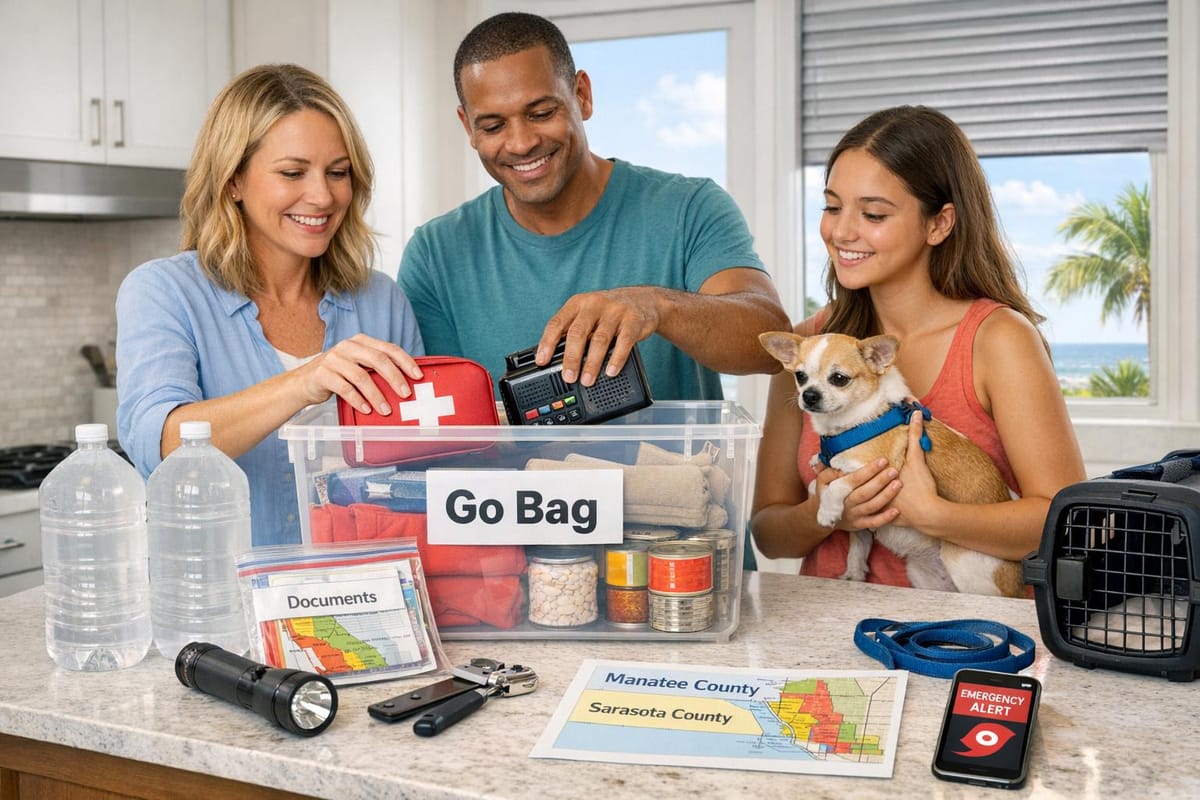
- Emergency Kit: Stock up on 7–10 days of water, food, medications, flashlights, and essential documents. Don't forget pet supplies.
- Evacuation Plan: Know your evacuation zone and map multiple routes. Sign up for local alerts like Alert Manatee or Alert Sarasota County.
- Home Prep: Secure windows, doors, and garage doors. Trim trees and bring outdoor items inside.
- Stay Informed: Follow local news, weather updates, and register for emergency alerts.
Start now - review your evacuation zone, check your supplies, and secure your home. Waiting until the last minute isn't an option when disaster strikes.
Hurricane Preparedness Checklist for Manatee and Sarasota Counties
Are YOU Hurricane Ready? A Florida Expert's Guide
Build Your Emergency Supply Kit
An emergency kit is your lifeline when outside help is delayed. Be prepared to manage on your own for 7–10 days until assistance arrives. Use portable, airtight plastic bins to keep your supplies dry and easy to access.
"Do not wait to gather your disaster supply kit items or make your plans. The decisions you make should not be based on the last storm you experienced." – Sandra Tapfumaneyi, Emergency Management Chief, Sarasota County
Basic Supplies You Need
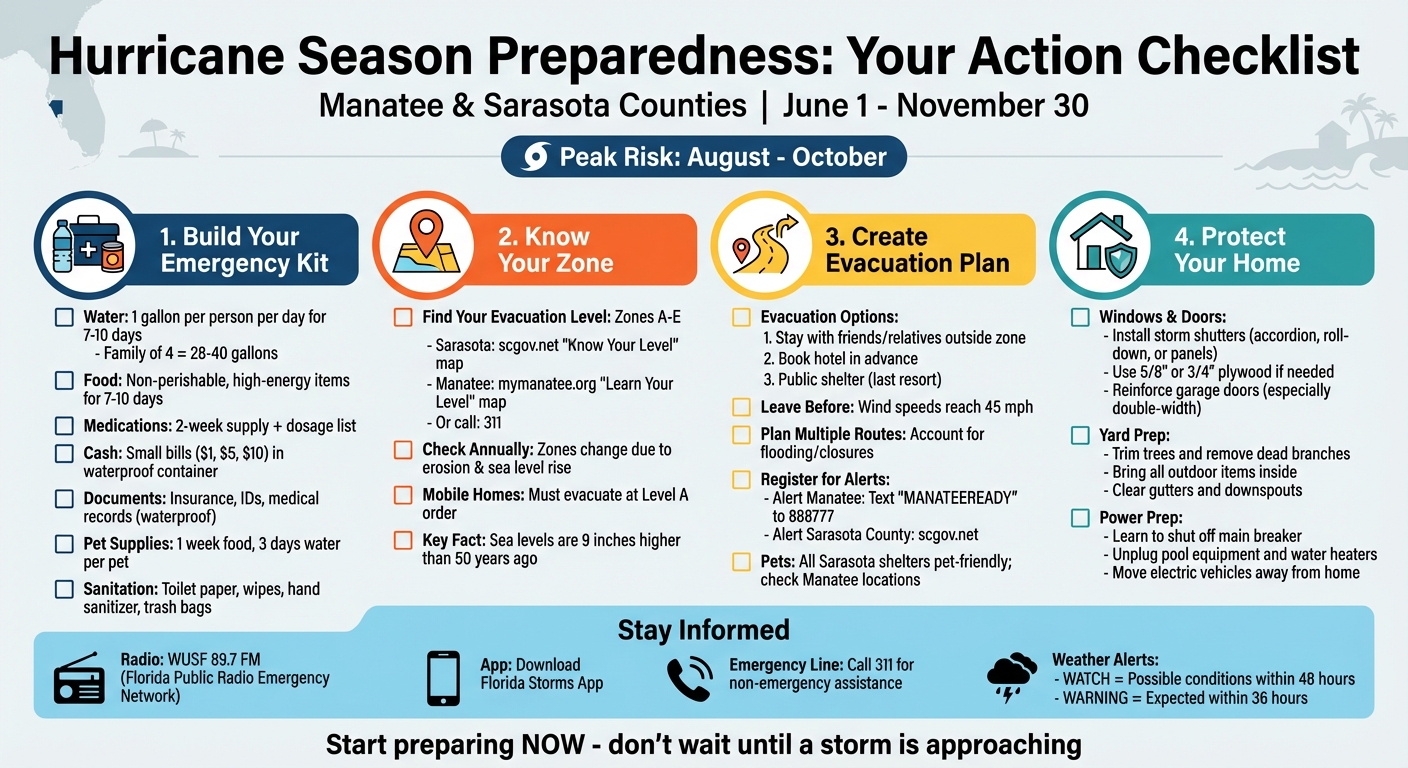
Start with the essentials that will sustain you for up to 10 days. Plan for at least one gallon of drinking water per person per day. For a family of four, this means 28 to 40 gallons of water just for drinking. Stock up on non-perishable, high-energy, low-salt foods, and don’t forget a manual can opener. Equip each family member with a flashlight and extra batteries, and consider portable or solar-powered chargers for phones.
Medications are crucial - keep a two-week supply along with a list of dosages and your doctor’s contact information. A well-stocked first aid kit should include bandages, antibiotic ointment, and pain relievers. For sanitation, pack essentials like toilet paper, disinfectant wipes, hand sanitizer, trash bags, and a bucket with cat litter for an improvised toilet. Store important documents, such as insurance policies, IDs, medical records, and bank information, in a waterproof container.
Supplies for Your Pets
Your pets depend on you during emergencies, so prepare a kit tailored to their needs. Include one week of food and at least three days of water for each pet. Ensure your pet is microchipped and wears a collar with updated ID tags. Keep vaccination records and medical history in a waterproof bag, along with a photo of you and your pet to prove ownership if you’re separated.
Use a sturdy carrier or crate that allows your pet to stand, turn, and lie down comfortably. Pack waste bags, cat litter, a small litter box, and a diluted bleach solution (nine parts water to one part bleach) for disinfection. Add comfort items to help reduce stress. If your pet isn’t accustomed to being in a crate, start acclimating them before hurricane season begins.
"If you need to evacuate, you must take your pet. Leaving pets behind is never a good idea." – Rick Yocum, Executive Director of the Humane Society of Manatee County
Keep Cash on Hand
Financial preparedness is just as important as physical supplies. Power outages can disable ATMs, credit card machines, and banks, leaving you without access to your accounts for days. Withdraw cash ahead of time, as ATMs may run out or lose power before the storm. Carry small denominations - $1, $5, and $10 bills - since businesses without power often can’t provide change. Store your cash in a waterproof container within your emergency kit. Ensure you have enough to cover essentials like food, water, and fuel for the 7–14 days you may need to rely on your own resources.
Know Your Evacuation Zone and Flood Risk
Understanding your storm surge and flood risk is crucial for making quick, informed decisions during a hurricane. Evacuation zones, labeled A through E, indicate areas at risk from storm surges caused by hurricanes. On the other hand, FEMA-mapped flood zones focus on freshwater flooding risks and play a role in determining insurance requirements. To get started, use local online tools to identify your specific zone.
Find Your Zone with Local Tools
Identifying your evacuation zone is an essential part of hurricane preparedness. In Sarasota and Manatee counties, free interactive tools are available to help residents determine their evacuation level. Sarasota County residents can use the "Know Your Level" map, which allows you to input your address to see your evacuation zone, nearby shelters, and evacuation routes. Similarly, Manatee County offers the "Learn Your Level" map and a Resident Information Tool for the same purpose. If internet access is an issue, you can call 311 for assistance. Additionally, the Florida Division of Emergency Management provides a statewide tool called "Know Your Zone", available at floridadisaster.org.
It’s important to check your evacuation level every year, as zones may change due to updated data, coastal erosion, or rising sea levels. If your property falls into two different zones, always follow the guidance for the lower (more vulnerable) zone. Keep in mind that all residents of mobile homes, manufactured homes, RVs, or travel trailers are required to evacuate when a Level A order is issued, no matter their specific location.
Understanding Flood Zones and Storm Surge
In addition to knowing your evacuation zone, it’s important to assess your overall flood risk. Evacuation levels are based on the expected storm surge - a powerful wall of seawater pushed ashore by hurricane winds. Higher predicted surge levels result in higher evacuation orders. Even if your home is in a low-risk FEMA flood Zone X, you could still face early evacuation if storm surge becomes a threat. Conversely, homes near inland waterways might be at risk even in moderate storms.
"Remember that sea levels are already 9 inches higher than they were 50 or so years ago, so minor storms have bigger flooding impacts. Escape routes can be very vulnerable because roads in many areas have not been raised." – Bob Bunting, CEO, Climate Adaptation Center
Interestingly, about 25% of flood insurance claims come from properties in moderate-to-low risk zones, such as FEMA’s Zone X. To better understand your long-term flood risk and insurance needs, use your county’s flood zone locator, which is separate from the evacuation map. This information is essential for planning home preparations and deciding on evacuation routes, which will be covered in later sections.
Make a Family Evacuation and Communication Plan
After identifying your evacuation zone, the next step is to craft a solid plan to keep everyone in your household safe and in touch. Local officials suggest evacuating to stay with friends or relatives outside your zone, booking a hotel, or, as a last resort, using a public shelter. It's crucial to leave before wind speeds hit 45 mph to ensure emergency responders can still assist you.
"Waiting until storm conditions deteriorate may prevent you from leaving, and after winds reach 45 mph, first responders will not be able to get to you." – Richard A. Collins, Emergency Services Director, Sarasota County
Before you evacuate, let extended family or contacts know where you're going. Designate someone outside the evacuation zone as a point of contact, and share their name, address, and phone number with everyone in your household. Sign up for Alert Manatee or Alert Sarasota County to get real-time evacuation updates via text, email, or phone. Keep portable chargers ready for backup power, and store essential documents - like medication lists and insurance policies - in a waterproof folder. To finalize your family plan, outline evacuation routes, make arrangements for special needs, and include your pets in the planning process.
Plan Your Evacuation Routes
Once you've chosen your evacuation destination, map out several routes to get there. Flooding or road closures can happen unexpectedly, so having alternate paths is critical. Rising sea levels are making routes more prone to flooding. If you need to evacuate large animals or livestock, leave early - trailers become unsafe to drive in winds over 40 mph.
Arrange for Special Needs and Accessibility
For family members with medical or accessibility needs, pre-register annually for special assistance programs. Manatee County offers a Special Needs Registry, while Sarasota County provides a Medical Needs Program. If you rely on public transportation, Sarasota County offers free bus services from designated rally points - like libraries or parks - to evacuation centers. Be sure to register for the Rally Point program in advance, as registration typically closes 72 hours before a storm's landfall. In Manatee County, call 311 for transportation assistance. Keep in mind that public shelters provide about 20 square feet per person and do not supply bedding or blankets, so pack accordingly.
Include Your Pets in the Plan
Your evacuation plan should always account for pets. In Sarasota County, all general population shelters are pet-friendly and welcome domestic animals such as dogs, cats, birds, rodents, and turtles. In Manatee County, only certain shelters accept pets, so confirm with local officials. Pets can ride on public transportation during evacuations as long as they are restrained on a leash or in a carrier; larger dogs may need a muzzle in high-stress situations.
"Pet owners are afraid they'll be separated from their animals, but they have rights in a state of emergency and can't be denied." – Rick Yocum, Executive Director, Humane Society of Manatee County
Prepare a pet emergency kit with all necessary supplies and keep it easily accessible. If your pet isn't used to being in a crate, practice ahead of time to help them adjust to a shelter environment. Note that government shelters do not accommodate livestock, so owners should move large animals to safer pastures early.
Protect Your Home from Hurricane Damage
Once you’ve finalized your emergency and evacuation plans, it’s time to focus on protecting your home from the destructive forces of hurricanes. Strengthening your home before hurricane season can help reduce the chance of severe damage. Pay special attention to your roof, walls, windows, and doors, as these are key areas where wind can infiltrate and cause significant harm. For instance, homes built under the 2002 Florida Building Code tend to fare better during storms, but even older homes can benefit from additional reinforcements.
Install Storm Shutters and Reinforce Doors
Investing in impact-resistant windows and doors provides long-term protection, but storm shutters can be a more accessible option. Here are a few popular choices:
- Accordion shutters: Easy to operate manually.
- Roll-down shutters: Convenient and often automated.
- Storm panels: The most budget-friendly option.
If professional shutters aren’t an option, you can use 5/8-inch or 3/4-inch plywood. Secure it with wood screws every 12 inches for wood-framed windows or masonry fasteners for brick or stucco walls. However, avoid using tape on windows - it doesn’t offer structural protection and can be a hassle to remove later.
Garage doors are another weak spot in many homes. Double-width garage doors are especially vulnerable, as they can fail under high winds, allowing pressure to build inside the house and cause major damage. To address this, you can:
- Install a commercial reinforcement kit (costing a few hundred dollars).
- Create temporary bracing with 2x4 lumber secured to the floor using masonry anchors. Be sure to disconnect the garage door opener while this bracing is in place.
Homes in Manatee County built after March 2012 are designed to withstand winds up to 150 mph, while those built before March 2002 may only be rated for 90–110 mph. This highlights the importance of reinforcing older structures.
Trim Trees and Secure Outdoor Items
Yard items like furniture, toys, and tools can become dangerous projectiles in hurricane-force winds. Bring all loose items indoors - into your house or garage - well before the storm arrives. Additionally, take these steps to minimize risks:
- Trim overhanging branches and remove dead or weak limbs to prevent them from damaging your home.
- Secure loose gutters and clear debris from downspouts to prevent them from becoming hazards and to maintain proper drainage.
- Never blow leaves, grass clippings, or yard waste into the street or stormwater systems, as this can clog pipes and worsen flooding.
Prepare for Power Outages
Power outages are almost inevitable during hurricanes, so it’s essential to be ready. Here’s how to prepare:
- Learn how to shut off your main breaker before the storm.
- Unplug pool equipment and water heaters, and switch off their circuit breakers before evacuating.
- If you suspect water has entered walls or ceilings after the storm, avoid using outlets and contact an electrician immediately.
- Move electric vehicles out of the garage and away from your home to reduce fire risks.
- Fill clean bathtubs and large containers with water for non-potable uses, like flushing toilets, during outages.
For a clever food safety trick, try the ice cube test: place an ice cube in a sealed bag in your freezer before evacuating. If it melts and refreezes into a different shape, you’ll know the power was out long enough to impact food safety.
Taking these steps can help protect your home and minimize damage during hurricane season.
Stay Informed with Local Alerts and Updates
Once you've secured your home, staying informed becomes essential. Getting timely updates on evacuations, weather changes, and recovery efforts can make all the difference during a hurricane.
"Stay vigilant by signing up for local emergency alerts" – Rich Collins, Sarasota County Emergency Services Director
Register for Emergency Alerts
Both Manatee and Sarasota counties offer alert systems designed to keep residents informed. Alert Manatee and Alert Sarasota County provide real-time updates on evacuation orders, boil water notices, severe weather warnings, and hazardous road conditions. Signing up is free and straightforward.
- For Manatee County, visit mymanatee.org or text "MANATEEREADY" to 888777 for quick registration.
- For Sarasota County, head to scgov.net to enroll. Use the "Jurisdiction Map" on the site to ensure you're receiving alerts specific to your home address, whether you live in the City of Venice, North Port, or unincorporated areas.
Make it a habit to update your contact details before hurricane season begins. If you rely on electricity for medical equipment, supplemental oxygen, or have mobility challenges, consider applying for the Special Needs Registry in your county. This ensures you receive tailored assistance during emergencies. Keep in mind that applications generally close 48 hours before a storm is expected to hit.
Beyond alerts, staying tuned to local news is another critical step in staying prepared.
Follow Local News and Weather Reports
Reliable communication channels are a key part of any emergency plan. Tune into WUSF 89.7 FM, the primary public radio station for the area, which provides continuous updates during severe weather. WUSF is part of the Florida Public Radio Emergency Network (FPREN), which offers real-time information across 13 Florida Public Media stations and digital platforms.
For more detailed resources, download the Florida Storms App. This app offers live forecasts, evacuation routes, shelter locations, and local radio streams. Stay alert to National Weather Service notifications: a "watch" signals possible hurricane conditions within 48 hours, while a "warning" means hurricane-force winds are expected within 36 hours.
If you own an iPhone 14 or later, or a Google Pixel 9 series phone, activate the satellite emergency feature to stay connected with emergency services if cellular networks go down. For non-emergency assistance during a storm, residents in both counties can call 311.
Conclusion
Hurricane season demands quick and thoughtful preparation. Recent storms are a clear reminder that waiting until the last minute isn't an option.
Start by putting together a 10-day emergency kit, identifying your evacuation zone, and signing up for local alert systems like Alert Manatee or Alert Sarasota County. These straightforward steps can make all the difference when help might be delayed.
"We can't predict what this season will bring, but we can prepare. That means updating emergency plans, checking insurance coverage, and knowing your evacuation level." – Rich Collins, Sarasota County Emergency Services Director
Beyond these basics, your family's safety hinges on the preparations you make before a storm even develops. Review your insurance policies, secure your home, and ensure every family member knows the evacuation plan. With sea levels now 9 inches higher than they were 50 years ago, even smaller storms can cause significant damage to unprepared homes.
The Atlantic hurricane season runs from June 1 to November 30. Take action now - check your evacuation zone annually at scgov.net or mymanatee.org, keep your gas tank at least half full, and stay informed through local alerts. The steps you take today can help protect your family when the next storm arrives.
FAQs
When should I decide to evacuate versus shelter in place?
If local officials issue an evacuation order for your area, it's crucial to follow their guidance - especially if you're in a level A or B zone, or living in a mobile home, boat, or RV. These areas are more vulnerable and should be evacuated promptly. However, if no evacuation order is in place and you're in a low-risk zone, it's generally safe to shelter in place. Stay informed by monitoring local alerts, as evacuation levels can shift depending on the storm's progression.
What should I do if I’m not in an evacuation zone but my area still floods?
If you live in a flood-prone area but aren’t in an official evacuation zone, it’s still important to take precautions to protect your home and ensure your safety. Consider implementing floodproofing measures, such as elevating utilities or installing barriers, to minimize potential damage. Stay informed by keeping an eye on local flood alerts and weather updates. And remember, if rising floodwaters put your safety at risk or block access routes, don’t wait for an official evacuation order - be prepared to leave if necessary.
How can I keep refrigerated food safe during a long power outage?
To ensure food safety during a power outage, plan ahead by freezing water in containers and stocking up on gel packs. Keep insulated coolers on hand for emergencies. Make sure your refrigerator stays at or below 40°F and your freezer at or below 0°F - use thermometers to keep track of the temperatures.
If the power is out for more than four hours, transfer perishable items to a cooler packed with ice or gel packs. Keep the cooler closed as much as possible to maintain the cold temperature.