
Ultimate Guide to Retail Partnerships for Small Businesses
Step-by-step plan to find, pitch, launch, and scale retail partnerships — set goals, KPIs, pilots, and joint marketing.

Retail partnerships can help small businesses grow by leveraging existing retailers' customer bases and trust. This approach minimizes costs, increases visibility, and boosts sales through shared efforts. For example:
- Omnichannel customers shop 1.7x more often, combining online and in-store options.
- Collaborations like the 2025 Off Road Tents and Guana Equipment giveaway drove over 7,000 new leads.
- Local opportunities in Manatee and Sarasota counties include Bealls, Waterside Place, and smaller stores like Pineapple Kitchen.
To succeed, focus on finding retailers aligned with your brand, define clear goals, establish measurable KPIs, and start with a pilot program. A well-prepared pitch, strong agreements, and ongoing collaboration are key to long-term success. Partnerships thrive when built on shared values and clear communication.
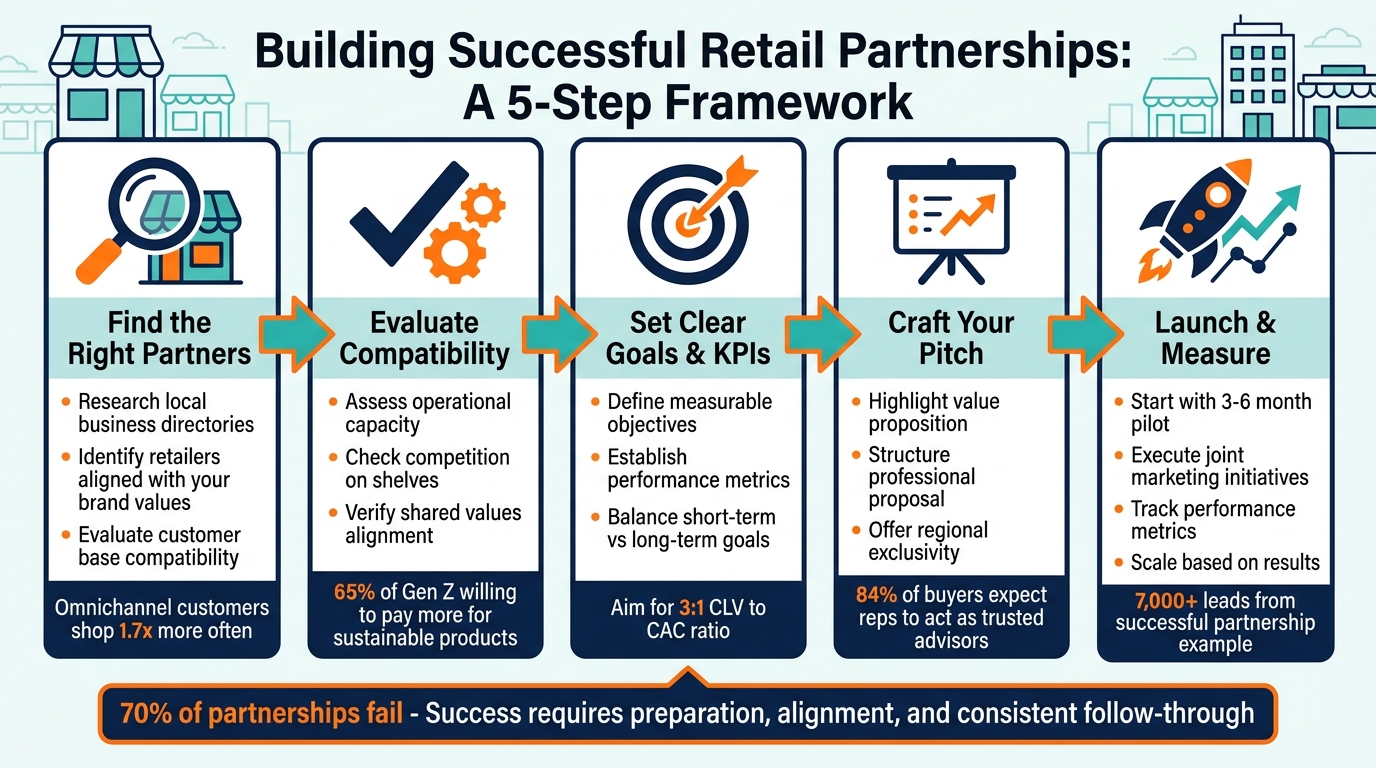
5-Step Process for Building Successful Retail Partnerships
The Blueprint: Crafting a Winning Strategy for Retail Partnerships to Scale Your Brand
sbb-itb-354efe9
Finding the Right Retail Partners
Aligning your product with retailers that share your values, customer base, and price range is key to successful partnerships. Essentially, you want to collaborate with businesses that reflect your brand's identity. For example, a yoga mat company would likely resonate more with a wellness boutique than a discount sporting goods store, even if the latter has higher foot traffic. Once you've identified the type of retailer that fits your brand, focus on finding local businesses that naturally complement your products.
Researching Local Retailers in Manasota
To start, explore local business directories that categorize retailers by their specialties. The Manatee Chamber of Commerce offers a directory featuring over 40 retail and shopping businesses across Bradenton and Sarasota. Similarly, the Lakewood Ranch Business Alliance (LWRBA) provides a directory tailored to the rapidly growing Lakewood Ranch area. These tools allow you to narrow your search by category, helping you pinpoint stores that align with your product.
Think about where your ideal customers shop. For example, Waterside Place at Lakewood Ranch is known for attracting visitors interested in upscale boutiques and specialty items. The Mall at University Town Center in Sarasota appeals to families and professionals with disposable income, while Ellenton Premium Outlets draws bargain hunters from across the region. Each location caters to different demographics, so choose retailers that naturally connect with your target audience.
For specialized or niche products, consider exploring beyond the big shopping centers. Pineapple Kitchen serves gourmet food lovers, The Teal Turtle Boutique attracts fashion-conscious shoppers, and Scavengers Marketplace appeals to those interested in vintage and home décor. Meanwhile, Gamble Creek Farms in Parrish is popular among customers seeking locally sourced goods. Smaller retailers like these often offer more personalized service and may be more open to testing new brands through pilot programs.
Once you’ve identified potential retail partners, it’s time to evaluate how well your brand aligns with theirs to ensure a mutually beneficial relationship.
Evaluating Compatibility and Mutual Benefits
After narrowing down your list of potential partners, the next step is to check for operational compatibility. Make sure your production capacity and fulfillment timelines can keep up with the retailer's sales pace and reorder demands. Ask about their minimum order quantities, inventory systems, and reorder schedules before committing to a partnership.
It’s also important to assess the competition. If the retailer already stocks direct competitors, your product will need a distinct edge to stand out. For instance, if a store carries multiple candle brands, what makes yours unique enough to earn shelf space? Visit the store and take note of the brands within your category to evaluate your chances.
Lastly, look for shared values and cultural alignment. In Manasota, where community connections are highly valued, aligning on principles like sustainability or local sourcing can strengthen partnerships. Research shows that 65% of Gen Z and 63% of Millennials are willing to pay more for eco-friendly products, making sustainability a strong factor to consider. If your brand emphasizes environmentally friendly materials or supports local suppliers, seek out retailers that actively promote those values through their marketing and in-store displays.
"The right partner amplifies what you're already doing - but that only happens when you evaluate fit on the right criteria." - Adelina Karpenkova, SME, Artisan
Before approaching retailers, ask your customers where they shop locally. Social media can be a goldmine for this kind of research - check mentions and tags to see which stores your followers are talking about. This approach helps you focus on retailers where your brand already resonates, avoiding partnerships that feel forced or out of sync with your audience’s preferences.
Setting Clear Partnership Goals
After identifying retail partners that align with your vision, the next step is to define measurable success criteria. Shared objectives are the backbone of any successful collaboration, shaping decisions on everything from product selection to performance evaluation. Without clear goals, disagreements over pricing, promotions, or resource allocation can derail even the most promising partnerships.
Well-defined goals also ensure mutual accountability. When both parties know their roles in production, logistics, and marketing, misunderstandings are minimized. For example, if your aim is to increase brand awareness in Sarasota, you'll need to agree on joint marketing campaigns and track metrics like social media engagement. If you're chasing immediate revenue, focus on sales velocity per location and inventory turnover rates.
Think of your goals as a roadmap - they outline the milestones that help you decide whether to scale the partnership or move on. Without these benchmarks, it’s impossible to measure your efforts or justify further investment. Once goals are set, measurable KPIs become the tools to track progress effectively.
Establishing Measurable KPIs
KPIs translate your partnership goals into actionable metrics. Choose indicators that directly support your objectives. For instance:
- To track sales and revenue: monitor sales velocity, sell-through rates, and average order value.
- For brand awareness: keep an eye on social media mentions, impressions, and reach.
- To measure customer growth: assess new versus returning customer ratios, signups, and feedback scores.
Between 2022 and 2024, AvePoint demonstrated the power of KPIs by increasing its channel-related revenue from 20% to 50% of total revenue through a focused partnership program. Sam Valme, Senior Director of Channel Experience, attributed this growth to consistent tracking of partner-driven revenue and engagement metrics. The company now aims for 70% channel revenue by onboarding 700 additional partners.
"When we first started with Impartner, we were at 20% channel revenue. After two years, we're at 50% of our revenue touching the channel."
– Sam Valme, Senior Director of Channel Experience, AvePoint
Balance is key when selecting metrics. Short-term indicators like units per transaction (UPT) reveal immediate sales performance, while long-term measures like Net Promoter Score (NPS) show whether the partnership is fostering lasting brand loyalty. For sustainable growth, aim for a customer lifetime value (CLV) to customer acquisition cost (CAC) ratio of around 3:1.
Using shared dashboards can enhance collaboration by giving both you and your retail partner real-time access to performance data. This transparency allows for quick adjustments - if inventory turnover slows at a particular location, the issue can be addressed immediately rather than waiting for a quarterly review. Such tools not only track current progress but also help determine whether to double down on short-term tactics or focus on long-term strategies.
Short-Term vs. Long-Term Goals
Short-term goals are all about quick wins. These might include testing new markets with minimal risk, driving buzz for a product launch, or boosting sales during peak seasons. Examples could be a holiday pop-up shop, a time-limited product promotion, or a social media contest designed to generate momentum and gauge the partnership’s potential.
Long-term goals, on the other hand, aim to build lasting value. These could involve expanding distribution networks, strengthening brand credibility, or forming enduring strategic alliances. Take Indochino’s partnership with Nordstrom as an example. Since 2020, Indochino has used Nordstrom’s shop-in-shop model to offer tailoring and sizing services in 38 locations, eliminating the need for standalone stores while driving profitable growth.
"Nordstrom as a brand and its team have been an incredible partner to Indochino since we launched our partnership in 2020... The showroom-in-shop model has become a core part of our profitable growth."
– Drew Green, CEO, Indochino
Start small with a pilot program before committing to a long-term arrangement. A three- to six-month trial with a limited number of SKUs or locations can help you test logistics, validate sales performance, and ensure compatibility. If the pilot achieves your KPIs - whether that’s a specific sell-through rate or positive customer feedback - you’ll have the data to justify scaling the partnership.
To protect both parties, include exit clauses in your agreement. These can be triggered if goals aren’t met or brand standards fall short. For small businesses in places like Manasota, where community reputation is vital, clear performance benchmarks help maintain trust and credibility. Well-defined goals and measurable metrics set the stage for a stronger pitch when you’re ready to take the partnership to the next level.
Crafting Your Pitch
Once you've outlined your goals and nailed down the right metrics, it's time to turn your preparation into a focused and engaging pitch. This is where you grab attention and show the retailer why a partnership with you is a win-win. The way you present your proposal can be the difference between securing a meeting and being overlooked.
Start with a strong hook - something that immediately grabs their interest. This could be a surprising statistic, a thought-provoking question, or a nod to a shared connection. For example, if you're pitching to a Sarasota retailer that recently launched a sustainability initiative, you might mention that 65% of Gen Z and 63% of Millennials are willing to pay more for sustainable products. Then, connect this insight to how your brand caters to that demand.
Shift the focus to the retailer's challenges instead of just listing your product's features. If they’ve highlighted issues like attracting younger customers or stocking unique inventory for a new store, position your offering as the solution. Your pitch should clearly outline what they’ll gain - whether it’s more foot traffic, access to a younger demographic, or exclusivity in the region. This approach shows you’ve done your homework and positions your brand as the answer to their specific needs.
Highlighting Your Value Proposition
Your value proposition should cut straight to the heart of the matter: Why should this retailer choose your brand over others? Use real-world performance data and customer testimonials to back up your claims. Tailor your pitch to align with the retailer’s goals. For instance, if a Bradenton retailer has recently prioritized local artisans, highlight your community connections. Or, if they’re expanding their wellness section, explain how your product fits seamlessly into that category. According to research, 84% of business buyers expect sales reps to act as trusted advisors, yet 59% feel that reps fail to understand their unique challenges.
Offering regional exclusivity can also make your pitch more appealing. For example, promising that no other retailer in Manatee or Sarasota counties will carry your product gives them a competitive edge. Pair this with co-marketing efforts like social media campaigns or in-store events to sweeten the deal. Drawing from local success stories can further reinforce your pitch in the context of the vibrant Manasota retail scene.
Shop-in-shop partnerships are another proven strategy. These arrangements allow brands to expand their reach without the costs of opening standalone stores, offering a growth model that has worked for many.
Structuring a Professional Proposal
Once your value proposition clicks, it’s time to formalize your offer in a well-organized proposal. Break it into four key sections: brand overview, partnership details, value exchange, and projected outcomes.
In the brand overview, share your company’s story, current retail presence, and growth milestones. Include testimonials or case studies to illustrate your market performance. People remember stories far better than raw data - up to 22 times more, in fact. For example, Airbnb’s 2008 pitch to investors secured $600,000 by showcasing customer testimonials and photos.
Next, define the partnership structure. Specify the type of collaboration you’re proposing - whether it’s wholesale, shop-in-shop, licensing, or co-branded products. Clearly outline operational roles, like who will handle production, logistics, and marketing, to avoid confusion. A great example is Off Road Tents’ collaboration with Guana Equipment on a rooftop tent giveaway. This partnership collected over 7,000 verified leads and boosted product sales because both parties had clear responsibilities from the start.
In the value exchange section, explain what the retailer stands to gain. Whether it’s increased foot traffic, filling gaps in their product lineup, or boosting profitability, make it clear how your proposal addresses their needs. Back this up with projected outcomes - like potential revenue increases or improved customer engagement based on similar initiatives you’ve run before.
Keep your proposal concise. Research shows that emails with about 20 lines of text and three or fewer images have the highest click-through rates. Use visuals like product photos or charts to enhance your pitch without overwhelming the reader. And if you’re presenting in person, stick to the "TED Talk principle" - keep it under 18 minutes to avoid losing their attention.
End your proposal with a clear call to action. Suggest a specific meeting date or propose a pilot program lasting three to six months with a limited number of SKUs. This makes the next steps straightforward.
"If you don't clearly state what you're asking for, I have no idea what you need and how to help you."
– Mark Cuban
Launching and Managing the Partnership
Once you’ve secured approval, it’s time to put your plan into action. Armed with clearly defined goals and a compelling pitch, you now move into the execution phase. This is where the groundwork you’ve laid turns into measurable outcomes. Transitioning from a signed agreement to a fully operational partnership demands clear communication, detailed planning, and constant collaboration. How well you manage this phase often determines whether your partnership will flourish or fade out prematurely.
Negotiating Terms and Responsibilities
Before the official launch, it’s essential to finalize the partnership details in a formal agreement. Start by outlining the scope and duration of the partnership. For example, will it begin as a 3-to-6-month pilot with a limited number of SKUs, or are you committing to a longer-term arrangement? A pilot phase allows both parties to test operational compatibility without making long-term commitments.
Next, assign roles and responsibilities for production, logistics, and marketing. Clarify critical details like who handles shipping costs, how to address damaged products, and other logistical concerns. Documenting these specifics minimizes misunderstandings down the road. Financial terms should also be clearly defined, covering compensation methods - such as royalties, profit-sharing, or upfront payments - along with payment schedules and minimum order quantities.
Quality control is just as important as financial agreements. Define brand standards and approval processes to ensure both parties uphold shared values. For instance, if you’re a sustainable brand partnering with a retailer known for eco-friendly products, your packaging and messaging should reflect that same commitment. It’s also smart to include termination clauses that outline exit strategies if performance targets aren’t met or brand standards are compromised.
Uri Weinberger, Founder of Milky Mama, highlights the importance of transparency in negotiations: "Be transparent and when you're going to the negotiating table, be up front and say, 'This has to work within these parameters.'"
Another critical element is data and systems integration. Ensure inventory and sales systems are synced in real time to avoid stockouts or other disruptions. Additionally, establish who owns the customer relationship and the data generated through the partnership. Before finalizing the agreement, consult with the team members who will manage daily operations to confirm they’re prepared and equipped to handle their responsibilities.
Executing Joint Marketing Initiatives
Once the operational framework is in place, shift your focus to joint marketing efforts that benefit both brands. Collaborative campaigns can tap into a retailer’s existing customer base while boosting your brand’s visibility. Popular strategies include in-store workshops, shared popup shops, co-branded product lines, social media takeovers, and bundled email campaigns.
A creative example of this is Urban Outfitters’ partnership with U-Haul, where they engaged college students through a Manhattan scavenger hunt. They turned glass-walled trucks into dorm-like spaces and offered participants chances to win exclusive event access, effectively targeting Gen Z during back-to-school season.
Design marketing initiatives that resonate with the retailer’s audience and values. For instance, if you’re working with a Bradenton retailer that prioritizes local artisans, you could host in-store events or share social media stories highlighting your community ties. Establish measurable KPIs - like sell-through rates, social media engagement, impressions, and the ratio of new-to-existing customers - right from the start. Regular check-ins, such as weekly updates, help both parties track progress and stay aligned on execution. And don’t forget to celebrate successes together, whether it’s hitting a sales target or creating buzz online.
Measuring Success and Scaling the Partnership
Tracking and Analyzing Performance Metrics
Once your partnership is live, it’s time to focus on the numbers that matter. Start by monitoring four key metric groups: revenue, customer value, retail operations, and engagement. These metrics provide actionable insights, unlike surface-level data like social media likes. For example:
- Revenue metrics: Keep an eye on partner program ROI and revenue growth.
- Customer value metrics: Measure customer lifetime value (CLTV) and churn rate.
- Retail operations metrics: Track sales per square foot and inventory turnover.
- Engagement metrics: Monitor lead response time and training completion rates.
Real-world examples highlight the importance of tracking these metrics. AvePoint, under the leadership of Sam Valme, increased their channel-driven revenue from 20% to 50% of total revenue between 2022 and 2024. Similarly, Palo Alto Networks saw a 40% quarter-over-quarter boost in partner engagement by closely analyzing co-marketing efforts with their partners.
For long-term profitability, compare Customer Acquisition Cost (CAC) against CLTV. And if you’re in physical retail, inventory turnover is a critical metric to ensure products aren’t sitting idle on shelves. By 2026, 65% of B2B sales organizations are expected to rely on data-driven decision-making instead of intuition, making it essential to adopt this approach now. These metrics not only illuminate your current performance but also help pinpoint areas ripe for growth.
Expanding Opportunities for Growth
Once your pilot program hits its targets, use those results to inform your next steps. Begin by evaluating performance differences across locations. For example, determine why certain stores outperform others. Is it better foot traffic, smarter shelf placement, or more knowledgeable staff? These insights can guide you in replicating success in other retail locations where your partner already operates.
Consider broadening your product offerings based on early sales data. A great example of this is Indochino’s shop-in-shop model with Nordstrom. Starting with 38 locations, this approach became a key growth driver for the brand. Scaling strategies like these is essential to staying competitive in busy retail markets.
Set clear benchmarks during your pilot phase. These could include hitting a specific sales goal, reaching a particular sell-through rate, or maintaining steady inventory turnover. Once your model proves successful in one region, you can confidently expand. This might mean introducing new SKUs, entering additional retail locations, or bundling products to increase the average order value.
Conclusion
Creating a successful retail partnership in the Manatee-Sarasota area hinges on preparation, clear alignment, and consistent follow-through. Partnerships thrive on thorough vetting, well-defined agreements, and open communication. Considering that around 70% of business partnerships ultimately fail, careful planning and transparency are absolutely essential.
To strengthen your strategy, take advantage of local resources. Organizations like SCORE Manasota, the Florida SBDC at USF, and the Manatee Chamber of Commerce provide free consulting and host networking events that can connect small businesses with major retailers. Additionally, the Downtown Sarasota Alliance offers a prime promotional opportunity by distributing over 35,000 copies of its City Guide annually to airports, hotels, and visitor centers - an excellent way to boost visibility for collaborative campaigns.
Before finalizing any agreement, run through a partnership checklist to ensure a strong foundation. Start by defining your shared goal in a single, clear sentence. Outline the specific roles and contributions of each party, and establish how you’ll measure success. To minimize risk, consider launching a small pilot project to test compatibility before committing to a larger initiative. Regular check-ins, whether through weekly meetings or quick daily calls, can help address potential issues before they grow.
With the vibrant retail environment in Manasota, the opportunities for partnerships are abundant. The region is home to key players like Bealls, Inc. (headquartered in Bradenton), Costco Wholesale, and The Mall at University Town Center. Plus, with single-family home sales up 14.7% year-over-year as of March 2026, the area is poised for continued growth. The time to take the next step in your partnership journey is now.
FAQs
What’s the best way to find retail partners that match my brand in Manatee and Sarasota?
If you're looking to connect with retail partners in Manatee and Sarasota, start by tapping into local resources. The Manatee Chamber of Commerce directory is a fantastic place to begin, offering a wealth of information on businesses in the area. Additionally, organizations like Manasota SCORE not only provide connections but also mentorship opportunities to help guide your efforts.
Don't stop there. Consider exploring community-focused platforms, attending local networking events, or even visiting stores in person. This hands-on approach can help you identify businesses that share your brand's values and cater to a similar audience. Remember, building strong relationships is the foundation of success in this process.
What KPIs should I track to know if a retail partnership is working?
To measure how well a retail partnership is working, focus on a few key performance indicators (KPIs). Start with sales growth that can be directly tied to the collaboration. Then, look at customer engagement metrics, such as increased foot traffic in stores or more interactions online. Another important area to monitor is market expansion, whether through gaining new customers or reaching into new regions.
Don't forget to keep an eye on ROI to understand the profitability of the partnership. Lastly, consider long-term metrics like customer retention, which can reveal how much loyalty the partnership is building over time.
What should be included in a pilot program and retail partnership agreement?
A pilot program and retail partnership agreement should lay out clear objectives, a defined scope, specific timelines, and well-outlined roles for both parties. Key elements to include are:
- Resource sharing: Specify how resources like staff, technology, or inventory will be allocated.
- Branding rights: Detail how each party can use the other’s branding or trademarks.
- Performance metrics: Establish measurable benchmarks to track the program’s success.
- Conflict resolution: Outline how disputes will be handled to avoid disruptions.
Additionally, make sure the agreement defines expectations for communication and collaboration to ensure both sides are aligned. By focusing on shared benefits, actionable goals, and clear responsibilities, you can build a partnership that’s set up for success.