Housing Shortages and Seasonal Worker Retention
Rising housing costs in Manasota push seasonal workers out; employer-funded projects and public loans aim to keep staff with below-market rents.
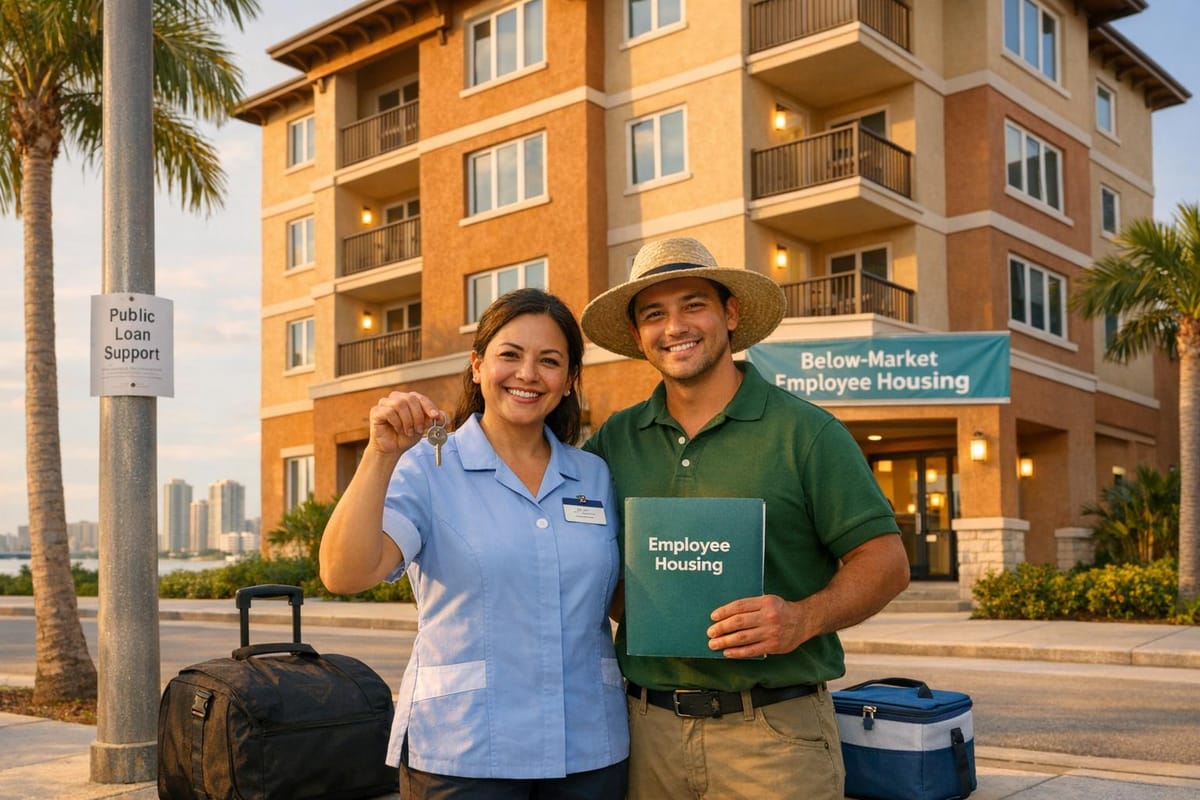
Manasota is facing a housing crisis that's pushing workers out of the region. Rising housing costs are making it nearly impossible for seasonal and service workers to stay. Here's the situation:
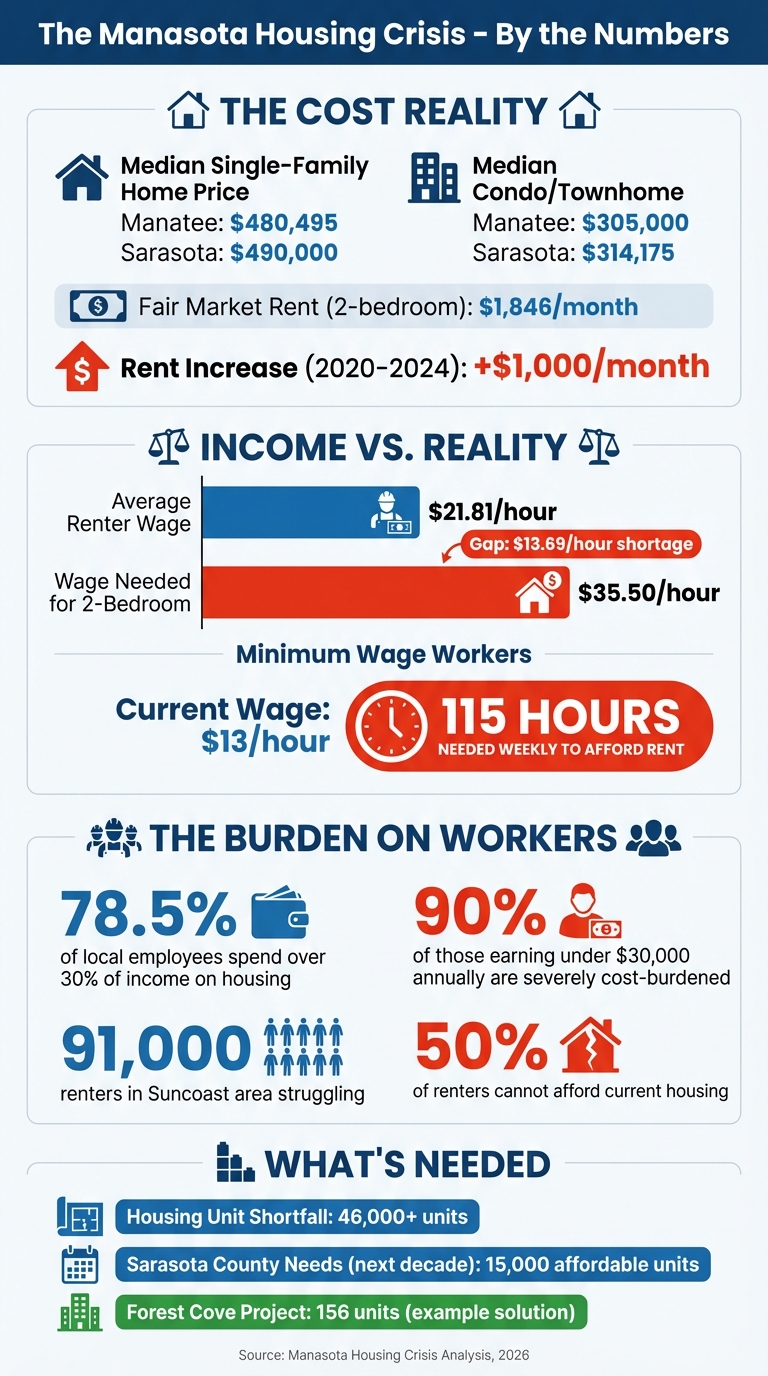
- Average hourly wage vs. housing cost: Renters earn $21.81/hour but need $35.50/hour to afford a modest two-bedroom apartment.
- Minimum wage challenge: At $13/hour, workers would need to clock 115 hours weekly to cover rent.
- Cost burden: 78.5% of local employees spend over 30% of their income on housing, with 90% of those earning under $30,000 annually struggling even more.
This crisis is hurting businesses, especially in industries like hospitality and healthcare, as they lose employees due to unaffordable living conditions. While Sarasota County needs 15,000 affordable housing units in the next decade, solutions like the Forest Cove project in Bradenton are emerging. This initiative combines employer funding and public loans to offer apartments at below-market rates, aiming to ease the burden on workers and stabilize the local workforce. However, more collaborative efforts are needed to address the growing shortfall.
Manasota Housing Crisis: Key Statistics and Affordability Gap for Workers
The Housing Crisis in Manasota: Problems for Seasonal Workers
Housing Shortages and Affordability Problems
As of January 2026, housing prices in Manatee and Sarasota counties have reached staggering levels. The median price for a single-family home in Manatee County is $480,495, while in Sarasota County, it climbs slightly higher to $490,000. Even condos and townhomes, often seen as more affordable options, come with hefty price tags - $305,000 and $314,175, respectively.
Renters aren’t faring any better. The fair market rent for a modest two-bedroom apartment now averages $1,846 per month, but half of the 91,000 renters in the Suncoast area are already struggling to afford their current housing. Between 2020 and 2024, monthly rents have skyrocketed by an average of $1,000, leaving seasonal workers in particular at a breaking point.
Adding to the problem is a rental market plagued by high operating costs. Despite Sarasota's rental vacancy rate hitting nearly 16% in early 2026 - the highest in a decade - rents remain stubbornly high. Why? Landlords are grappling with soaring insurance premiums and rising property taxes, largely driven by repeated hurricane damage. These financial burdens make it nearly impossible for property owners to lower rents, even as demand softens. Local advocates warn that without immediate action, these pressures will only deepen the region’s workforce challenges. As Jon Thaxton, Director of Policy and Advocacy at Gulf Coast Community Foundation, explains:
"If you're drowning in 25 feet of water, and now the water is only 20 feet, you're still going to drown. The bottom line is housing is still out of reach."
In high-cost areas like Lakewood Ranch and Longboat Key, the situation is even grimmer. Renters need to earn over $50 an hour - or about $110,000 annually - just to afford basic housing. For seasonal workers in tourism and service industries, these income levels are far out of reach, forcing many to reconsider their ability to stay in the region.
How Housing Shortages Affect Worker Retention
The housing crisis isn’t just a personal struggle for workers - it’s a growing problem for businesses, too. When affordable housing is out of reach, retaining and attracting employees becomes nearly impossible. Marlon Brown, Director of Government Affairs at the Greater Sarasota Chamber of Commerce, has seen this challenge up close. Even when businesses offer competitive wages, the lack of affordable housing drives potential workers away.
This issue is playing out across Manasota, with no signs of slowing. Real estate consultant Jack McCabe warns:
"If Florida hasn't felt the pain of it yet, it's definitely coming. You're going to lose a lot of seniors and service workers."
For those who do take jobs in the region, the financial strain is immense. Many are forced to commute long distances from more affordable areas, work multiple jobs to cover rent, or spend over 50% of their income on housing. This kind of instability leads to high turnover rates, lower job satisfaction, and, ultimately, a steady stream of workers leaving the state altogether. The hardest-hit industries - tourism, hospitality, and healthcare - are already struggling to maintain adequate staffing, and the situation only seems to be worsening.
Employers along Maine's coast take extreme measures to house workers
Workforce Housing Programs: Local Solutions
To address the growing housing challenges in the region, local leaders and organizations are stepping up with creative workforce housing initiatives.
Forest Cove: An Employer-Coalition Model
Set to begin construction in early 2026 in Bradenton, Forest Cove is a 156-unit workforce housing project that’s rethinking how communities tackle housing affordability. Spearheaded by Mark Vengroff of One Stop Housing and the Bradenton Area Economic Development Corporation, this project uses a unique employer-coalition approach. Here's how it works: mid-sized companies, including Oysters Rock Hospitality (450 employees), Goodwill Industries Manasota, CareerSource Suncoast, S&B Metal Products, and Spirit Movers, contribute funding upfront. In return, they receive a 6%-7% return on investment, plus property value appreciation. The real benefit? These companies secure affordable housing for their employees, with rents set 17%-39% below market rates.
For instance:
- Studio apartments: $925/month (market average: $1,529)
- Two-bedroom units: $1,700/month (market average: $2,038)
Annual rent increases are capped at about $25 per year, ensuring affordability over time. One Stop Housing oversees both the development and property management aspects, ensuring the project runs smoothly.
Charlie Balliette, CEO of S&B Metal Products, highlights the importance of this initiative:
"We give raises, but if rent goes up 40%, it's not like profitability goes up equally... finding Forest Cove was amazing. There really isn't anything like this that we have come across."
Eleni Sokos, Executive Vice-President at Oysters Rock Hospitality, echoes this sentiment:
"Putting people closer to work increases quality of life... Once [employees are] hired, we want them to stay long term."
The program is designed for households earning 60%-120% of the area median income, helping those hit hardest by rising housing costs. Employees living at Forest Cove could save between $4,000 and $7,200 annually compared to market-rate housing. If an employee leaves their job, their lease won’t be renewed, but they’ll have the option to move into another affordable unit.
This approach is one of several innovative ideas emerging in the Manasota region to retain vital workers.
Public-Private Partnerships
Forest Cove’s success also relies on strong public-private collaboration. In April 2025, the Manatee County Commission approved a $5.66 million catalytic loan at an interest rate of 2.5% (or half the federal rate, whichever is higher). This low-interest loan bridges funding gaps that traditional financing often cannot, making it possible to offer affordable housing for seasonal workers while improving employee retention.
Mark Vengroff sees this as a game-changer:
"I think it's going to set Manatee County apart as a real visionary of public-private partnerships in this kind of way. It could make a good dent in this issue."
The need for such solutions is urgent. Sarasota and Manatee counties face a shortfall of over 46,000 workforce housing units, and nearly 40% of households spend more than 30% of their income on housing. By combining low-interest public loans with private employer investments, Forest Cove showcases how partnerships can tackle the housing crisis without overwhelming taxpayers or individual businesses.
Long-Term Solutions to Improve Retention
Building on examples like Forest Cove, long-term strategies aim to strengthen workforce retention by addressing affordable housing needs while supporting the region's economic stability. These approaches ensure critical workers remain in the area.
Employer-Supported Housing Programs
The Forest Cove model highlights how employer-coalition housing can work effectively on a larger scale. By pooling resources, mid-sized companies can invest in housing developments that provide measurable returns - typically around 6% to 7% - along with property value growth. This approach transforms housing into a meaningful asset. Professional management is a significant benefit; companies such as S&B Metal Products and Oysters Rock Hospitality partner with organizations like One Stop Housing, which oversees construction, leasing, and daily operations.
To address limited housing availability, employers may use lottery systems, offering additional entries to long-tenured employees or management staff. Lease agreements are structured so that if an employee leaves the company, their lease is not renewed, though they can complete their current term.
These employer-backed initiatives lay the groundwork for broader regulatory changes that can further speed up housing development.
Faster Development and Reduced Barriers
Streamlining permitting processes is critical to scaling housing solutions. For example, Manatee County's Housing Rapid Response Team accelerates workforce housing projects by waiving fees and simplifying the permitting process. Mark Vengroff, Managing Partner at One Stop Housing, praised these efforts:
"Manatee County really has done a phenomenal job in streamlining that [permitting]... They are willing to help us."
Speed is essential as the region grapples with significant housing shortages. Local governments play a pivotal role by offering low-interest catalytic loans, such as the $5.66 million loan at 2.5% that supported Forest Cove. These financial tools help developers stay viable while keeping rental rates affordable. Additionally, placing these housing developments near employment hubs and transit routes like U.S. 41 or Cortez Road reduces commute times and alleviates infrastructure pressure, ultimately improving workers' daily lives.
Conclusion
The housing crisis in Manasota has grown beyond a real estate issue - it's now a workforce emergency that puts the region's economic stability at risk. When housing costs far outpace wages, businesses lose both potential hires and existing employees to more affordable regions. This trend is driving workers to leave Florida altogether, a problem that salary increases alone can't fix. Tackling these challenges requires bold and creative approaches, and the Forest Cove model offers one such path forward.
The Forest Cove strategy shows how a multi-faceted approach can address housing affordability. By combining employer equity stakes, public–private partnerships, and faster permitting processes, this model delivers housing well below market rates while still offering solid financial returns - proving it can be replicated elsewhere. Manatee County has already demonstrated how government support can accelerate progress, using catalytic loans and a Rapid Response Team to fast-track approvals and spur development.
Looking ahead, sustained collaboration among all stakeholders is critical. Employers need to continue backing housing initiatives, while local governments must secure stable funding sources and maintain regulatory support for developers. With Sarasota County projected to need 15,000 new affordable units over the next decade, the scale of the challenge remains daunting.
The solution lies in teamwork. When businesses, governments, and developers pool resources, share risks, and focus on building workforce housing near employment hubs, the region can retain the workers who are essential to its economy. Without decisive action, the cost-of-living crisis will persist, leaving businesses vulnerable and threatening the foundation of Manasota's economic future.
FAQs
Why are rents still high even with more vacant rentals?
Rents are staying high because housing costs have soared. To afford a two-bedroom rental, a full-time worker would need to make more than $35 an hour. Unfortunately, the average income falls roughly 40% below that threshold. This gap leaves many renters juggling multiple jobs or side hustles just to cover their basic living expenses.
Who qualifies for workforce housing like Forest Cove?
Workforce housing, such as Forest Cove, is designed for individuals working for participating employers and earning between 60% and 120% of the area's median income. To qualify, applicants must meet the income guidelines and be employed by an eligible participating employer.
How can businesses and local government scale these housing solutions faster?
Businesses and local governments can work together to tackle housing challenges by launching creative initiatives like employer-supported housing. Take Manatee County, for example, where mid-sized businesses have teamed up to co-own a 156-unit affordable housing complex specifically for their employees.
Collaborations with organizations and economic agencies can also simplify processes like land acquisition, permitting, and securing funding. By securing early commitments from employers and making the most of available land and resources, communities can fast-track affordable housing projects and help alleviate workforce shortages.