Volunteer Programs at Manasota Animal Shelters
Compare volunteer options across Manasota shelters: ages, fees, roles, and application steps to find the right fit.

Animal shelters in Manatee and Sarasota counties rely heavily on volunteers to care for animals and improve adoption rates. Three main programs - Suncoast Humane Society, Humane Society of Sarasota County (HSSC), and Manatee County Animal Welfare (MCAW) - offer various roles and requirements for volunteers. Here's a quick breakdown:
- Suncoast Humane Society: Offers flexible programs like Doggy Day Out and Weekend Warrior. Volunteers as young as 12 can join, with a $20 orientation fee. In 2025, volunteers contributed over 32,000 hours.
- HSSC: Known for its Pet Therapy program, which has fees totaling $130 and requires weekday availability. Volunteers must be 18+ for this role. Other roles include dog walking and cat socialization.
- MCAW: Allows younger volunteers (14+ for cats/rabbits, 16+ for dogs) and has a detailed onboarding process. Offers medical roles, rabbit care shifts, and a foster program with all supplies provided.
Quick Comparison
| Program | Minimum Age | Entry Fees | Key Roles | Time Commitment |
|---|---|---|---|---|
| Suncoast Humane Society | 12+ | $20 | Doggy Day Out, Weekend Warrior | Flexible |
| HSSC | 18+ (Pet Therapy) | $130 | Pet Therapy, Dog Walking | Weekdays before 5 PM |
| MCAW | 14+ (Cats/Rabbits), 16+ (Dogs) | None | Medical Roles, Rabbit Care | Monthly minimum |
Each program caters to different interests, schedules, and age groups, making it easier to find a fit for your goals.
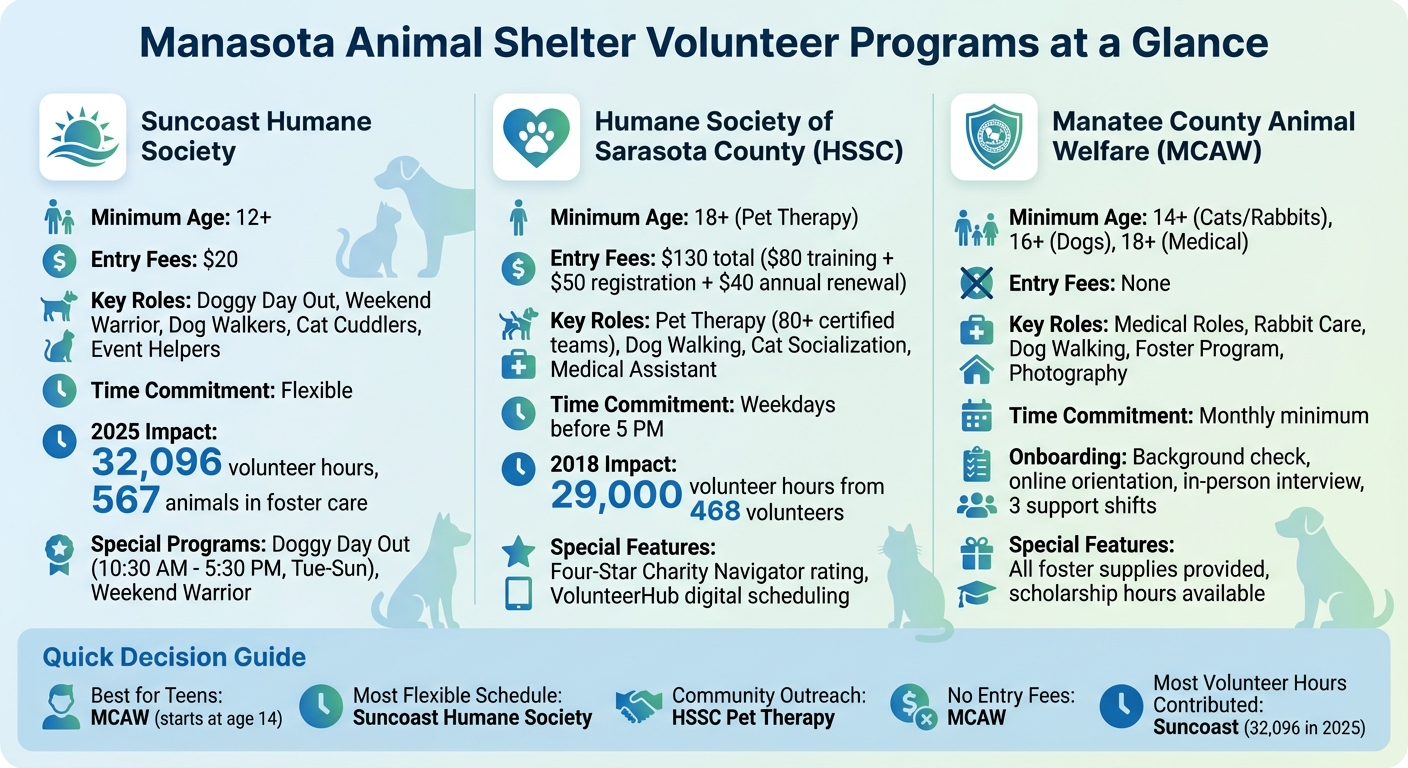
Manasota Animal Shelter Volunteer Programs Comparison: Age, Fees, and Roles
volunteer with me at an animal shelter 🐾 | what it's really like to volunteer at a dog rescue
1. Suncoast Humane Society Volunteer Program
Suncoast Humane Society is one of Manasota's standout programs, offering a variety of roles and strong support for volunteers dedicated to helping animals.
Requirements
The program seeks individuals who are passionate about improving the lives of animals and making a positive difference.
Volunteer Roles
There’s a role for everyone at Suncoast Humane Society. Opportunities include Dog Walkers, Cat Cuddlers, Satellite Cat Caretakers, Event Helpers, and Administrative Support.
If you’re looking for a more flexible option, the Doggy Day Out program is a great choice. Volunteers can take a shelter dog out for a few hours between 10:30 AM and 5:30 PM, Tuesday through Sunday. Activities might include a walk, a visit to your home, or even treating the pup to a "pup cup". For those who want to go a step further, the Weekend Warrior program allows volunteers to host a dog for the entire weekend, giving the animal a break from the shelter environment.
The impact of these efforts is impressive - 567 animals were supported through foster care programs in 2025, and volunteers contributed a total of 32,096 hours of service. These numbers show how much the program relies on and values its volunteers.
With such a range of roles, volunteers can find something that fits their schedule and interests.
Benefits
Volunteers not only help animals but also gain hands-on experience that directly increases adoption rates. Suncoast Humane Society ensures volunteers are equipped for success, providing all necessary supplies. As they explain:
"Suncoast Humane Society provides all of the needed supplies and support you need to be a successful foster and save a life today."
This level of support makes volunteering both rewarding and manageable.
Application Process
Getting involved starts with an online application. Separate forms are available for those interested in Foster Care or the Doggy Day Out program. Foster placements are carefully matched to ensure the animal's needs align with the volunteer’s lifestyle and availability.
For more information about fostering, reach out via email at foster@humane.org or call (941) 474-7887 EXT: 413.
2. Humane Society of Sarasota County Volunteer Program
The Humane Society of Sarasota County (HSSC) is a private, no-kill shelter known for its Four-Star Charity Navigator rating. Volunteers play a crucial role in helping HSSC maintain its high standards of care. The program offers a variety of roles tailored to individual skills and availability.
Requirements
To join the program, all volunteers must attend an initial orientation and complete specific training for their chosen roles. For example, Pet Therapy volunteers must be at least 18 years old. Canine Companions are tasked with walking dogs twice daily for 15-minute sessions, while Feline Friends and additional Canine Companion roles require proper animal handling skills. For those who prefer to avoid direct interaction with animals, support roles like Canine/Feline Support and Medical Assistant are available. These clearly defined roles help HSSC stand out from other local volunteer programs.
Volunteer Roles
HSSC provides a range of opportunities for volunteers, from hands-on animal care to behind-the-scenes support. Canine Companions ensure dogs get daily exercise, while Feline Friends focus on socializing cats. Operational support tasks include washing dishes and preparing supplies.
One standout offering is the Pet Therapy Program, which sends over 80 certified teams to schools, hospitals, and senior care facilities. This program involves a four-week training session, limited to 10 dogs per class, with associated fees: $80 for training, $50 for initial registration, and $40 for annual renewal. With such diverse roles, volunteers can choose activities that align with their interests and skills.
Benefits
Volunteers not only gain practical experience but also contribute significantly to the shelter's mission. In 2018 alone, 468 volunteers donated an impressive 29,000 hours of their time. Volunteer Coordinator Hayley Harvey highlights their impact:
"I don't know how to put into words how important volunteers are to our mission! Volunteers have given us around 29,000 hours of their time in the past year, helping us reach our goals and provide an important service to the community."
HSSC also uses VolunteerHub, a mobile-friendly platform that simplifies scheduling, sends automated reminders, and tracks volunteer hours.
Application Process
HSSC has made the application process straightforward with an online system. Interested individuals can visit the "SIGN UP" portal on the HSSC website. After completing orientation and training, volunteers are ready to start. Pet Therapy visits primarily occur on weekdays before 5:00 PM, and HSSC encourages K-9 Obedience Courses for dogs that need additional preparation for therapy work. Current volunteers can also expand their roles through the VolunteerHub platform.
3. Manatee County Animal Welfare Volunteer Program
Manatee County Animal Welfare (MCAW) runs a volunteer program across its Bradenton locations: Bishop Animal Shelter, Palmetto Animal Shelter, and Cat Town. This program stands out for its detailed onboarding process and variety of roles that directly impact animal care.
Requirements
MCAW's onboarding process is more detailed than many other local programs. Volunteers must follow several steps: submit an online application with a signed Release and Waiver of Liability, pass a background check, complete an online orientation, attend an in-person interview and tour, and finish three "Support Task" shifts before beginning roles that involve animal handling.
Age requirements depend on the role. Volunteers working with cats and rabbits must be at least 14 years old, while dog-walking roles require volunteers to be 16 or older. Medical roles are reserved for those 18 and older. Medical volunteers also need to commit to at least one day per week (4 to 7 hours), be capable of lifting and restraining animals, and complete a shadowing day before being fully accepted. To stay active, all volunteers must participate at least once per month.
Volunteer Roles
MCAW offers a variety of roles to keep the shelter running smoothly. General roles include dog walking and socializing cats and dogs. For those interested in rabbits, Rabbit Care Volunteers work in two-hour shifts - either from 10:00 a.m. to 12:00 p.m. or from 3:00 p.m. to 5:00 p.m. - at the Bishop Animal Shelter.
Medical volunteers assist the Veterinary Services department by cleaning surgical equipment, monitoring post-surgery animals, and maintaining cleanliness in medical areas. These volunteers also handle and restrain animals during recovery. Beyond animal care, other roles like photography and assisting with special events allow volunteers to contribute in unique ways.
The foster program provides temporary homes for animals with specific needs, such as large breed dogs, kittens, or animals requiring medical care or extra socialization. According to MCAW:
Foster parents are volunteers that provide temporary care for animals who aren't quite ready for adoption due to age, health or behavior. By opening your home, you are freeing up space for other animals.
Foster volunteers receive all necessary supplies from MCAW but are responsible for housing, transportation, and socialization. Those interested can contact the program via email at foster@mymanatee.org or call 941-742-5933 ext. 8314.
Benefits
Volunteers play a key role in MCAW's mission to save lives while also gaining personal rewards. This structured program helps volunteers develop skills, build connections, and even earn hours that may qualify for college scholarships. As MCAW emphasizes:
Volunteers are essential to our lifesaving mission. Some of the volunteer activities you can help with include: dog walking, socializing dogs & cats, enrichment activities, fostering, photography, and special events.
Application Process
The application process is thorough to ensure safety and readiness. Volunteers must submit an online application, complete an online orientation, attend an in-person interview (where they receive a wristband), and finish three prerequisite support shifts. This process ensures that volunteers are well-equipped to perform their roles while upholding standards for the animals and staff.
Pros and Cons
This section breaks down the main advantages and challenges of each volunteer program in the Manasota area, based on the earlier reviews.
Each program offers distinct opportunities, but they come with their own set of requirements and limitations. For example, MCAW allows younger volunteers to get involved - starting as young as 14 for cats and rabbits or 16 for dogs - making it a great option for teens looking to gain experience and earn scholarship hours. However, MCAW’s onboarding process is quite thorough, requiring a background check, online orientation, an in-person interview, and three mandatory "Support Task" shifts before volunteers can directly handle animals.
On the other hand, the Humane Society of Sarasota County (HSSC) stands out with its Pet Therapy program, featuring over 80 certified teams. This program, however, comes with upfront costs: $80 for training, $50 for initial registration, and $40 annually, totaling $130 to get started. Additionally, it requires weekday availability before 5:00 PM, which could be tricky for those with traditional full-time jobs. HSSC does offer the convenience of digital scheduling through VolunteerHub.
Here’s a quick comparison of the two programs (HSSC details focus specifically on the Pet Therapy track):
| Feature | HSSC (Pet Therapy) | MCAW |
|---|---|---|
| Minimum Age | 18+ (for Pet Therapy) | 14+ (Cats/Rabbits), 16+ (Dogs) |
| Entry Fees | $130 total for Pet Therapy | None |
| Application Process | Moderate (orientation and training) | High (interview, background check, 3 support tasks) |
| Time Commitment | Weekday shifts before 5:00 PM | At least a monthly minimum |
| Medical Roles | Administrative/cleaning (no handling) | Surgical recovery/restraint (handling) |
| Key Benefits | Digital scheduling and community outreach | Foster supplies provided and scholarship hours |
MCAW also provides a foster program where all supplies are covered, making it a cost-effective choice for those who want to care for animals at home. Meanwhile, HSSC’s Pet Therapy program allows volunteers to bring their own pets into schools and hospitals, fostering meaningful connections within the community.
Ultimately, deciding between these programs depends on factors like your age, budget, schedule, and desired level of involvement. Teens or individuals looking for budget-friendly options might lean toward MCAW, while those interested in community-facing roles with their own pets may find HSSC’s Pet Therapy track a better fit. These comparisons help clarify which program aligns best with your goals as a volunteer.
Conclusion
When deciding on a volunteer program, it’s important to find one that aligns with your personal needs and schedule. For teenagers eager to get involved, Manatee County Animal Welfare (MCAW) welcomes volunteers as young as 14 for cats and rabbits, while dog walking is available to those 16 and older. Adults looking for a more specialized experience might explore the Humane Society of Sarasota County (HSSC) Pet Therapy program. However, keep in mind its $130 upfront fee and weekday schedule, which may not work for everyone.
Your availability is another key factor. If you work full-time, programs requiring weekday visits before 5:00 PM - like HSSC’s school and hospital Pet Therapy visits - might be tricky. On the other hand, MCAW’s foster program is a flexible, cost-effective choice, as they provide all necessary supplies, making it ideal for those with extra space at home.
The type of work you’re interested in should also influence your choice. MCAW offers hands-on roles like surgical recovery assistance and animal restraint, as well as specialized shifts for rabbit care, available in two time slots: 10:00 a.m. to 12:00 p.m. or 3:00 p.m. to 5:00 p.m. Meanwhile, HSSC’s Medical Assistant positions are more focused on administrative tasks rather than direct animal interaction.
Start with a manageable commitment. HSSC volunteers logged an impressive 29,000 hours in a single year, showing the collective impact of consistent participation. However, overcommitting can lead to burnout - something 28% of volunteers reported experiencing in 2022. It’s better to pace yourself and choose a schedule you can maintain long-term.
If direct animal care isn’t your preference, consider contributing professional skills like photography, event planning, or social media management. MCAW actively seeks volunteers with these talents, allowing you to support their mission without hands-on animal work. Whether you choose MCAW, HSSC, or Suncoast Humane Society, your efforts will contribute to the essential work these shelters do in the community. Every hour you give makes a difference.
FAQs
Which shelter is best for teen volunteers?
For teenagers in the Manasota area looking to get involved, local animal shelters provide some great opportunities. Manatee County Animal Services allows volunteers aged 14 and up to help with tasks like dog walking, but you'll need to complete an orientation first. Over at Cat Depot, younger volunteers can join their Teen Program, which includes training and requires a fee to participate. Meanwhile, the Humane Society of Sarasota County offers limited roles for teens through its Teen Program, which also involves a fee to cover training and insurance.
What costs or fees should I expect to volunteer?
Most animal shelters in the Manatee and Sarasota area offer volunteer opportunities without any fees. However, a few, such as Cat Depot, ask for a $25 fee during orientation. This fee helps cover the cost of essentials like a t-shirt, name tag, and training materials.
How do I choose between fostering and in-shelter volunteering?
Choosing between fostering and in-shelter volunteering comes down to your schedule, comfort level, and the kind of impact you want to make.
Fostering means welcoming animals into your home, providing them with care and attention until they find a permanent family. It often requires more of your time but allows for a deeper, one-on-one connection with the animals.
In-shelter volunteering, on the other hand, includes tasks like walking dogs, cleaning, or assisting with daily shelter operations. It typically involves a smaller time commitment per animal but helps a larger number of animals overall.
If you’re ready to open your home and provide personalized care, fostering might be the right choice. But if you prefer contributing on-site and helping many animals at once, volunteering at a shelter could be a better fit.