Tourism Trends Shaping Manasota Retail
Manasota retailers balance winter tourism surges with year‑round visitors and local shoppers to sustain revenue amid seasonal swings.
Tourism in Manasota, covering Manatee and Sarasota counties, drives a dynamic retail market with seasonal and year-round influences. Here's the key takeaway: Seasonal tourism peaks during winter months, providing a major revenue boost for local businesses, while year-round tourism and local residents ensure steady income during slower periods.
Key Points:
- Seasonal Impact: Winter tourism attracts visitors from cities like New York and Chicago, significantly increasing retail activity. For example, in mid-2025, Sarasota County's retail sector employed 35,979 people, making it a key economic driver.
- Year-Round Tourism: Growing trends like "anti-tourism" and campaigns such as "The Sarasota Keys are Calling" encourage off-peak travel, stabilizing retail demand.
- Local Support: With Sarasota County's population projected to hit 510,000 by 2030 and a per capita income of $85,157, local spending is crucial during off-seasons.
- Challenges: Businesses face revenue dips during slower months, competition from national brands, and logistical hurdles. Creative efforts like collaborative events and unique in-store experiences help mitigate these issues.
The balance between seasonal surges and consistent local support is what sustains Manasota's retail economy. Retailers must align strategies to cater to both tourists and residents, ensuring resilience in a competitive and fluctuating market.
1. Seasonal Tourism Effects
Retail Demand Patterns
During the winter months, retail activity in Manasota experiences a noticeable surge as visitors from cities like New York, Boston, and Chicago escape to the area's beaches and barrier islands. Platforms like Airbnb and Vrbo have shifted tourism demand into residential neighborhoods, prompting retailers to adapt by offering products tailored to temporary renters, not just those in traditional hotel zones.
Mixed-use developments are also becoming more common, combining retail and residential spaces to cater to both tourists and local residents.
"The influx of visitors supports the expansion of commercial establishments like restaurants, shops, and entertainment venues".
Retailers are fine-tuning their strategies to appeal to a diverse customer base, ensuring they capture spending year-round. This flexibility is key to leveraging the economic boost provided by seasonal tourism.
Economic Contributions
Seasonal tourism pumps millions of dollars into Manasota’s retail economy each year. After environmental disruptions, the Bradenton Area Visitors and Convention Bureau stepped in with a $200,000 "Florida's West Coast" campaign to reignite tourism and support local businesses. This initiative highlights how critical seasonal visitors are to the region’s financial health, particularly for the hospitality and retail industries.
The importance of winter tourism is evident in how businesses prepare. On Anna Maria Island, 40–60% of hospitality establishments, and 60–80% on Longboat Key, were ready to reopen ahead of the winter tourism peak. For many of these businesses, the winter season is a make-or-break period, heavily influencing their annual revenue.
Challenges for Businesses
While seasonal tourism brings significant economic benefits, it also presents challenges. Carolyn Nees, owner of The Vintage Vine Market in Bradenton, shared that her store’s revenue has dropped by about 25% year-over-year. Such revenue fluctuations force businesses to depend on high-traffic seasons like Christmas and Spring Break to balance slower periods.
To address these challenges, local businesses are teaming up through initiatives like the Holiday Shop Crawl. This event brought together 13 retailers in Manatee County to share marketing efforts and attract customers during mid-December. Nees explained:
"We're hoping to, kind of as a community, as colleagues, try to introduce each other's customers and cross-shop".
Retailers are also adding unique experiences to attract visitors during slower times. For example, The Fudge Factory offers candy-cane-making demonstrations to draw in customers. These collaborative and creative efforts showcase how businesses are adapting to the ebb and flow of tourism to stay resilient in a competitive market.
sbb-itb-354efe9
2. Year-Round Tourism Effects
Retail Demand Patterns
Retailers in the Manasota area are rethinking their strategies to cater to visitors throughout the year, not just during the traditional winter peak. Fall marketing campaigns now emphasize shopping, golf, and the area's peaceful vibe, appealing to travelers who prefer destinations with fewer crowds. This shift caters to a growing number of tourists seeking alternatives to overcrowded hotspots.
One key trend driving this change is "anti-tourism", which encourages visitors to explore less-traveled destinations like the Manasota barrier islands during off-peak months. Searches for accommodations in these areas are growing over 15% faster than searches for more popular tourist hubs. Travelers today are drawn to authentic local experiences, prompting retailers to focus on products that reflect the region's culture and promote wellness. This evolution in tourism not only diversifies the types of visitors but also ensures more consistent revenue throughout the year.
Visit Sarasota County launched a campaign called "The Sarasota Keys are Calling", spearheaded by President and CEO Erin Duggan. This initiative highlighted the charm of barrier islands such as Manasota, Venice, and Casey Key through social media, digital ads, and other promotional efforts. The campaign garnered over 40 million impressions, helping to restore the area's image after storm recovery. Duggan noted:
"Since tourism is our community's top industry and economic driver, these seasonal campaigns demonstrate that we're not resting on our laurels".
These changing consumer behaviors are helping to stabilize the region's economy beyond peak tourist seasons.
Economic Contributions
While seasonal tourism continues to generate significant revenue, year-round economic stability increasingly relies on local residents who shop and support businesses during slower periods. In 2025, Florida welcomed a record 143.3 million visitors, with domestic travelers making up 91.5% of the total. The fourth quarter alone saw 33.5 million visitors.
However, international tourism is facing hurdles. The U.S. was projected to lose $12.5 billion in international visitor spending in 2025, with nearly half of surveyed travelers citing political concerns as a deterrent. To counteract this, tourism leaders are focusing on emerging markets like Brazil (up 10.4%), the United Kingdom (up 6%), and Colombia (up 6%). Meanwhile, Canadian visitation took a hit, dropping by 14.7% in the same year.
Challenges for Businesses
The influx of major national brands into the area has created new challenges for local businesses, particularly in managing commercial growth and infrastructure demands. Companies are increasingly relying on data, such as rooftop exposure and household income, to evaluate long-term opportunities. Large retailers like IKEA serve as anchors, attracting other businesses and creating jobs, but they also contribute to traffic congestion and logistical complexities.
Communities like Lakewood Ranch, with their multigenerational populations, offer businesses a steady customer base year-round. This helps retailers move away from the uncertainties of seasonal tourism. However, businesses must be prepared to address delivery challenges and adapt their operations to prioritize the needs of local residents, not just tourists. These adjustments mirror the strategies retailers use to navigate the ups and downs of seasonal demand. As Bryan Griffin, President and CEO of Visit Florida, emphasized:
"We're doing what we can, just as we are with any country outside the United States, to make sure that visitation remains strong".
Is Florida Tourism in Trouble?
Pros and Cons
Seasonal vs Year-Round Tourism Impact on Manasota Retail
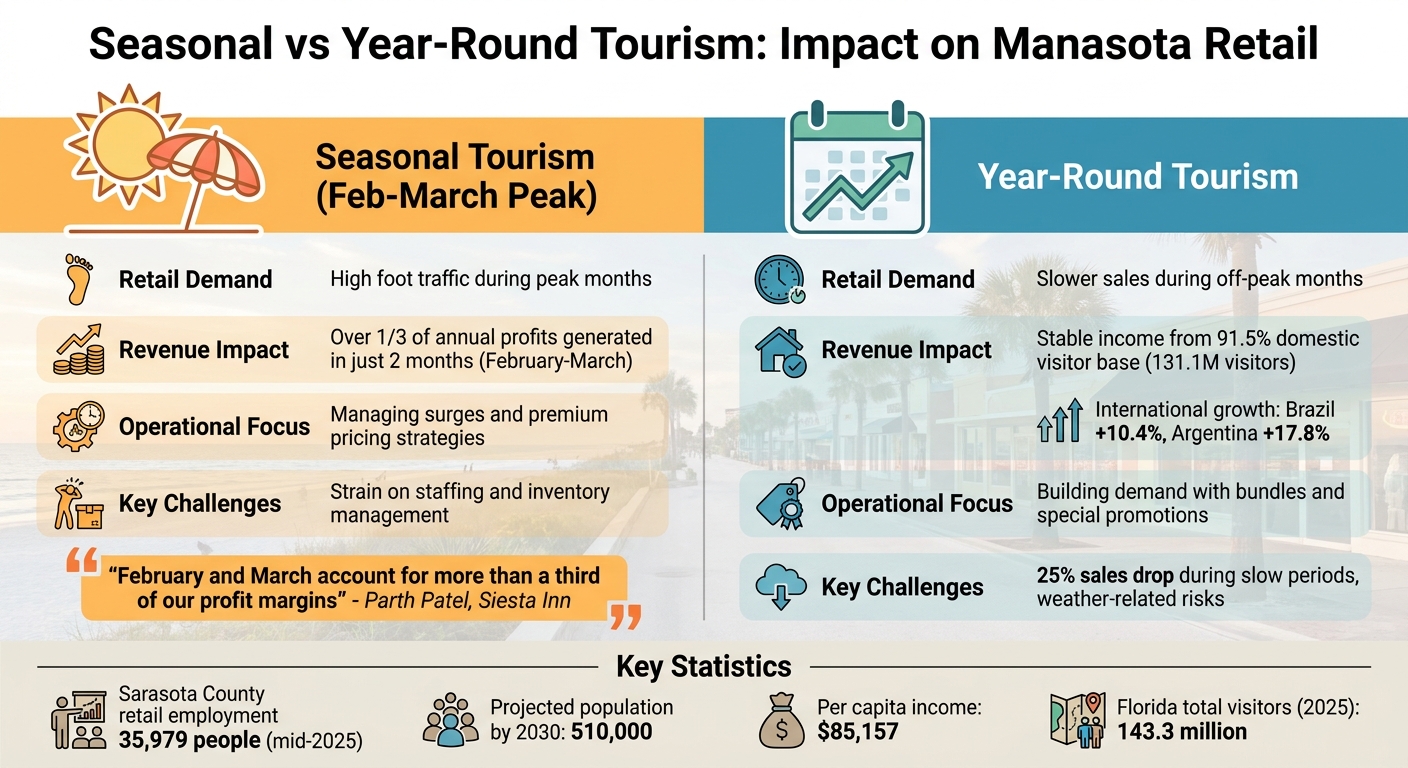
Seasonal and year-round tourism each bring a mix of benefits and challenges for Manasota retailers, directly impacting how they manage their operations and finances.
Seasonal tourism delivers an intense revenue boost in a short period, often enough to sustain businesses for the entire year. Parth Patel, Director of Operations at the Siesta Inn in Sarasota, highlighted this seasonal dependency:
"I would consider February and March to be our two months out of the whole year that account for more than a third of our profit margins. This is our bread and butter at this time of the year".
For example, in March 2026, the Siesta Inn was fully booked every weekend during February and March, generating enough revenue to fund a complete renovation of the motel. However, this approach isn't without its challenges. Businesses face significant pressure to optimize staffing and inventory during these peak months, making it a high-stakes operation. While the surge in revenue is impressive, the narrow time frame requires careful planning and execution.
Year-round tourism, on the other hand, provides a steadier income stream. Florida's 131.1 million domestic visitors contribute to this stability. International markets, such as Brazil and Argentina, have also shown growth, with visitor increases of 10.4% and 17.8% respectively. This consistency helps smooth out the financial ups and downs, but it comes with its own set of hurdles. For instance, some businesses experience a 25% drop in sales during slower seasons, prompting creative solutions like The Vintage Vine Market’s participation in collaborative events such as the Holiday Shop Crawl.
The table below highlights key differences between seasonal and year-round tourism:
| Factor | Seasonal Tourism (Feb–March Peak) | Year-Round Tourism |
|---|---|---|
| Retail Demand | High foot traffic | Slower sales during off-peak months |
| Revenue Impact | Over one-third of annual profits in two months | Stable income from a 91.5% domestic visitor base |
| Operational Focus | Managing surges and premium pricing | Building demand with bundles and specials |
| Key Challenges | Strain on staffing and inventory | 25% sales drop and weather-related risks |
These differences illustrate the complex dynamics of Manasota’s retail economy, which requires businesses to be flexible and resourceful.
Retailers who succeed in this environment tend to balance the highs of seasonal tourism with strategies to engage the local community year-round. Dan Yonko of the Manatee Chamber of Commerce noted:
"a lot of people are doing bundles and specials".
Conclusion
Retailers in the Manasota area face a unique challenge: leveraging the seasonal tourism boom while ensuring year-round stability. To succeed, they must strike a balance between making the most of the busy winter months and implementing strategies that keep the growing local population engaged throughout the year.
Adapting to shifting demand is essential. This means adjusting inventory, staffing, and marketing efforts to cater to the influx of seasonal visitors while building loyal relationships with permanent residents in areas like Lakewood Ranch. Heather Kasten, President and CEO of the Greater Sarasota Chamber of Commerce, highlights this approach:
"They are very data driven. They look at things like rooftops. They look at household income, and they also look at long-term opportunity."
This adaptability is what drives the retail scene in the region.
Tourism in the area is also changing. Travelers are moving away from traditional sightseeing and are instead seeking authentic, experience-driven visits. Searches for secondary destinations are growing over 15% faster than for more mainstream tourist spots. Retailers who embrace local culture and establish genuine connections with the community are better positioned to tap into these evolving preferences.
Adding to these challenges, hurricanes remain a significant factor. After Hurricanes Helene and Milton, the $200,000 "Florida's West Coast" campaign showcased how collaborative recovery efforts can rebuild visitor trust. Businesses that stay connected with tourism bureaus and act quickly in response to such events are more likely to remain resilient.
Keeping up with tourism trends is crucial for making informed decisions. Tools like Manasota.co offer local businesses valuable insights into shifting tourism patterns, helping them adapt effectively. By combining data-driven strategies with strong community ties, retailers in Manasota can build businesses that thrive during both the peak tourist season and the quieter months.
FAQs
How can retailers prepare for the winter tourism rush?
Retailers in the Manasota area have a great opportunity to gear up for the winter tourism season. To make the most of this busy period, it’s essential to stock up on seasonal items and local favorites that catch the eye of tourists. Beyond inventory, creating memorable customer experiences can make a big difference. This might include running targeted marketing campaigns or teaming up with local tourism efforts to draw in more visitors. Additionally, practical adjustments - like extending store hours or providing extra staff training - can help businesses smoothly manage the uptick in foot traffic. These efforts not only boost sales but also contribute to the community’s overall growth.
What are quick ways to boost sales during the off-season?
Local businesses in the Manasota area have plenty of opportunities to keep sales strong during the off-season by tapping into seasonal events and creative promotions. Hosting activities like festivals, markets, or special sales can attract both residents and visitors. Offering limited-time discounts or exclusive products tied to the season can spark a sense of urgency and interest.
Boosting your online presence is another key move. Social media campaigns and email promotions can help spread the word and bring customers through the door. Partnering with local events or teaming up with other businesses to create bundled offers is another way to draw in crowds and keep revenue flowing.
How can small local shops compete with national brands?
Small local shops have a unique edge by prioritizing personalized service and creating genuine, community-focused experiences that big chains simply can’t match. By forming strong relationships with their customers and relying on word-of-mouth recommendations, these businesses can build trust and loyalty. Partnering with other local businesses is another smart way to boost visibility and attract new customers.
Getting involved in regional events is also a great way to connect with the community and showcase what makes the shop special. Plus, small shops have the advantage of being agile - they can quickly adapt to the specific needs and preferences of local consumers. These strategies not only help small businesses stand out but also carve out a loyal customer base, ensuring they thrive even when competing with national chains.