Manasota Tourism History: From Beaches to Resorts
From millennia-old coastal communities to modern resorts and arts venues, a concise history of Manasota's tourism evolution.
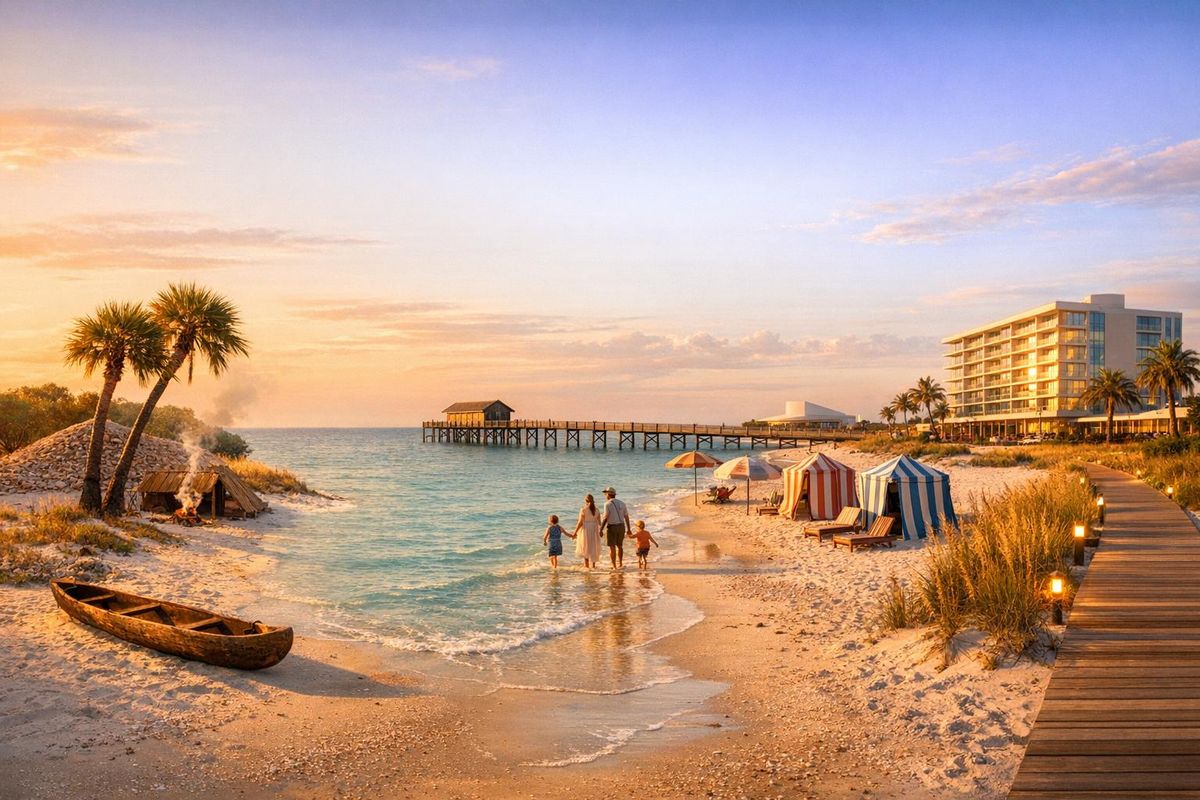
Manasota’s journey from a quiet fishing village to a thriving tourism hotspot is a story of transformation, driven by its natural beauty and visionary developers. Located in Florida's Manatee and Sarasota counties, the region’s appeal has evolved over centuries, offering a mix of history, leisure, and modern attractions.
- Early Roots (12,000 Years Ago): Indigenous communities thrived on marine resources, leaving behind archaeological markers like shell middens.
- Tourism Beginnings (1800s): John Webb opened the area's first winter resort in 1867, while John Hamilton Gillespie built Florida's first golf course alongside the De Soto Hotel in 1887.
- Development Boom (1900s): Bertha Palmer and John Ringling shaped Sarasota’s infrastructure with luxury hotels, railroads, and bridges. The Tamiami Trail (completed in 1928) connected the region to major cities.
- Post-War Growth (1940s–50s): Barrier islands became livable year-round, and cultural landmarks like the Ringling Museum of Art emerged.
- Modern Era: Today, Manasota offers luxury resorts, thriving arts venues, and preserved natural spaces like Manasota Key.
From its indigenous past to its modern resorts, Manasota continues to balance historic charm with contemporary amenities, attracting visitors year-round.
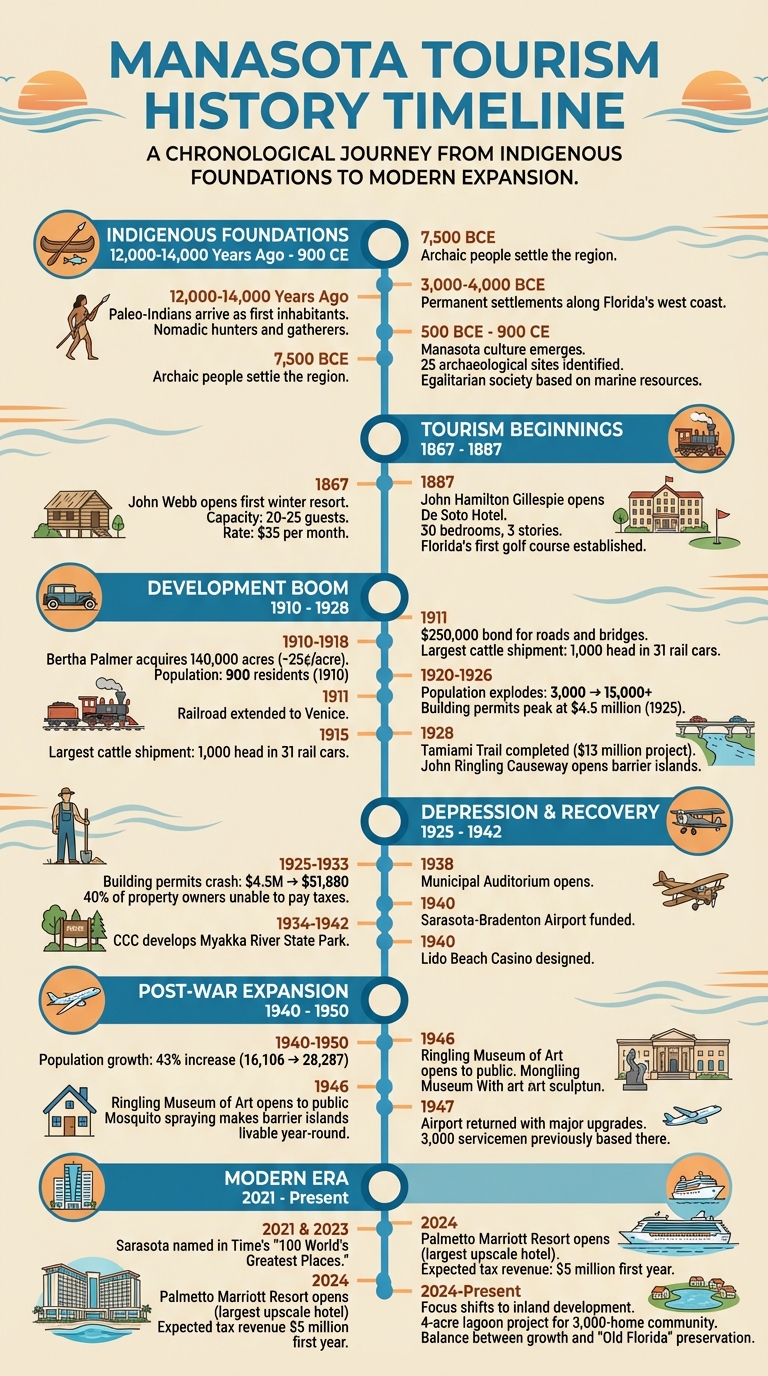
Manasota Tourism Evolution Timeline: 12,000 BCE to Present
Early Beginnings: Indigenous Communities and Coastal Landscapes
Native Communities and First Settlers
The Manasota region has a rich history of indigenous life along its coast. The first known inhabitants were Paleo-Indians, arriving roughly 12,000 to 14,000 years ago. These nomadic hunters and gatherers were followed by the Archaic people around 7,500 BCE. By 3,000 to 4,000 BCE, some groups began to settle permanently along Florida's west coast.
Between 500 BCE and 900 CE, the Manasota culture emerged as the dominant way of life in what are now Sarasota and Manatee counties. Archaeologist Dan Hughes describes this culture:
The Manasota culture describes the culture of coastal dwellers who subsisted heavily on marine resources and lived in Sarasota from 500 B.C. to A.D. 800/1000.
These coastal communities thrived in hammocks near bays and estuaries, where they relied on abundant marine life such as fish and shellfish. Archaeologists have identified 25 Manasota culture sites stretching from Tampa Bay to Charlotte Harbor.
Manasota society was known for its egalitarian structure, with leaders chosen based on merit rather than inheritance. Around 900 to 1,000 CE, the culture evolved into the Safety Harbor culture, which introduced a more hierarchical society with noble classes, warriors, and ceremonial mounds. Spanish explorers later documented the Uzita, a tribal group in the Manatee and Sarasota area, who skillfully navigated the Little Manatee River. These early societies’ deep connection to the coastal environment laid the groundwork for the region’s eventual transformation into a hub for tourism.
Gulf Coast Natural Features
The region’s natural landscape played a vital role in shaping its identity. Waterways like Sarasota Bay, Tampa Bay, and Charlotte Harbor were teeming with fish, providing a steady food source.
The area’s ecosystems - ranging from pine flatwoods and freshwater streams to coastal hammocks - supported a varied diet and way of life. High bluffs, such as the "Yellow Bluffs" and "Spanish Point", were especially valued for their protection and sweeping views of the water. Indigenous communities also left behind shell middens, large mounds of discarded shells that now serve as archaeological markers of their diets and settlement patterns. This harmony between the natural environment and human resourcefulness set the stage for the Manasota region to grow into a destination of historical and environmental significance.
A Brief History of Florida Tourism - A Take 5 for Florida History 12
First Tourist Developments: 1800s
The 1800s marked the beginning of tourism in Manasota, building on its long-standing appeal as a coastal destination.
John Webb's Winter Resort
Manasota's tourism story kicked off in 1867 when John and Eliza Webb established the area's first winter resort at Webb's Point on Little Sarasota Bay. Their decision to settle there was driven by Eliza's asthma - Florida's subtropical climate offered her much-needed relief. In a letter to her sister, Eliza described the region's winters as:
And then our winters why do you know they seem to me to be a foretaste of that better country to which we all hope to go some time.
What started as a log home with a thatched palmetto roof evolved into a seasonal resort with individual guest cottages, accommodating 20 to 25 guests at a time. Guests paid $35 per month, which covered room, board, fuel, and laundry. Most visitors were Northerners escaping the cold, drawn by activities like boat outings, picnics, and the area's plentiful fish, oysters, and game. To attract these visitors, the Webbs advertised in northern newspapers, establishing the "snowbird" tradition that remains a hallmark of Florida tourism.
The resort operated until 1910, when the property was sold to Bertha Palmer, signaling a shift from modest pioneer hospitality to larger-scale development. While the Webbs catered to health-conscious travelers, another figure was envisioning a more luxurious destination.
John Hamilton Gillespie's De Soto Hotel
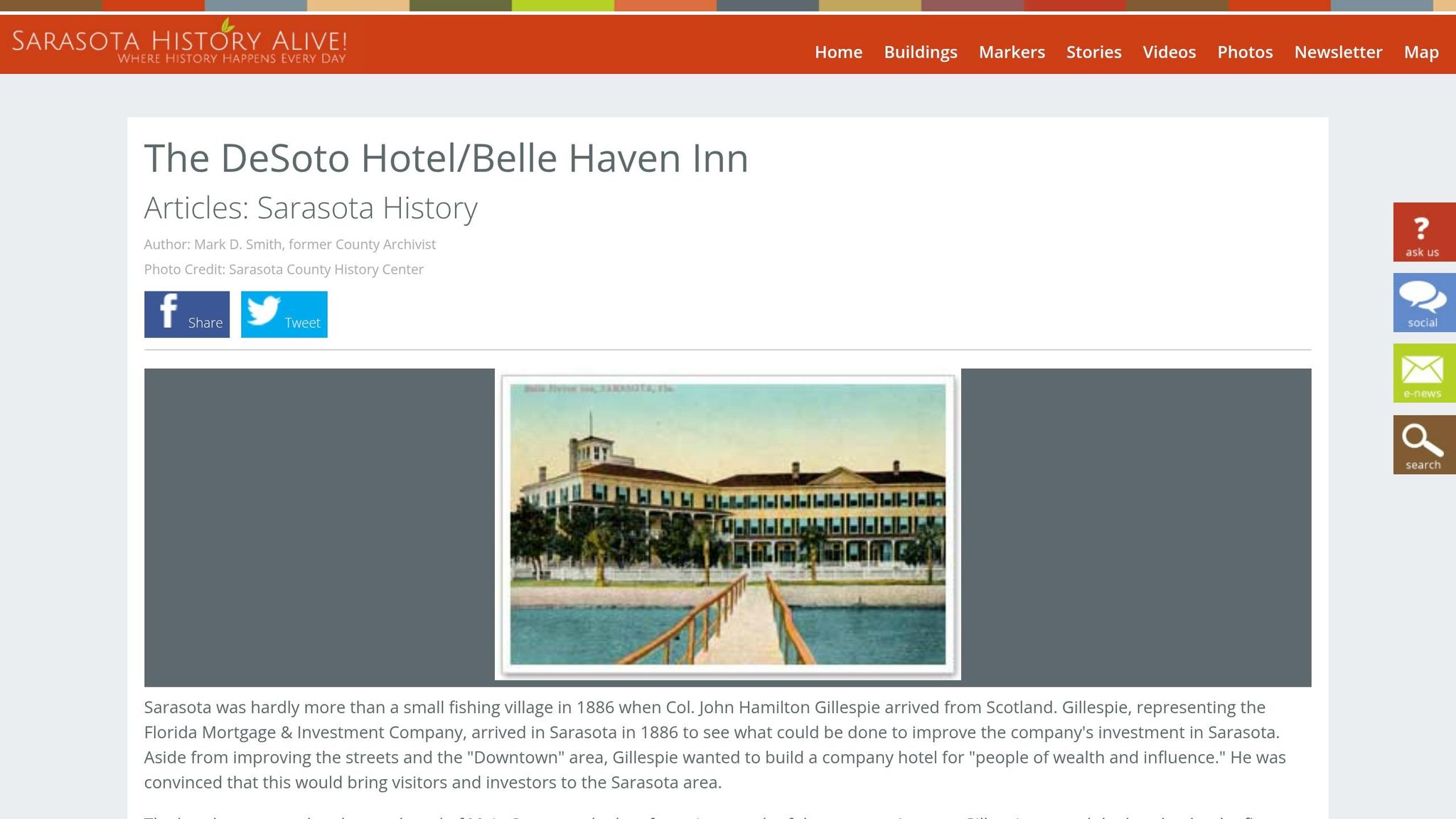
John Hamilton Gillespie, a Scottish entrepreneur, arrived in Sarasota in 1886 with grand plans to transform the struggling fishing village into a hub for affluent visitors and investors. Representing the Florida Mortgage & Investment Company, Gillespie aimed to create a hotel that would appeal to "people of wealth and influence", as noted by former County Archivist Mark D. Smith.
On February 25, 1887, Gillespie opened the De Soto Hotel at the south end of Main Street. This three-story building, constructed with lumber from Cedar Key and Apalachicola, featured 30 bedrooms and an observation tower. Its grand opening ball drew over 200 guests and lasted until dawn, making it the biggest social event south of Manatee at the time.
To further enhance the hotel's allure, Gillespie introduced Florida's first golf course in May 1886. What began as a two-hole practice course expanded into a 110-acre, nine-hole course by 1905. The hotel's presence also spurred infrastructure improvements, such as better roads and steamship connections to Tampa.
The De Soto Hotel marked a shift toward luxury tourism, targeting elite visitors rather than the informal, family-run accommodations of the past. Although an economic downturn in 1890 temporarily closed the hotel, it reopened as the Belle Haven Inn in 1902 and continued to operate. Together, Webb's resort and Gillespie's hotel laid the groundwork for Manasota's evolution into a sought-after tourist destination.
Early 1900s: Infrastructure and Investment
The early 1900s marked a turning point for Manasota, as investments in infrastructure transformed this remote area into a sought-after winter retreat. Wealthy investors and ambitious projects opened the doors to a new wave of visitors.
Bertha Palmer's Sarasota Development
Chicago socialite Bertha Palmer played a pivotal role in reshaping Sarasota between 1910 and 1918. She acquired approximately 140,000 acres - about one-quarter of what is now Sarasota County - for an initial price of around 25¢ per acre. When she first arrived in 1910, Sarasota was little more than a quiet fishing village with a population of just 900.
Recognizing the importance of transportation for growth, Palmer used her influence to extend the Seaboard Air Line Railroad from Fruitville to Venice by 1911. This development connected Sarasota to wider markets and made it more accessible to winter visitors. Historian Frank Cassell explained:
She understood that the agricultural world she was creating wouldn't work unless there were adequate railroad connections to carry crops north and west... The railroad was absolutely critical to Sarasota's success.
Palmer’s winter estate, "The Oaks", featured cutting-edge amenities like an electric plant and a modern water system, setting a new standard for luxury living. By hosting international socialites and royalty at her estate, she positioned Sarasota as a fashionable winter destination for her wealthy Chicago peers. As Sarasota History Alive! noted:
Mrs. Palmer was in large part responsible for transforming the sleepy town of Sarasota into a national winter residence destination for the well to do.
Her ranch also made history in November 1915 by shipping 1,000 head of cattle in 31 rail cars - the largest cattle shipment Manatee County had ever seen. Palmer’s vision laid the groundwork for the region’s future infrastructure growth.
Roads, Bridges, and Access
Building on Palmer’s initiatives, local leaders pushed forward with crucial roadway and bridge projects. In 1915, a committee was formed to construct 34 miles of well-paved roads and bridges connecting Sarasota, Venice, and Bee Ridge. The Sarasota/Venice Special Road and Bridges Bond District issued a $250,000 bond to fund these efforts in the same year.
The 1920s brought even more transformative projects. Developer Owen Burns and circus mogul John Ringling collaborated to build the John Ringling Causeway, which connected downtown Sarasota to St. Armands and Lido Keys. This causeway opened the barrier islands to resort development, turning the coastline into a hub for leisure and tourism.
The completion of the Tamiami Trail in 1928, a $13 million project linking Tampa and Miami, further boosted accessibility for automobile travelers. These infrastructure advancements fueled a population boom, with Sarasota's numbers climbing from 3,000 in 1920 to over 15,000 by 1926 during Florida's Land Boom. These developments not only connected communities but also laid the foundation for the luxury resorts and attractions that would define the region in the years to come.
Depression Era Through Post-War Growth
Tourism During the Great Depression
The Great Depression hit Manasota hard, leaving a deep mark on the local economy. From 1925 to 1933, Sarasota saw building permits plummet from over $4.5 million to just $51,880. Business licenses also dropped sharply, from 1,057 to 600 by 1931. Nearly 40% of city property owners couldn’t pay their taxes during the harshest years. As Mayor A.B. Edwards aptly described:
The water had been squeezed out of the sponge.
Despite the economic downturn, federal relief programs brought some hope. Projects like the Municipal Auditorium, which opened in early 1938, and the Lido Beach Casino, designed in 1940 by architect Ralph Twitchell, became hubs for local events, hosting everything from pageants to water ballet performances. Another significant initiative was the development of Myakka River State Park. Between 1934 and 1942, the Civilian Conservation Corps (CCC), under A.B. Edwards' leadership, constructed roads, bridges, and cabins while planting thousands of trees. The park officially opened to tourists in 1942.
Even though the Depression drained the region’s resources, these federal projects helped lay the groundwork for the area’s recovery and set the stage for its post-war transformation.
Post-War Resort Expansion
After the challenges of the war, Manasota entered a period of rapid growth, fueled by improved infrastructure and public health measures. World War II had a significant impact on the region, especially through projects like the Sarasota-Bradenton Airport. Originally funded by the WPA in 1938, the airport served as a base for 3,000 servicemen during the war. Once the Army Air Corps returned it to the Airport Authority in late 1947, it had undergone extensive upgrades. Former Sarasota County Historian Ann Shank reflected on this turning point:
Sarasota County found that the war effort brought the Depression era to a close.
The post-war boom was undeniable. Between 1940 and 1950, Sarasota County’s population jumped by 43%, growing from 16,106 to 28,287 residents. Two key developments made this growth possible. First, mosquito spraying programs in 1946–1947 made the barrier islands livable year-round. Second, expanded water and electric systems supported the increasing population and tourism demand.
This period also saw cultural and architectural milestones. The Ringling Museum of Art opened to the public in 1946, signaling a new chapter for the region. That same year, F.W. Wagner bought Warm Mineral Springs for $60,000, envisioning it as a wellness resort called the "Healthorium". Meanwhile, Siesta Key, home to only about 300 residents in the mid-1940s, began to thrive. Architects like Paul Rudolph and Ralph Twitchell designed modern homes that would define the "Sarasota School of Architecture". As historian Mark D. Smith observed:
Sarasota County emerged from the collapse of the land boom, the Great Depression and the rigors of war with a new outlook to the future.
Contemporary Tourism: Resorts and Arts
From Beaches to Arts and Dining
Manasota's tourism story has come a long way, transforming from a seasonal beach destination into a lively, year-round hub for arts and culture. The arts scene isn't just about entertainment - it’s become a driving force for the local economy and a source of enrichment for both residents and visitors. A great example of this shift is the Manatee Performing Arts Center. What started as a seasonal, volunteer-run theater has grown into a professional operation with 10 full-time staff and over 70 contracted professionals. In March 2026, the center showcased an eclectic lineup, including the bluegrass musical Bright Star, a performance by master magician Lee Terbosic, and an ABBA tribute concert by the Las Vegas Show Band.
Downtown Bradenton is also stepping up its cultural game with the creation of Sara's Studios, a massive 31,000-square-foot performing arts conservatory that broke ground in August 2025. This facility will serve as the permanent home for The Pops Orchestra of Bradenton and Sarasota and includes classrooms and rehearsal spaces to nurture local talent. Investments like this have elevated the region’s reputation; Sarasota was even named one of Time magazine's "100 of the World's Greatest Places" in both 2021 and 2023, thanks to its rich arts scene.
While the arts bring vibrancy to the area, modern resorts add a layer of luxury and relaxation, offering visitors a well-rounded experience.
Modern Resort Development
Manasota’s appeal now extends beyond its cultural renaissance, with luxury resorts redefining what it means to vacation in the region. These resorts blend high-end amenities with Florida’s natural charm. For instance, The Resort at Longboat Key Club spans 410 acres on land originally intended to host John Ringling’s Ritz-Carlton. Today, it features 20 Har-Tru tennis courts, championship golf courses, a full-service spa (offering treatments priced between $175 and $375), and private cabanas available for $250 to $600 per day.
The Palmetto Marriott Resort and Spa, which opened in July 2024, is the latest addition to Manatee County’s luxury offerings. As the county’s largest upscale hotel, it boasts the Revive Spa, rooftop dining, and "The Yard", a 40,000-square-foot outdoor amphitheater for concerts and events. In its first year, the resort is expected to bring in nearly $5 million in tax revenue for the city. Spa Director Angela Panchak expressed her enthusiasm for the Revive Spa:
"The Revive Spa at Palmetto Marriott is excited to pamper our local community and resort guests with a place to retreat, find calm, invigorate, indulge and be refreshed!"
For those who prefer a quieter, more nostalgic experience, Manasota Key offers a slice of "Old Florida." Known as the "Shark Tooth Capital of the World", the area is perfect for activities like shelling and shark tooth hunting. The historic Manasota Beach Club, which has been welcoming guests for 66 seasons and is listed on the National Register of Historic Places, offers a charming escape with a focus on these timeless pastimes. Pro tip: for the best shark tooth finds, head to the beach with a sifter about 45 to 60 minutes before sunset. This seamless blend of historic charm and modern luxury ensures that Manasota appeals to a wide variety of travelers.
Conclusion
Manasota's rich tourism history stretches back 8,000 years, beginning with indigenous peoples who relied on these coastal waters for fishing. Fast forward to today, the region boasts luxury resorts and a wealth of cultural attractions. While early settlers faced agricultural setbacks, they quickly shifted focus to highlight the area's hunting, fishing, and laid-back coastal lifestyle. Visionaries like Bertha Palmer, who acquired between 80,000 and 90,000 acres in the early 1900s, and John Ringling, whose influence shaped the region’s cultural identity, played pivotal roles in its transformation.
Though economic hardships in the late 1920s slowed growth, recovery came swiftly. Over time, Manasota transitioned from a seasonal beach getaway to a year-round destination, offering a unique mix of unspoiled natural beauty and a vibrant cultural scene. The area now attracts a wide array of visitors, from fossil enthusiasts exploring Manasota Key to travelers captivated by its deep history and timeless charm.
Manasota’s ability to overcome challenges has paved the way for ongoing growth. As development on barrier islands reaches capacity, the focus has shifted inland. For example, in November 2024, construction began on a 4-acre lagoon in Parrish, designed to serve a 3,000-home community. However, maintaining the region's "Old Florida" character and its connection to nature remains a pressing challenge, especially as stricter zoning laws and environmental concerns take center stage.
The restoration of the Manasota Beach Club after the 2024 storms embodies this delicate balance. Efforts to preserve its place on the National Register of Historic Places, restore native plant life, and rebuild infrastructure reflect the region's commitment to honoring its heritage while planning for the future. As the Buffum family so eloquently put it:
Manasota Key is more than just a winter retreat; it was a sanctuary for the soul.
This sentiment captures the essence of what has drawn people to Manasota for thousands of years - and what will continue to shape its appeal for generations to come.
FAQs
What events turned Manasota into a major tourism destination?
Manasota's journey to becoming a popular tourist destination traces back centuries. European explorers settled in the area as early as the 1400s, followed by the rise of fishing communities in the 1700s. Its shores, brimming with seashells, fossils, and archaeological treasures, caught the attention of researchers and collectors alike.
The 1920s Florida land boom brought a surge in infrastructure development and widespread publicity, further putting Manasota on the map. The discovery of prehistoric artifacts and ancient burial sites added a layer of historical intrigue, creating a unique blend of natural charm and rich heritage that continues to draw visitors.
Who were the key people behind Manasota’s early resort growth?
Mrs. Bertha Palmer was a pivotal figure in the early development of Manasota as a resort destination. Arriving in Sarasota in 1910, she acquired a large amount of land and significantly influenced the area's growth and attractiveness, helping to establish its reputation as a desirable location.
How can Manasota preserve “Old Florida” as development expands?
Manasota has the opportunity to keep the charm of "Old Florida" alive by focusing on protecting its historical districts, heritage sites, and longstanding traditions. For example, local ordinances and community-driven efforts can play a key role in safeguarding places like the Old Manatee Historic District, ensuring its rich history remains intact.
Beyond regulations, supporting local museums, cultural festivals, and heritage tourism can help preserve the area's unique identity. These initiatives not only celebrate the past but also educate visitors and residents, fostering a deeper appreciation for the region's roots.
Striking a balance between growth and preservation is crucial. Thoughtful planning can ensure that new development respects and complements the area's history, rather than overshadowing or erasing it. By prioritizing preservation alongside progress, Manasota can maintain its distinctive character for generations to come.