
State Tax Credits for Florida Caregivers
No Florida caregiver tax credit; rely on federal relief: Child & Dependent Care Credit, $500 Other Dependent Credit, medical deductions.

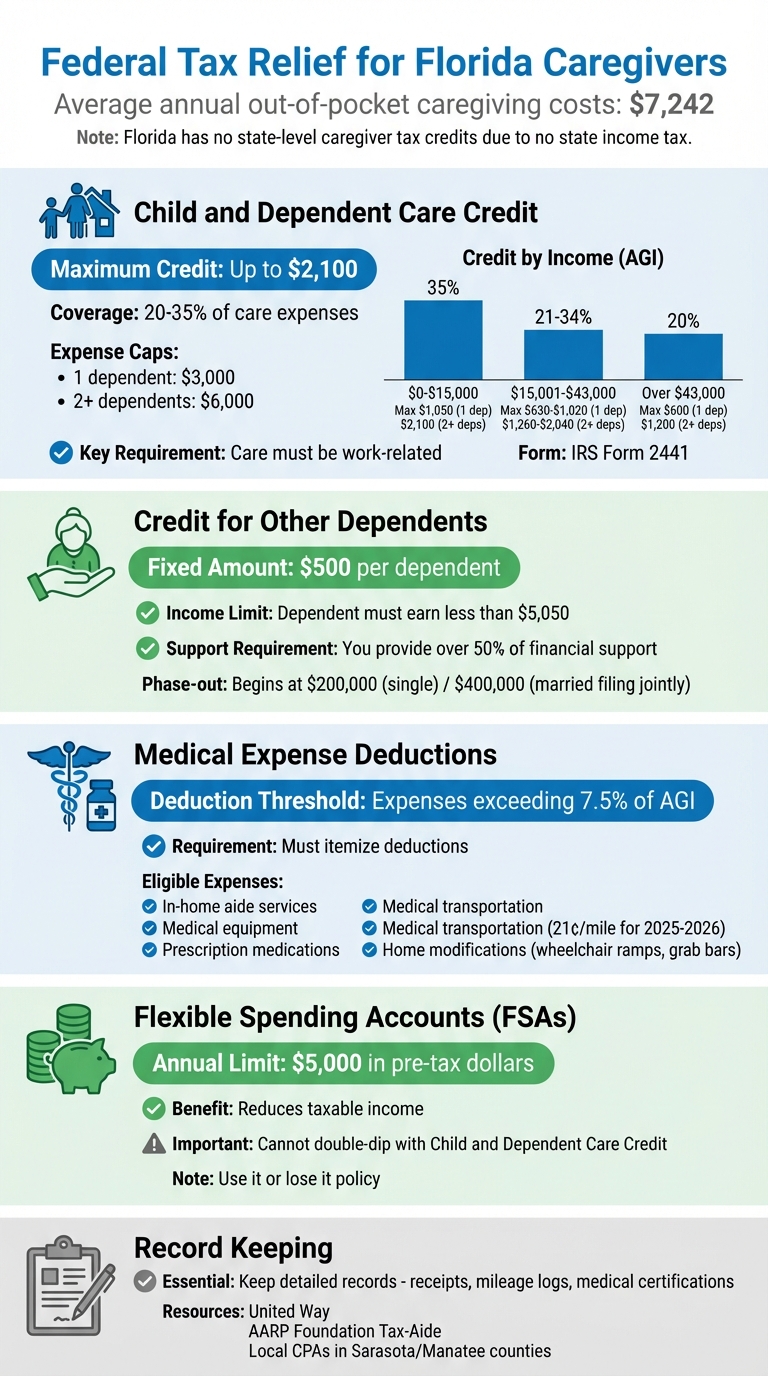
Caring for a family member can be costly, with U.S. caregivers spending an average of $7,242 annually on out-of-pocket expenses. While some states offer tax credits to ease this burden, Florida does not have state-level caregiver tax credits due to its lack of a personal income tax. However, Florida caregivers can still benefit from federal programs like the Child and Dependent Care Credit (up to $2,100) and the Credit for Other Dependents ($500 per dependent). These programs help offset caregiving costs such as medical expenses, home modifications, and in-home care.
Key takeaways for Florida caregivers:
- Child and Dependent Care Credit: Covers up to 35% of care expenses, capped at $3,000 for one dependent or $6,000 for two or more.
- Credit for Other Dependents: Provides $500 per qualifying dependent with specific income and support requirements.
- Medical Expense Deductions: Allows itemized deductions for unreimbursed medical expenses exceeding 7.5% of your adjusted gross income.
- Flexible Spending Accounts (FSAs): Set aside up to $5,000 in pre-tax dollars for caregiving expenses through employer-sponsored plans.
Thorough record-keeping and proper documentation are essential to claim these benefits. Keep receipts, mileage logs, and medical certifications to ensure eligibility. For additional help, consider local resources like the United Way or professional tax advisors in Sarasota and Manatee counties.
Federal Tax Credits and Deductions for Florida Caregivers 2026
Family Caregivers: Don’t Miss Out On Important Tax Benefits
Florida's Tax System and Caregiver Credits
Florida’s tax system is unique in that it does not impose a state personal income tax. While this might sound appealing on the surface, it comes with a drawback for caregivers: there are no state-level caregiver tax credits available. This means caregivers in Florida, including those in Manatee and Sarasota counties, have to rely entirely on federal tax relief programs like the Child and Dependent Care Credit and the Credit for Other Dependents to offset caregiving expenses. Unfortunately, this leaves them without the additional financial support that state-level credits could provide.
Caregiver Tax Credits in Other States
To see what Florida caregivers are missing out on, let’s take a look at some examples from other states that do offer caregiver tax credits:
- Georgia: Caregivers can claim the Qualified Caregiving Expense Credit, which covers 10% of caregiving expenses, capped at $150 annually. This applies to care for family members who are 62 or older or have disabilities.
- South Carolina: Offers a Dependent Care Credit that matches 7% of the federal child and dependent care credit, with a maximum benefit of about $210 for one dependent.
- North Dakota: Provides a Family Member Care Credit, covering 50% of caregiving expenses up to $4,000 annually for family members aged 65 or older or with disabilities.
- Missouri: Features a Shared Care Tax Credit of up to $500 for individuals providing in-home care to someone aged 60 or older.
These state-level credits act as a supplement to federal programs, giving caregivers an additional layer of financial relief. In contrast, Florida residents miss out on this type of support due to the absence of a state income tax system that could fund such credits.
Federal Tax Credits for Florida Caregivers
Caregivers in Manatee and Sarasota counties, Florida, often turn to federal tax relief programs to help manage the costs of caregiving. Two key options available are the Child and Dependent Care Credit and the Credit for Other Dependents. Each program offers financial relief in different ways. Here’s a closer look at how these credits work and their eligibility requirements.
Child and Dependent Care Credit
This credit helps offset the cost of care for certain individuals, allowing you to work or search for work. Eligible individuals include children under 13 years old, as well as a spouse or dependent incapable of self-care who lived with you for more than half the year. To qualify, you must pay for care services specifically to enable you (and your spouse, if filing jointly) to work or actively job hunt.
The credit covers a percentage of care expenses - ranging from 20% to 35% - based on your adjusted gross income (AGI). The percentage scales down as AGI increases, starting at 35% for those earning under $15,000 and dropping to 20% for those with an AGI above $43,000. Expenses eligible for the credit are capped at $3,000 for one qualifying individual or $6,000 for two or more, leading to a maximum credit of $1,050 for one dependent or $2,100 for two or more.
| Adjusted Gross Income (AGI) | Credit Percentage | Max Credit (1 Dependent) | Max Credit (2+ Dependents) |
|---|---|---|---|
| $0 - $15,000 | 35% | $1,050 | $2,100 |
| $15,001 - $43,000 | 21% - 34% | $630 - $1,020 | $1,260 - $2,040 |
| Over $43,000 | 20% | $600 | $1,200 |
It’s important to note that this credit is nonrefundable, meaning it can reduce your tax liability to zero but won’t generate a refund if the credit exceeds the taxes owed. To claim it, you’ll need to provide the care provider’s name, address, and Taxpayer Identification Number (usually a Social Security number) on IRS Form 2441. Additionally, if you receive dependent care benefits from your employer, such as through a Flexible Spending Account, those benefits must be deducted from the expense limits.
Credit for Other Dependents
The Credit for Other Dependents is another federal option, specifically designed to assist caregivers supporting elderly relatives. In Florida, this credit can benefit those caring for parents, grandparents, or other elderly dependents. To qualify, the dependent must earn less than $5,050 in 2026, and you must provide over 50% of their financial support, including essentials like housing, food, and medical care. The dependent must also be a U.S. citizen, U.S. national, or legal resident, and they cannot file a joint tax return with a spouse.
Unlike the Child and Dependent Care Credit, this credit is a fixed amount of $500 per dependent. However, it begins to phase out for single filers earning more than $200,000 or married couples filing jointly with incomes above $400,000. If caregiving costs are shared among multiple family members, and no one person provides more than 50% of the dependent’s support, a Multiple Support Agreement (IRS Form 2120) can be used to determine who is eligible to claim the credit.
Other Tax Deductions and Credits for Caregivers
While Florida doesn't offer state-level tax credits, federal deductions and flexible spending accounts (FSAs) can provide financial relief for caregivers. By utilizing medical expense deductions and FSAs, caregivers in areas like Manatee and Sarasota counties can significantly reduce their financial burden.
Medical Expense Deductions
If you're covering more than 50% of a parent’s or grandparent’s support, you may be eligible to deduct unreimbursed medical expenses that exceed 7.5% of your adjusted gross income (AGI) - provided you itemize deductions. This deduction applies even if their income is too high for them to qualify as a dependent.
For long-term care services to qualify, a physician must certify that the individual is "chronically ill." This means they either cannot perform at least two daily living activities or require constant supervision due to cognitive issues. For example, in a 2011 U.S. Tax Court case, the estate of Baral successfully claimed a $50,000 deduction for caregiver wages after obtaining such certification. However, $5,566 in supply costs was disallowed because proper receipts weren’t provided.
"Qualified long-term care services count as medical care if the patient is a chronically ill individual... and the care is provided according to a plan of care prescribed by a licensed health care practitioner." – TaxShark
Eligible expenses include:
- In-home aide services and nursing care
- Caregiver agency fees and respite care
- Medical equipment like wheelchairs or hearing aids
- Prescription medications
- Transportation for medical purposes (deductible at 21 cents per mile for 2025 and 2026)
- Home modifications, such as wheelchair ramps or grab bars (only costs exceeding any increase in home value qualify)
With family caregivers spending an average of $7,200 annually out-of-pocket on care, these deductions can provide meaningful tax relief. To make the most of this deduction, maintain detailed records, such as a mileage log with dates and purposes, and secure a doctor’s letter confirming the medical necessity of the care.
Dependent Care Flexible Spending Accounts (FSAs)
Flexible spending accounts are another effective tool for caregivers to lower taxable income. Employer-sponsored Dependent Care FSAs allow you to set aside up to $5,000 in pre-tax dollars for qualifying care expenses in the 2026 tax year. Since these contributions are deducted from your paycheck before federal income tax and FICA taxes are calculated, they directly reduce your taxable income.
To qualify, the care expenses must be work-related. This means the care must enable you (and your spouse, if applicable) to work or seek employment. FSAs can cover care for:
- A child under 13
- A spouse or dependent of any age who is physically or mentally unable to care for themselves and lives with you for more than half the year
However, you cannot double-dip. If you contribute $5,000 to an FSA, that amount must be subtracted from the total expenses eligible for the federal Child and Dependent Care Credit.
For those in higher tax brackets, FSAs often provide more savings than the credit because the pre-tax exclusion can exceed the credit’s value. To determine which option benefits you most, multiply your FSA contribution by your marginal tax rate. Keep in mind, FSAs operate on a "use it or lose it" basis - any unused funds at the end of the plan year (or an allowed grace period) are forfeited.
How to File for Tax Credits in Manatee and Sarasota Counties
For caregivers in Manatee and Sarasota counties, careful filing and organized record-keeping are key to making the most of available tax credits.
Steps to Claim Federal Tax Credits
When filing for federal caregiver tax credits, accuracy is critical. Two primary credits available to caregivers in Florida are the Child and Dependent Care Credit and the Credit for Other Dependents.
To claim the Child and Dependent Care Credit, complete Form 2441 and attach it to your Form 1040 or 1040-SR. This credit covers 20% to 35% of eligible expenses, with a maximum of $3,000 for one qualifying person or $6,000 for two or more. The care must be work-related, meaning you paid for it so you could work or look for work. Additionally, the care recipient must have lived with you for more than half the year and be unable to care for themselves.
Make sure to include your caregiver's name, address, and Taxpayer Identification Number (TIN) on Form 2441. Without this, your claim might be denied. If you used a caregiver from a Sarasota or Bradenton agency, request their Employer Identification Number (EIN) on all invoices.
For medical expenses, such as in-home nursing or adult day care, use Schedule A to claim itemized deductions. These expenses are deductible only if they exceed 7.5% of your adjusted gross income. To qualify, secure a written plan of care or a letter from a licensed healthcare provider certifying that your care recipient is chronically ill. This requirement was highlighted in the 2011 U.S. Tax Court case Estate of Baral, where caregiver wages were successfully deducted with proper documentation.
If you're claiming the Credit for Other Dependents - which offers up to $500 per qualifying dependent - ensure the care recipient's gross income is less than $5,050 for the 2026 tax year. Caregivers providing more than half of a relative's household costs may also qualify for Head of Household filing status, which comes with a standard deduction of $21,900 - about $7,300 more than the single filer deduction.
Once you've submitted your credits, organize all supporting documents to back up your claims.
Keeping Records of Caregiving Expenses
Proper documentation is crucial to support your tax credits and deductions. Set up a centralized system - physical or digital - to store receipts and logs throughout the year.
Here’s what to keep:
- Medical Records: Save receipts, insurance Explanation of Benefits (EOBs), prescription details, and pharmacy receipts. For home modifications, like wheelchair ramps or grab bars, get a doctor’s letter certifying that they’re medically necessary. If the modification doesn’t increase your home’s value, it’s fully deductible. If it does, only the cost exceeding the value increase qualifies.
- Mileage Logs: If you drive to medical appointments or adult day care centers in the Manasota area, record the date, destination, purpose, and miles driven. For 2026, the standard mileage rate for medical transportation is 21 cents per mile.
- Payment Records: Save contracts, invoices, and proof of payments for caregiving essentials like food, housing (including the fair rental value if the care recipient lives with you), utilities, and personal items. This helps show that you provide over 50% of the care recipient’s support, a key requirement for meeting the "medical dependent" test.
Keep all tax-related caregiving records for at least three years from your filing date. For property improvement records, hold onto them for up to seven years.
If you need assistance, local resources are available. For example, the United Way of South Sarasota County offers free Volunteer Income Tax Assistance (VITA) services for households earning $74,000 or less annually. The AARP Foundation Tax-Aide also provides free tax help for older adults and caregivers. For more complex tax situations, consider reaching out to local CPA firms like Kerkering, Barberio & Co., which has offices in Sarasota and Lakewood Ranch and specializes in caregiver tax planning.
Conclusion
Caregivers in Manasota often face significant financial challenges, but tax relief options can help lighten the load. Although Florida doesn't offer state-level caregiver tax credits due to the lack of a state income tax, federal programs like the Child and Dependent Care Credit, the Credit for Other Dependents, and medical expense deductions can provide meaningful financial relief - provided you meet the eligibility requirements.
The cornerstone of claiming these benefits is thorough record-keeping. On average, family caregivers spend $7,242 annually out of pocket on caregiving expenses. Without organized documentation, you risk missing out on deductions you’re entitled to. Keeping receipts, tracking mileage, and maintaining medical records throughout the year ensures you can claim every eligible credit. As tax regulations continue to shift, staying organized becomes even more vital.
Tax laws can be tricky, especially when it comes to dependency tests, medical deductions, and filing statuses. Nugent & Associates emphasizes the complexity of these rules:
The tax benefits and regulations related to caring for someone are complicated. If you are a caregiver and would like to discuss your situation and options further, please call our office.
To make the most of available tax benefits, consider consulting a local tax professional in Sarasota or Lakewood Ranch. Their expertise can help you navigate the rules and maximize your savings.
FAQs
Can I claim both the Dependent Care FSA and the Child and Dependent Care Credit?
Yes, you can claim both benefits, but the IRS typically requires you to apply only one benefit to the same expenses. This rule is in place to prevent "double-dipping." You’ll need to decide whether to use the Dependent Care FSA or the Child and Dependent Care Credit for particular expenses, but not both for the same costs.
What caregiving costs count as deductible medical expenses on my taxes?
Deductible caregiving expenses can cover qualified long-term care services, costs for a "medical dependent", and amounts that exceed 7.5% of your adjusted gross income. These might include expenses like nursing home care, memory care, prescriptions, and on-site nursing services, provided they comply with IRS guidelines. It's always a good idea to consult a tax professional to confirm what qualifies.
How do I prove I provide over half of a parent’s support for tax benefits?
To prove you provide more than half of a parent's support for tax benefits, it's important to keep detailed records of the expenses you cover. This includes costs like housing, food, and medical bills. Hold on to receipts, bank statements, and payment records as evidence. Additionally, some IRS forms might ask for a written statement or affidavit. For the exact requirements, check the IRS guidelines or consult a tax professional for advice.