Ultimate Guide to School Fundraising in Manasota
Community-focused guide to compliant fundraising, grants, and digital tools that help Manasota schools close classroom funding gaps.
In Manasota, schools face tight budgets, leaving teachers spending an average of $895 annually on classroom supplies. Fundraising is a vital solution to bridge this gap, supporting programs like STEM, arts, and mentoring. This guide offers practical ideas for schools in Bradenton, Sarasota, Lakewood Ranch, and nearby areas, including:
- Local Resources: Leverage options like the Manatee Education Foundation and the Giving Challenge, which has raised over $75 million since 2012.
- Fundraising Ideas: Organize read-a-thons, outdoor events, and restaurant nights with local businesses like Panera Bread and Chuck E. Cheese's.
- Digital Tools: Use platforms like DonorsChoose, Snap! Raise, or Schoolfundr for online campaigns, and boost visibility with social media and QR codes.
- Legal and Tax Rules: Ensure compliance with district policies, IRS guidelines, and Florida tax laws for smooth operations.
- Grants: Apply for funding from organizations like the Southwest Florida Water Management District and the Sarasota Education Foundation.
Thoughtful planning, community partnerships, and digital tools can help schools meet their goals while supporting teachers and students.
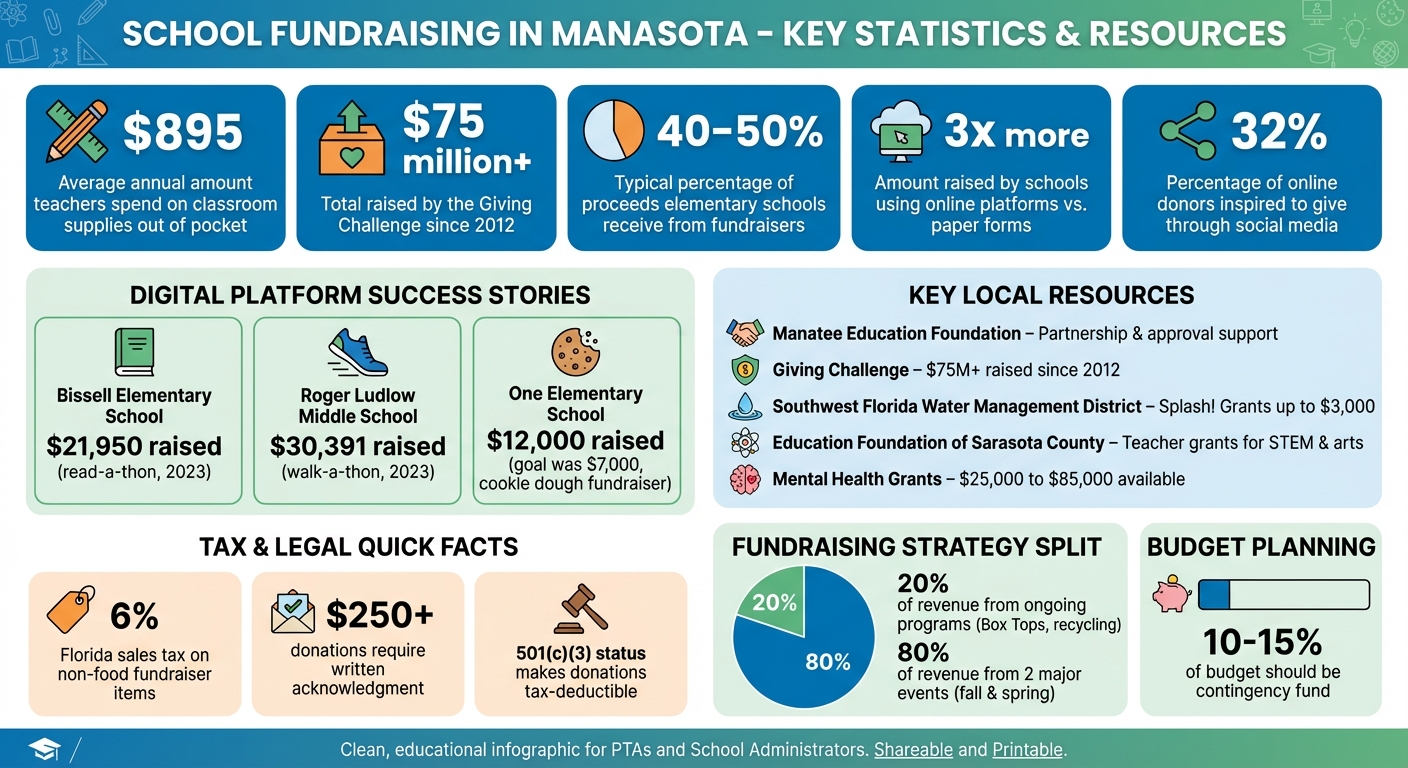
School Fundraising Statistics and Key Resources for Manasota Schools
10 Easy & Fun Elementary School Fundraising Ideas + (Free Kit!)
School District Rules and Requirements
Make sure to review your local school district's approval process before launching a fundraiser. This helps ensure you meet legal standards and follow district policies, which can save time and build trust within the community. For example, in Manatee County, specific guidelines are in place to help fundraisers align with district standards and avoid potential issues. If you're in a different area, like Sarasota County, check with your local school administration for details specific to your district.
Getting Approval for Your Fundraiser
In Manatee County, fundraising efforts are coordinated through designated contacts and approved platforms. If you have questions about protocols, donations, or event ticketing, reach out to Jeramiah Bowman at bowmanj@manateeschools.net. Once your fundraiser is approved, all payments and donations are processed through the RevTrak Web Store. This platform is pre-approved by the district to meet financial reporting and security standards.
You can also partner with the Manatee Education Foundation to simplify the approval process, as they have an established system in place.
After receiving approval, double-check that your fundraiser complies with all legal and tax requirements.
Legal and Tax Requirements
Understanding the tax rules for your fundraiser is essential to protect both your organization and its donors. Many school-affiliated fundraising groups operate as 501(c)(3) organizations, meaning donations are typically tax-deductible. However, the IRS's quid pro quo rule applies. For instance, if someone pays $65 for a gala ticket and the dinner's fair market value is $25, only $40 of that ticket price qualifies as a deductible contribution.
In Florida, a 6% sales tax applies to non-food items sold during fundraisers. This tax is usually based on the wholesale cost. However, food items are generally exempt. If your school or nonprofit has a valid Florida tax-exempt certificate, you won't need to pay this tax on qualifying purchases.
For any donation of $250 or more, provide a contemporaneous written acknowledgment so donors can claim their tax deductions. Keep in mind that payments for activities like raffle tickets, bingo, or lottery tickets are not considered deductible charitable contributions under IRS rules. Before getting started, confirm your organization's tax-exempt status using the IRS Tax Exempt Organization Search tool.
Proven Fundraising Methods for Elementary Schools
Finding the right fundraising strategies can make a big difference in both community involvement and financial returns. In Manasota, elementary school fundraisers typically bring back 40–50% of their proceeds to the school. This makes it clear why schools are moving away from traditional product-selling models that often return less than half of the earnings to the organization. By focusing on methods that are both engaging and effective, schools can achieve better results while building stronger connections within the community.
Classic Fundraising Events
Read-a-thons are a standout choice for elementary schools because they tie directly to educational goals and require minimal costs to organize. Students can gather pledges for each book they read or collect flat donations through online platforms, which also simplify the administrative side of things. One organizer from an elementary school shared their success story:
"The cookie dough fundraiser was too easy! I was able to do the majority of organizing myself... Our goal was $7,000 and we wound up with $12,000!"
Outdoor events are another excellent option, especially given Manasota's favorable weather. Ideas include a "Superhero Sprint" walk-a-thon, a DIY kite festival, art auctions featuring student work, or a "Carnival of Cultures" where families contribute food, music, and crafts that reflect their heritage.
To keep volunteers energized and avoid burnout, it helps to spread fundraisers throughout the year. For example, you might organize a fall read-a-thon to fund classroom supplies, a winter catalog sale for holiday programs, spring spirit-item sales for playground upgrades, and ongoing efforts like Box Tops or Scrip programs during the summer months.
Beyond school-organized events, partnering with local businesses can provide additional opportunities to raise funds.
Working with Local Businesses
Restaurant fundraiser nights offer a simple way to raise money while giving families a break from cooking. For example, Panera Bread locations in Sarasota and Manatee counties donate 20% of sales from scheduled fundraising events directly to schools. As Panera Bread explains:
"Schedule a night to host an event at your local bakery-cafe, invite your friends and family, and we'll donate a portion of sales directly back to your organization."
Another great option is Chuck E. Cheese's in Bradenton (905 44th Ave. West). Their events combine arcade games, dancing, and dining, creating a fun atmosphere for families while raising funds through event sales. According to Chuck E. Cheese's:
"When you give elementary school kids the chance to play awesome arcade games, participate in silly dance-offs, and play games with friends, your event is guaranteed to be a great success."
Local businesses can also donate items for raffles or auctions, such as themed gift baskets. Additionally, you can work with professionals - like yoga instructors - to host unique events like family wellness nights.
Grants and Community Foundation Support
While fundraisers and business collaborations are effective, grants can provide a much-needed financial boost to support school programs.
The Southwest Florida Water Management District offers Splash! School Grants of up to $3,000 to help K-12 teachers in public and charter schools create freshwater education projects. Applications are available online.
The Education Foundation of Sarasota County also provides teacher grants to fund hands-on learning experiences in the classroom. These grants cover a wide range of needs, from STEM initiatives to arts enrichment, helping teachers enhance student learning without relying solely on fundraising.
Other grant opportunities include up to $2,000 for environmental curricula and writing instruction awards, as well as theater performance grants of up to $5,000 to take students to plays and productions. Larger grants, ranging from $25,000 to $85,000, are available for mental health programs to support school-based services. To increase your chances of success, reach out to program staff early for guidance and submit a Letter of Intent weeks before the final deadline.
Digital Fundraising Tools and Methods
Digital platforms have transformed how schools in Manasota - covering Bradenton, Sarasota, and Lakewood Ranch - approach fundraising. These tools make it easier to connect with more donors while simplifying the donation process. Schools using online platforms often raise triple the amount compared to those sticking with paper sponsorship forms.
Online Fundraising Platforms
There’s no shortage of platforms designed specifically for schools. Here are some standout options:
- DonorsChoose: This platform is perfect for teachers seeking classroom supplies. Educators post their project needs - like books or tech - and donors fund them. The materials are then shipped directly to the school. DonorsChoose is highly rated for transparency by Charity Navigator and GuideStar.
- Donorbox: Ideal for PTA-led campaigns, it supports recurring donations and text-to-give features without charging monthly fees or requiring long-term contracts. Over 100,000 nonprofits have raised more than $3 billion using Donorbox.
- Donately: Focusing on peer-to-peer fundraising, this platform allows parents and supporters to create personal fundraising pages to expand outreach. However, its free tier includes a 4% platform fee.
-
Schoolfundr: Best for activity-based fundraisers like read-a-thons or walk-a-thons, this platform ensures schools keep all funds raised, minus standard payment processing fees. In 2023, Bissell Elementary School raised $21,950 through a read-a-thon, while Roger Ludlow Middle School brought in $30,391 with a walk-a-thon. As Schoolfundr states:
"Schoolfundr takes no cut from what you raise; you keep everything minus standard payment processing fees."
- Snap! Raise: Designed for elementary schools, this platform prioritizes data security and involves guardians in the process. It has helped over 150,000 schools and teams raise more than $1 billion.
These platforms also integrate seamlessly with virtual events, broadening fundraising opportunities.
Virtual Events and Social Media
Social media has become a powerhouse for fundraising. About 32% of online donors say it’s the channel most likely to inspire them to give. Among platforms, Facebook leads in turning engagement into donations, making it a strong choice for connecting with parents, grandparents, and alumni in the Manasota area.
To maximize success, storytelling is key. Short-form videos - like Instagram Reels or TikToks - tend to perform three times better than static images. Structuring campaigns into three phases can also make a difference: start with pre-launch teasers, follow with daily updates featuring student stories, and finish with a 48-hour push to create urgency.
Student-driven content consistently generates higher engagement. For example, 20–30 second videos of students explaining why the fundraiser matters often resonate more than generic graphics. As Clay Boggess from Big Fundraising Ideas puts it:
"In short: your product fundraiser is the engine. Social media is the fuel that drives more people to it."
Virtual events like online auctions, talent shows, or live Q&A sessions can be streamed on platforms like YouTube and linked directly to donation pages. Schools can also equip supporters with ready-made text and visuals to share on their own social networks, amplifying the campaign’s reach.
Beyond social media, mobile payment solutions make it easy to collect donations during in-person events.
Mobile Payment and QR Code Donations
QR codes have become a simple yet powerful way to connect physical events with digital donations. By scanning a code on a flyer, poster, or sign, donors are instantly directed to a secure donation page. Many fundraising platforms automatically generate these codes, and setting one up takes less than 15 minutes.
Once your QR code is ready, you can print it on backpack flyers, event banners, car wash signs, or even student-created thank-you notes. Before distributing, test the code to ensure it links correctly to the donation page.
As Schools & Money highlights:
"QR codes aren't a trend, they're a tool. And in school fundraising, they're proving to be one of the simplest and most innovative ways to modernize how we ask for support."
For live events like PTA meetings or sports games, you can pair QR codes with text-to-give options. These systems allow donors to contribute by texting a keyword to a shortcode. They support payments via credit cards, digital wallets like Apple Pay and Google Pay, and bank transfers. Organizers can also track how many people scanned the code and where the traffic came from.
How to Organize and Run a Fundraiser
Setting Targets and Creating Budgets
Start by analyzing past fundraising efforts to establish a realistic baseline. Then, define a specific goal, like "Raise $10,000 for a technology upgrade by December". A clear target ensures that everyone knows exactly what you're aiming for.
Consider using the 80/20 approach: plan two major events (fall and spring) to generate 80% of your revenue, while smaller, ongoing activities like Box Tops or recycling programs cover the remaining 20%. For instance, if your school has 500 students, aim for each major event to net $20,000, while year-round programs can bring in up to $10,000.
When drafting your budget, break down expenses into fixed costs (e.g., rentals, promotional materials) and variable costs (e.g., shipping). Always allocate 10% to 15% of your budget as a contingency fund for unexpected costs. To make progress manageable, divide larger goals into monthly targets - like $2,500 per month over four months.
Adopt SMART goals (Specific, Measurable, Achievable, Relevant, Time-bound) to keep your objectives focused. For example, "Raise $5,000 for new playground equipment by May 1st" is more effective than a vague goal like "raise money for the playground." Once your budget and goals are in place, assemble a team of dedicated volunteers to help bring your vision to life.
Managing Volunteers and Building Community Support
The backbone of any successful fundraiser is a strong team of volunteers. Recruit a small but enthusiastic group of parents who share your passion. As Kristine Ensor explains:
"Groups of parents that are on the same page and have equal passions to create a PTA or PTO ensure the group's success".
Start by crafting a clear mission statement that explains your group's purpose and how it benefits students and families. Then, organize your volunteers into specialized committees - like Fundraising and Finance, Community Affairs, and Membership Recruitment. Assign leadership roles such as Chairperson, Secretary, and Treasurer to oversee your efforts and meet nonprofit requirements.
Make volunteering as accessible as possible by offering a variety of roles tailored to different skills and availability. Communicate the importance of your mission to parents, emphasizing how their involvement directly impacts their children's education. Hosting family-friendly events is a great way to share your goals in a relaxed setting and encourage participation. Schools like Buffalo Creek Middle School in Manasota have seen success by streamlining donations through tools like the School District of Manatee County's web store, which also promotes financial transparency.
Measuring Results and Learning from Each Event
Once your fundraiser is complete, evaluate its success by comparing actual revenue to your original targets using a simple spreadsheet. Include details like total donations, expenses, and net profit, and share this information with your volunteers and supporters to maintain transparency.
To build stronger relationships with donors, follow the "3-to-1" rule: for every donation received, express gratitude, share the results, and provide another engagement opportunity before making another ask. Mary G. Roebling, a board member, advises:
"When we get a gift that we think is special, let's find a way to thank the person at least seven times before we ever ask them again for another gift".
Create a post-event report to document what worked and what didn’t. Record details like which promotional strategies attracted the most donors, which volunteer roles were hardest to fill, and whether your timeline was realistic. Pay attention to local event calendars in Manasota to avoid conflicts with other fundraisers targeting the same donor base. Use these insights to fine-tune your approach, ensuring future fundraisers are even more effective.
Conclusion
Raising funds for schools in Manasota calls for thoughtful planning, strong community ties, and adherence to local guidelines. By setting clear objectives and following approval processes, schools can maintain focus and accountability throughout their efforts.
Manasota schools benefit from unique regional support systems. For instance, the Giving Challenge has been a game-changer for local schools since 2012. Additionally, organizations like the Manatee Education Foundation provide valuable resources, from building tailored partnerships to unlocking grant opportunities.
Collaboration plays a key role in successful fundraising. The PTA's "3-to-1 rule" - offering three non-fundraising programs for every fundraiser - helps keep the community engaged without overwhelming donors. This balance ensures that educational priorities remain front and center.
Digital tools also enhance fundraising efforts. Platforms like the School District of Manatee County's RevTrak Web Store simplify online donations. Meanwhile, strategic use of social media, including popular regional hashtags like #GivingChallenge, can amplify visibility during key campaigns.
Whether you're hosting a read-a-thon, teaming up with local businesses, or running an online drive, combining careful planning, community partnerships, and digital strategies can create meaningful, lasting results for Manasota schools. For more stories and updates from Bradenton, Sarasota, Lakewood Ranch, and surrounding areas, visit Manasota.co.
FAQs
What fundraiser works best for my elementary school?
The success of a fundraiser hinges on your school’s goals, the level of community engagement, and the resources available. While traditional events like bake sales or carnivals can be fun, they often demand a lot of time and effort. On the other hand, simpler, community-centered approaches - like pizza card sales or product-based fundraisers - can deliver great results with less hassle. The key is to pick something that connects with your community and matches your team’s abilities and fundraising goals.
What approvals are needed before fundraising in Manatee or Sarasota?
Before starting a fundraiser in Manatee or Sarasota, you’ll need approval from the school principal and must adhere to district policies. This process involves completing sponsor training and submitting a fundraising application for review. Make sure to review your district’s specific guidelines carefully to meet all necessary requirements.
How do we handle taxes and donor receipts correctly?
To manage taxes and donor receipts correctly, make sure your organization is officially recognized as a 501(c)(3) tax-exempt entity. This status allows your donors to claim tax deductions for their contributions. Always provide official receipts that include the donor's name, the donation amount, and your tax-exempt ID.
If your organization sells products, verify whether these sales are subject to sales tax. Properly handling sales tax is crucial to staying compliant with IRS regulations.