Manatee County Trail Plans: 140 Miles Ahead
140-mile, $130M plan to build bike and walking trails over 20+ years, linking neighborhoods, parks and regional routes.
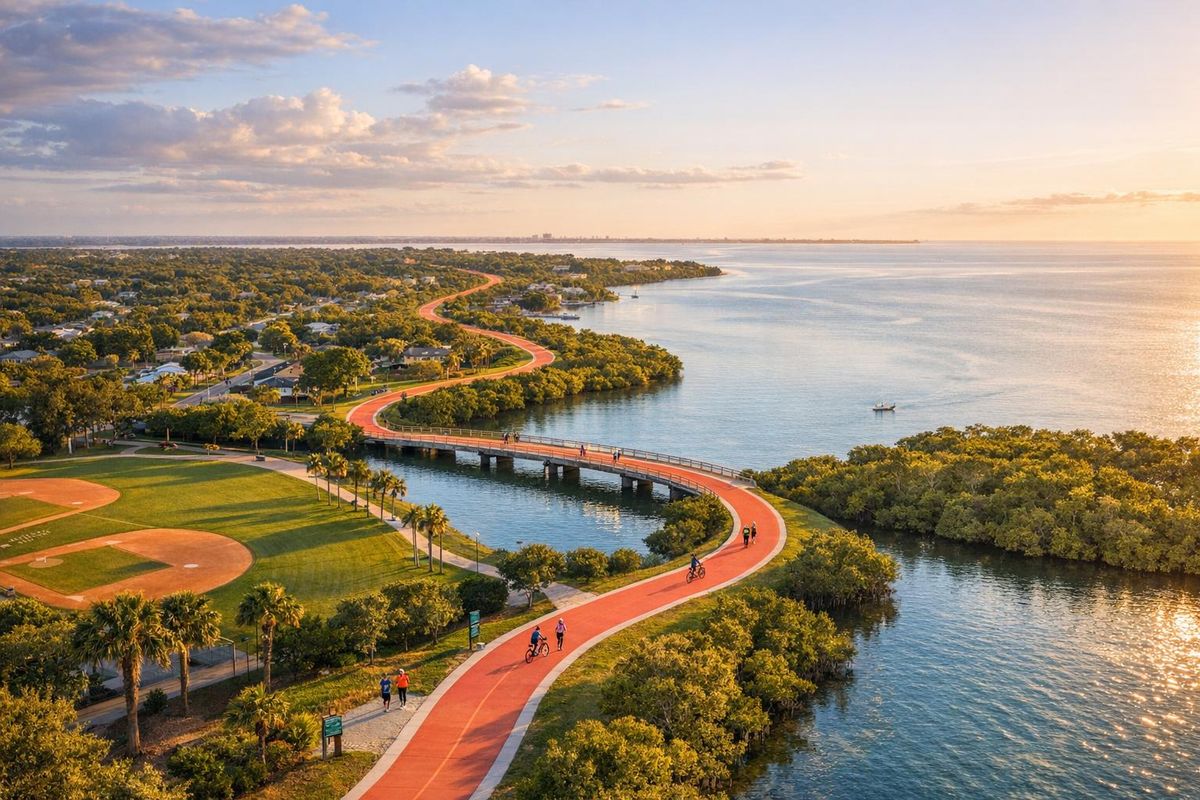
Manatee County is investing $130 million over 20 years to build a 140-mile network of bike and walking trails. Approved in November 2023, this project aims to link neighborhoods, parks, and commercial hubs while connecting to the statewide SUN Trail Network. Key goals include safer non-motorized travel, improved connectivity, and repurposing existing infrastructure like rail corridors and utility paths.
Highlights:
- Budget: $130 million, averaging $928,571 per mile.
- Timeline: 20+ years, with phased construction starting in 2026.
- Funding: Federal grants, developer fees, and local reserves.
- Key Projects: Gateway Greenway Trail (Lincoln Park to Parrish) and Veterans Resource Hub in Palmetto.
- Benefits: Safer travel, reduced traffic, and economic growth through tourism.
The project’s phased approach ensures steady progress while addressing community needs. Early segments prioritize connections to existing trails and regional networks like the Florida Gulf Coast Trail.
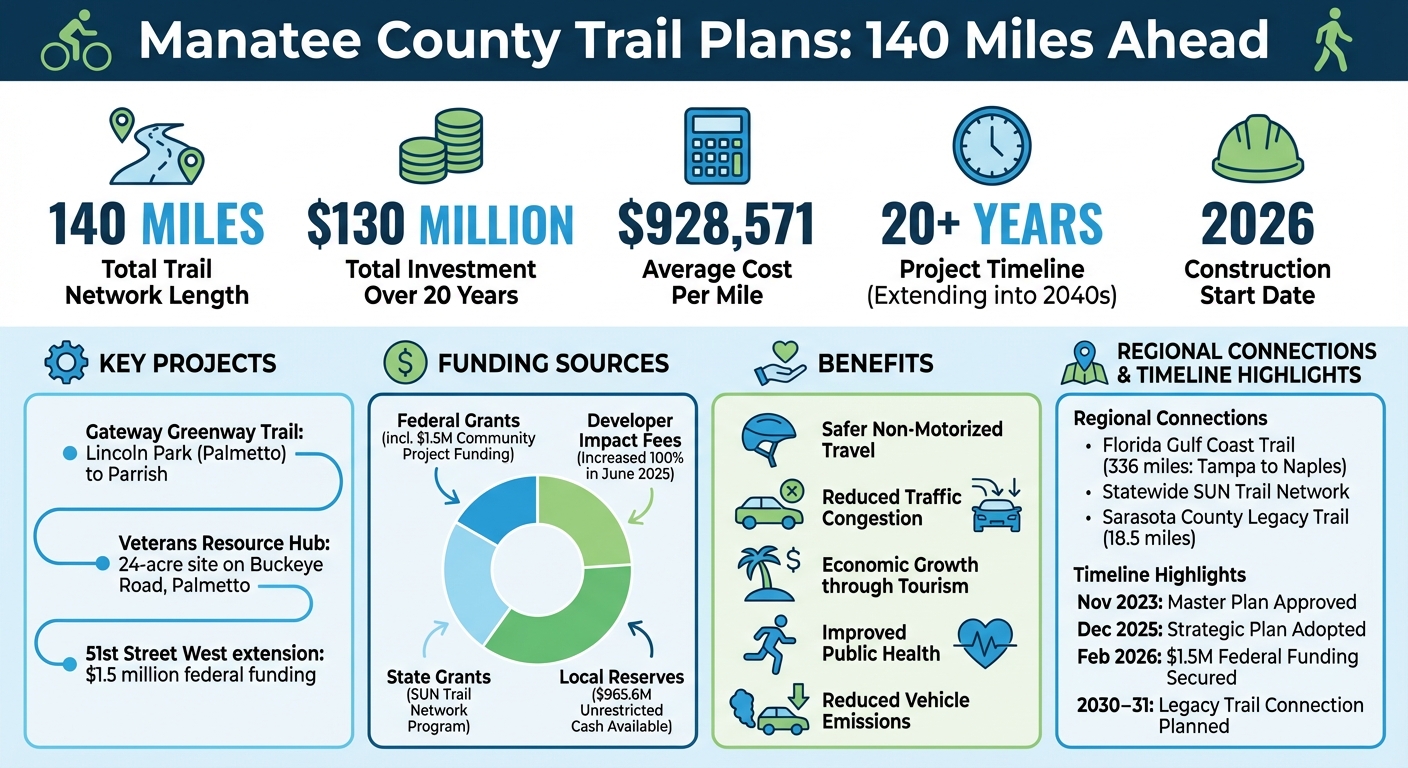
Manatee County Trail Network: Key Facts and Figures
Goals and Benefits of the Trail Network
The county’s trail network aims to provide safe, non-motorized travel options for daily commutes and recreational use. A core objective is to make the county more accessible for cyclists and pedestrians by creating dedicated routes that separate them from motorized traffic.
This system will link local neighborhoods to the statewide SUN Trail Network, ensuring continuous pathways for both short and long-distance travel. Projects like the Gateway Greenway will repurpose existing infrastructure - such as Florida Power & Light railroad corridors, utility pathways, and county road rights-of-way - to create these connections efficiently. Additionally, new roadway developments, like the 51st Street West extension funded with $1.5 million in federal aid in February 2026, are incorporating bike and pedestrian facilities from the outset.
Supporting Walking, Biking, and Non-Motorized Transportation
The trail network addresses the practical need for safe, car-free routes, making walking and biking viable alternatives to driving. By physically separating non-motorized travelers from vehicles, the county is removing a significant obstacle to active transportation. The system’s regional connections will also make traveling between communities without a car more realistic.
Manatee County’s Strategic Plan, adopted in December 2025, emphasizes this focus: "to improve our transportation and infrastructure, reduce flooding and build more multimodal trails so people can get around safely and easily". The project takes cues from successful examples like the Pinellas Trail, a 34-mile pathway that attracts nearly 900,000 visitors each year. This trail features a 15-foot-wide asphalt path and dedicated overpasses for safe crossings, setting a high standard for similar endeavors.
While expanding mobility is a priority, these trails also offer broader benefits, including improved public health, environmental gains, and economic opportunities.
Improving Health, Environment, and Economy
The trail network is poised to enhance public health by encouraging outdoor exercise, reduce vehicle emissions for cleaner air, and stimulate economic activity by connecting residents to commercial and job centers.
Tal Siddique, Chair of the Manatee Board of County Commissioners, highlighted these advantages in February 2026:
"They help us deliver on key community goals - improving quality of life, strengthening transportation networks and ensuring our veterans and their families have the support they deserve".
The county’s strategic goals tie trail development to economic growth through increased tourism and job creation. At the same time, the trails offer therapeutic outdoor spaces, promoting wellness for residents and visitors alike.
Planned Trail Segments and Locations
The Manatee County Trailways Master Plan outlines a vision for a 140-mile network designed to link neighborhoods, parks, and commercial hubs seamlessly.
First Priority Areas and Connection Points
One of the initial projects involves the Veterans Resource Hub and Memorial Park on Buckeye Road in Palmetto. This 24-acre site, located near SeaPort Manatee, is set to become a central destination and trail hub. In February 2024, county commissioners allocated $4 million to kick off the design phase, focusing on creating outdoor spaces for wellness and community events.
Dawn Kitterman highlighted the park's versatile purpose:
"The park's design will provide a therapeutic setting for wellness and outdoor activities, while also serving as a future event space for ceremonies, memorial events, service fairs, concerts, markets, and other community functions for veterans and the general public."
This project not only addresses local needs but also sets the stage for larger regional trail connections.
Connections to Regional Trail Systems
Despite a setback in July 2025, when $1 million earmarked for design and permitting was vetoed, the county remains committed to finding alternative funding. These efforts aim to integrate the Gateway Greenway Trail with the Florida Gulf Coast Trails system and the SUN Trail Network.
Budget and Funding Sources
Manatee County's 140-mile trail network comes with a $130 million price tag spread over 20 years. This ambitious project draws from a variety of funding sources to keep the development moving forward.
Where the Money Comes From
The funding plan taps into several streams. One key contributor is Federal Community Project Funding, which has allocated $1.5 million toward the Gateway Greenway Rails-to-Trails initiative.
Another major source is developer impact fees. In June 2025, county commissioners unanimously approved a 100% increase in these fees, ensuring that new developments shoulder more of the infrastructure costs they generate. Beyond that, the county enjoys a financial cushion, with $965.6 million in unrestricted cash reserves available as of the 2024 fiscal year. State grants, such as those from the SUN Trail Network program, also play a role, though the county experienced a setback in July 2025 when Governor Ron DeSantis vetoed a $1 million state appropriation for the Gateway Greenway Trail.
Together, these funding sources directly impact the cost of building trails across different types.
Cost Per Mile by Trail Type
With $130 million allocated for 140 miles, the average cost works out to roughly $928,571 per mile. However, this is a blended figure. Unpaved trails tend to cost less, while fully paved shared-use paths - complete with lighting, signage, and landscaping - are more expensive. To manage costs, the county strategically uses existing road rights-of-way and the Florida Power & Light railroad corridor.
This diverse funding approach not only supports current trail construction but also lays the groundwork for future expansions.
Construction Timeline and Phases
The county's vision for improved mobility and regional connectivity comes with a long-term commitment: the full build-out is expected to take over 20 years, extending well into the 2040s. This extended timeline allows for spreading costs, securing funding in stages, and adjusting plans to meet the changing needs of growing neighborhoods.
Near-Term and Long-Term Milestones
In November 2023, after 18 months of planning and design, commissioners approved the Trailways Master Plan. By December 2025, the Board adopted a Strategic Plan with a 5-1 vote, creating a clear framework to track progress on trail development. As Commission Chair George Kruse explained:
"It's clear, concise and it gives direction. Now it's up to everyone to follow the direction."
The county began implementing action plans and performance measures in 2026 to ensure steady progress. One of the early priorities is the Gateway Greenway Trail, which connects Lincoln Park in Palmetto to Parrish. In February 2026, Board Chair Tal Siddique secured $1.5 million in federal funding for this segment through U.S. Rep. Vern Buchanan. Another $1.5 million was allocated for the 51st Street West extension, which includes bicycle and pedestrian infrastructure.
These milestones mark the beginning of a phased approach to construction, ensuring deliberate and organized development.
How Projects Will Be Sequenced
The county has adopted a phased construction strategy to deliver early results and maximize community benefits. Priority segments aim to connect existing infrastructure quickly, providing immediate value. The Gateway Greenway is especially important because it links to the Florida Gulf Coast Trail, a planned 336-mile corridor stretching from Tampa to Naples. Leveraging existing resources will help speed up development while keeping costs manageable.
Project timelines will depend on funding availability and collaboration with regional partners. For instance, connections to Sarasota County's Legacy Trail, which already spans 18.5 miles, are scheduled for the 2030-31 fiscal year. Residents can stay informed and view planned trail segments by visiting www.mymanatee.org/trails.
Conclusion
Manatee County's 140-mile trail network is reshaping how people move and connect, thanks to a multi-modal transportation system supported by $130 million in funding over the next 20 years. By combining local and regional pathways, the county is creating a more connected and forward-thinking future.
This network will tie into the 336-mile Florida Gulf Coast Trail and the statewide SUN Trail Network, forming uninterrupted routes from Tampa to Naples. These efforts go beyond just improving transportation - they enhance daily life, strengthen community ties, and provide immediate benefits through initial high-priority segments, while paving the way for safer and more accessible travel options across the region.
With a phased rollout, the plan balances steady progress and cost management. Early segments will deliver tangible results quickly, while future expansions will connect residents to jobs, schools, and essential services throughout Manatee County and its neighboring areas.
This strategic vision sets the foundation for growth that prioritizes smarter transportation choices, reduces traffic, and boosts the economic health of linked communities. The path forward is set, funding is in place, and the transformation has already begun.
FAQs
Which trail segments will be built first, and where?
The initial sections of the trail will be developed as part of the Trailways Master Plan and the Veterans Memorial Park located on Buckeye Road. However, details about the exact locations and the sequence of construction are yet to be finalized.
How will the county pay for the trails if grant money changes?
If grant funding shifts, Manatee County intends to tap into other resources, such as federal funding, local government budgets, or alternative financial strategies. Recent approvals for federal funding and active county projects highlight the county’s capability to secure resources for efforts like these.
Will the trails be paved, lighted, and safely separated from traffic?
The available details don't clarify whether the trails will feature paving, lighting, or traffic separation to enhance safety.