10 Biking Safety Tips for Manasota Riders
Essential, no-nonsense safety rules—helmets, visibility, traffic laws, heat and route awareness—to reduce cycling risks in Manasota.
Cycling in the Manasota area is both rewarding and risky. While trails like the Legacy Trail and Lakewood Ranch offer scenic rides, Sarasota County ranks as one of the deadliest places for cyclists in the U.S. From wearing helmets to following traffic laws, staying safe requires preparation. Here’s a quick rundown of key tips:
- Helmet First: Always wear a properly fitted helmet; it reduces head injury risks by up to 85%.
- Be Seen: Use lights and reflective gear, especially at night.
- Follow Laws: Ride predictably and obey Florida traffic rules.
- Signal Clearly: Use hand signals and be courteous on shared paths.
- Check Speed: Slow down to avoid hazards like potholes and wet roads.
- Inspect Your Bike: Perform an ABC check (Air, Brakes, Chain) before every ride.
- Stay Hydrated: Florida heat demands regular water and electrolyte intake.
- Stay Alert: Avoid distractions like phones or headphones.
- Group Safety: Communicate in group rides and teach kids proper rules.
- Know Your Routes: Familiarize yourself with local paths like the Legacy Trail.
Cycling safely in Manasota means staying visible, prepared, and aware of your surroundings. Whether you're navigating busy roads or enjoying scenic trails, these practices will help you ride confidently and avoid accidents.
Top10 Safety Tips for Cycling in Florida
1. Wear a Properly Fitted Helmet on Every Ride
Safety begins with the right equipment, and nothing is more important than a helmet. According to the CDC, wearing a helmet can reduce the risk of head injury by up to 85% in a crash.
In Florida, helmets are required by law for riders and passengers under the age of 16. While adults aren't legally obligated to wear one, skipping a helmet can have serious consequences. Under Florida's comparative fault rules, if you're injured without a helmet, insurance companies may argue that your injuries were worse because of that choice, potentially reducing your compensation.
Getting the right fit is just as crucial as wearing a helmet. It should sit level on your head, about one to two finger-widths above your eyebrows. Adjust the side straps to form a "V" shape just below your ears, and buckle the chin strap snugly, leaving room for only one or two fingers underneath. Give your head a shake - if the helmet moves, it's too loose. In busy areas like Manatee and Sarasota counties, a secure helmet fit is essential for protection.
"A loose, tilted, or poorly-adjusted helmet cannot reliably provide the user protection and could result in other avoidable injuries." - UHealth BikeSafe Program
Look for a helmet with a CPSC certification label (16 C.F.R. part 1203) inside, as this is the federal safety standard in the U.S.. If you're riding an e-bike that reaches speeds over 20 mph, opt for a helmet designed for higher speeds. And remember, once a helmet has been in a crash, it needs to be replaced - the foam inside may no longer offer proper protection.
2. Make Yourself Visible Day and Night
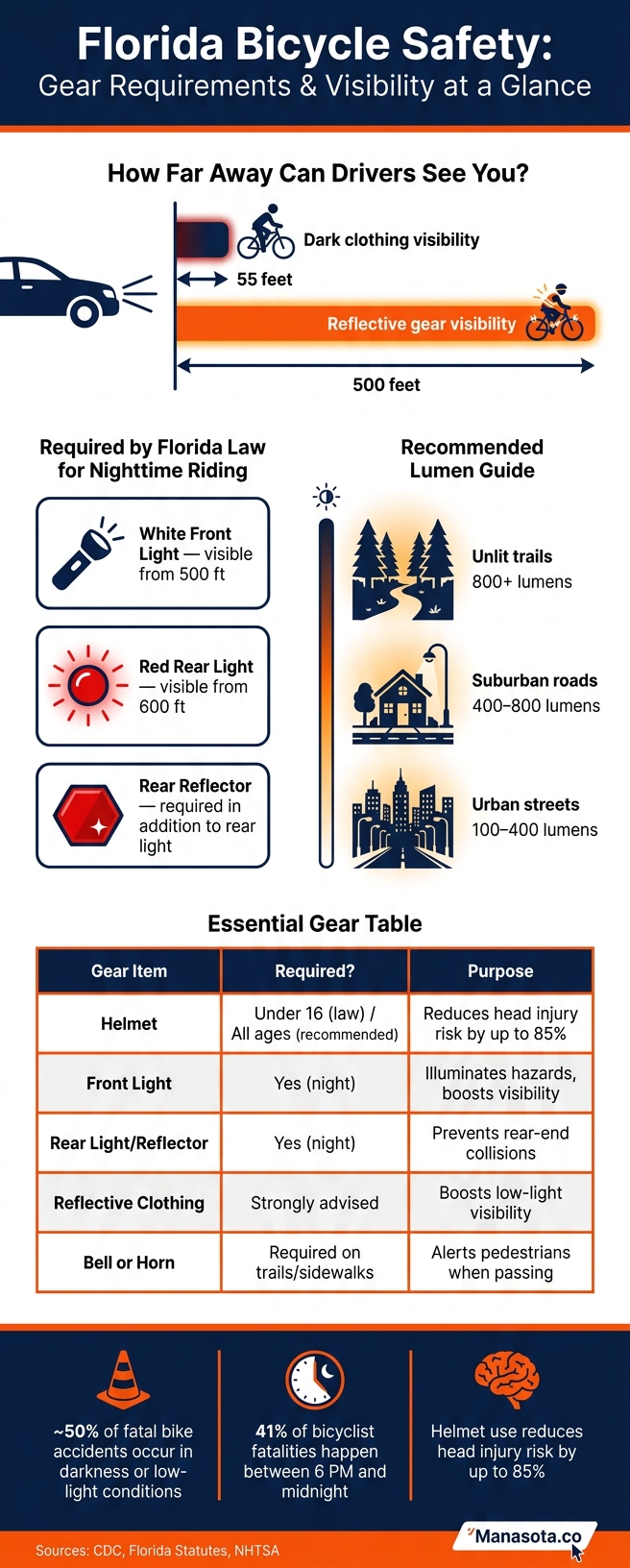
Staying visible is a critical part of cycling safely in Manasota, especially when riding during low-light hours. National statistics reveal that about 50% of fatal bicycle accidents occur in darkness or low-light conditions, with 41% of bicyclist fatalities happening between 6 p.m. and midnight. This makes proper lighting and reflective gear non-negotiable for safe cycling.
Here's a stark contrast: a driver can see a cyclist wearing dark clothing from just 55 feet away, but reflective gear boosts that visibility to an impressive 500 feet. That difference could mean the difference between being seen - or not.
Florida law is clear on nighttime cycling requirements. Cyclists must use a white front light visible from at least 500 feet, a red rear light visible from at least 600 feet, and a rear reflector. Importantly, a reflector alone doesn’t meet the legal standard, unlike in some other states. To optimize your safety, adjust your light brightness to match your environment:
- 100–400 lumens for urban streets
- 400–800 lumens for suburban roads
- Over 800 lumens for unlit trails.
Reflective gear placement matters, too. Instead of relying solely on a stationary vest, attach reflective materials to moving joints like your ankles, knees, or wrists. Motion naturally draws attention, making you more noticeable. A simple option, like reflective ankle bands (priced around $10–$15), is a budget-friendly way to enhance your visibility.
"Being seen isn't a feature. It's a system. The cyclists who get hit aren't usually the ones with no lights - they're the ones with one good light who assumed that was enough." - Lakisha Davis, Tech Enthusiast, Metapress
During daylight hours, fluorescent or neon-colored clothing helps you stand out against natural surroundings. At night, however, fluorescent colors lose their effectiveness. Instead, switch to retroreflective materials that reflect car headlights directly back to drivers. Combining bright daytime colors with reflective nighttime gear ensures you're visible no matter when or where you ride in Manasota.
3. Ride Predictably and Follow Florida Traffic Laws
In Florida, bicycles are treated as vehicles, meaning riders have the same rights and responsibilities as motorists. This classification requires cyclists to ride predictably and follow all traffic laws.
"In Florida the bicycle is legally defined as a vehicle and the bicyclist is a driver. Bicyclists have the same rights to the roadways, and must obey the same traffic laws as the drivers of other vehicles." - Florida Bicycle Association
To ensure safety, ride in a straight line, signal your turns at least 100 feet before making them, and always ride in the same direction as traffic. Riding against traffic significantly increases the likelihood of accidents.
Position yourself correctly in the lane by riding close to the right curb. However, if the lane is less than 14 feet wide - making it unsafe for a car and bike to travel side by side - you are allowed to take the full lane. At Sarasota roundabouts, make yourself visible, signal when exiting, and remember that vehicles must yield to cyclists already in the circle.
When approaching railroad crossings, stop between 15 and 50 feet from the tracks and proceed only when it’s safe. Ignoring this rule can lead to fines of up to $500 for a first offense and $1,000 for repeat violations.
In construction zones, like the area near the I-75 Fruitville Road interchange, ride with extra care to handle potential hazards predictably. By consistently following traffic laws, cyclists can foster better relationships with motorists.
"The impressions our actions leave on the motorists we encounter have a tremendous effect on cycling advocacy." - Florida Bicycle Association
4. Use Hand Signals and Share the Trail Politely
Adding to the importance of predictable riding and following traffic laws, using clear hand signals is a key part of staying safe on Manasota's shared trails. Hand signals let drivers, fellow cyclists, and pedestrians know your next move. In Florida, bicycles are classified as vehicles, so signaling turns and stops is not just courteous - it's the law. The signals are simple: extend your left arm straight out for a left turn, raise your left arm upward (or extend your right arm straight out) for a right turn, and point your left arm downward to indicate a stop or slowdown.
Make sure to signal early, giving others plenty of time to adjust and respond to your actions.
On shared paths like The Legacy Trail in Sarasota County, good trail etiquette is just as essential as signaling. Always yield to pedestrians, and give an audible warning before passing. You can use a bell or say, "on your left." Chris Slack from Pinnacle Wheel Works shares a helpful strategy:
"I'll ding it at two distances - once far back and then when I get closer... Sometimes you yell and it startles people." - Chris Slack, Pinnacle Wheel Works
This two-step dinging method allows people to notice you without being startled. Also, remember that the speed limit on The Legacy Trail is 15 mph. These practices not only make solo rides safer but also establish good habits when riding in groups.
When cycling with others, stick to riding two abreast at most. If you need to stop or slow down, move completely off the paved path to keep it clear for others. Proper signaling and courteous behavior are essential for safely navigating the diverse conditions of Manasota's trails.
"The Trail is a multi-use, non-motorized trail that supports a wide diversity of users... All have equal rights to use the trail." - Friends of The Legacy Trail
5. Watch Your Speed and Look Out for Road Hazards
Keeping your speed in check is crucial for giving yourself enough time to react to unexpected situations. Sarasota and Manatee counties are riddled with hazards like potholes, cracked pavement, gravel, and oily road surfaces. Hitting these at high speed can significantly increase your risk of serious injury. Slowing down - especially on roads you're not familiar with or after it rains - can make all the difference.
Florida's bike crash statistics are sobering. By the early months of 2026, the state had already recorded over 1,000 bike crashes, highlighting how important it is to control your speed on local roads.
This advice is even more critical on Manasota roads, where the absence of proper bike lanes makes cycling more dangerous. Roads like US-41, Clark Road, and Beneva Road have narrow or nonexistent bike lanes, forcing cyclists closer to fast-moving traffic. On these kinds of streets, how you manage your speed and lane position is vital. If a lane is too tight to safely share with a car, it's both legal and safer to ride slightly left of center and take the full lane. This discourages cars from trying to pass dangerously close.
Intersections are another area where extra caution is a must. Richard Garrett, President of the Florida Bicycle Association, emphasizes the importance of vigilance:
"Follow the rules of the road. And the third thing, which I say to cyclists and pedestrians - always watch out for the right-hand hook." - Richard Garrett, President, Florida Bicycle Association
A "right-hand hook" happens when a driver turns right directly into the path of a cyclist. To avoid this, slow down at intersections and stay alert, especially after it rains. Wet roads can hide hazards and make surfaces slick, so taking it slow gives you the best chance to react safely.
6. Inspect Your Bike Before Every Ride
Mechanical issues during a ride can be risky. As Sarasota Magazine highlights:
"A simple check before riding can save you from accidents caused by broken equipment."
To avoid mishaps, perform a quick pre-ride ABC check - Air, Brakes, and Chain.
Start with your tires: give them a firm squeeze - they should feel solid, not soft. Use a pressure gauge to ensure they match the recommended PSI, and check for cuts or embedded debris in the tread. Next, test your brakes by squeezing each lever while rolling the bike forward. If a lever pulls all the way to the handlebar, inspect the cables and pads for wear. Finally, look at the chain - it should be clean and shift smoothly through all gears.
Two quick tests can confirm your bike's readiness. Lift each wheel and spin it to ensure it moves freely without wobbling or rubbing against the brake pads. Then, hold the front brake and rock the bike gently; if you hear a clunk near the handlebars, the headset might be loose and needs adjustment.
Always carry a repair kit with essentials like a multitool, spare tube, tire levers, and a pump or CO₂ inflator. If you're unsure about your bike's condition, local shops like Village Bikes, Ryder Bikes, or Sarasota Cycle can help with a professional tune-up.
Jim Rutberg of USA Cycling emphasizes:
"You should check the following things before every ride because problems in these areas can occur seemingly out of the blue."
With your bike inspected and ready to roll, you're all set to move on to the next step in staying safe.
sbb-itb-354efe9
7. Ride Smart in Florida Heat and Changing Weather
Staying safe on Florida roads isn't just about having the right gear and following traffic rules - it’s also about being prepared for the state’s unpredictable weather and intense heat.
Florida summers, especially in the Manasota area, can be brutal. The combination of high temperatures and humidity creates a challenging environment for cyclists. During peak summer, riders can sweat up to 1.5 liters per hour, and with humidity levels often exceeding 70–80%, sweat doesn’t evaporate as efficiently. This forces your body to work even harder to regulate its temperature.
Stay Ahead of Dehydration
Start hydrating well before you hit the road. Experts recommend drinking 16–20 ounces of water at least two hours before your ride. Once you're cycling, take small sips every 15–20 minutes rather than waiting until thirst kicks in. As Bicycle Doctor House Calls puts it:
"Thirst is a lagging indicator; by the time you feel thirsty, your body is already experiencing mild dehydration."
For rides lasting over an hour, water alone might not cut it. Use electrolyte tablets or sports drinks to replenish key minerals like sodium, potassium, and magnesium that are lost through sweat. Timing your rides can also make a big difference. Try to ride early in the morning or late in the evening to avoid the blazing sun between 11 AM and 3 PM.
Dress to Beat the Heat
What you wear can significantly affect how well you handle Florida’s heat. Ditch cotton and go for moisture-wicking, lightweight fabrics that keep you cool and dry. A study published in Frontiers in Sports and Active Living (2022) showed that cyclists wearing a 60%/40% polyester-nylon blend completed a 20-km trial 15.7 seconds faster than those in cotton. Light-colored clothing, like white jerseys, is another smart choice since it reflects sunlight rather than absorbing it.
Prepare for Sudden Weather Changes
Florida’s weather is famously unpredictable. A sunny day can quickly turn into a rainstorm. If you get caught in the rain, slow down, avoid puddles that might conceal potholes, and be cautious on wet roads, which can become slick with oil residue - especially around corners. And if lightning strikes or the rain becomes too heavy, it’s best to pull over and wait it out.
"If a storm gets too heavy, pull over and wait until the rain calms a bit before finishing your ride." - Bill Bone, Personal Injury Lawyer and Cycling Event Sponsor
8. Stay Focused and Avoid Distractions While Riding
Using your phone while biking is a big no-no. Texting or calling can steal your attention at the worst possible moments. As William W. Price P.A. explains:
"Just like with driving, looking at your phone while biking can distract you from the road. Save texts and calls for when you are off your bike."
Headphones are another common culprit that can limit your awareness. In Florida, it’s illegal for cyclists to wear headphones or similar devices in both ears. This restriction, outlined in Florida Statute §316.304, ensures you can still hear vital sounds like car horns or emergency sirens. If you want to listen to music or navigation cues, try using a single-ear device or helmet-mounted speakers that let you stay aware of your surroundings.
Staying alert goes beyond avoiding phones and headphones. Always keep both hands on the handlebars so you’re ready to brake if needed. Be cautious of "dooring" accidents - when a parked car door suddenly opens into your path - by maintaining at least 3 feet of space from parked cars. On busy roads like U.S. 41 or Beach Road near Siesta Key, even a brief lapse in focus can result in a serious crash. Staying vigilant is one of the best ways to keep yourself safe on the road.
9. Ride Safely in Groups and with Kids
Group rides are a key part of cycling culture in Manatee and Sarasota counties, but they come with added responsibilities. To keep things safe and manageable, stick to groups of no more than 10 riders and maintain proper spacing throughout. Good communication within the group is essential and builds on earlier tips for individual cycling safety.
In group rides, coordination is everything. Use clear hand signals and call out hazards like "pothole", "gravel", or "car back" so everyone stays informed and prepared. At intersections, each rider should assess traffic for themselves instead of relying on someone else to shout "clear". This ensures everyone takes responsibility for their own safety.
"Groups of cyclists are typically the most visible members of the cycling community - we can be billboards for exemplary behavior, or we can reinforce the stereotypes that cyclists are scofflaws." - Florida Bicycle Association
When riding with kids, extra preparation is a must. Make sure they understand that bicycles are legally considered vehicles in Florida, meaning they must follow traffic laws just like cars - stopping at red lights, yielding at stop signs, and riding with traffic flow. Helmets are legally required, so double-check that they’re wearing one. Teach kids to avoid overlapping their front wheel with the back wheel of the rider ahead, as this is a common cause of crashes in group settings. In Manatee County, kids riding on sidewalks must keep their speed under 15 mph and always yield to pedestrians. These practices not only keep young riders safe but also promote a culture of responsibility and awareness in the cycling community.
10. Learn Local Routes and Use Local Resources
Getting to know the local trails can make your rides safer and more enjoyable. One standout in Manasota is the Legacy Trail, an 18.5-mile paved path stretching from Fruitville Road in Sarasota to the Historic Venice Train Depot. Along the way, you'll find 15 trailheads offering various amenities. It's a popular spot, attracting about 644,000 users in 2024, so be prepared for some company, especially on weekends.
The Legacy Trail has grown into a larger network of over 30 miles of interconnected paved paths. These include the Venetian Waterway and three North Port connectors: a paved trail, the hard-packed South Powerline Trail, and the natural-surface Alphabet Trail in Deer Prairie Creek Preserve. Each route offers a different experience, catering to a variety of riding preferences.
If you're using the Legacy Trail, keep in mind its 15 mph speed limit and operating hours from 6:00 a.m. to sunset, with enforcement by the Sarasota County Sheriff's Office. For added safety, the trail features yellow 911 emergency markers (e.g., "LT 15.60") to help emergency responders locate you quickly in case of an incident.
"These markers will facilitate emergency responders to pinpoint your location and speed their response time. In an emergency, simply locate the nearest 911 marker, and call 911 giving them the location." - Friends of The Legacy Trail
For up-to-date information, consider subscribing to Sarasota County's maintenance and closures newsletter. It provides details on mowing schedules, construction detours, and changes to trail access. Additionally, the Friends of the Legacy Trail website offers printable maps and GPS coordinates for major access points. Another useful resource is Manasota.co, which covers community news and highlights Lakewood Ranch's 150 miles of trails, along with updates from Manatee and Sarasota counties.
Safety Gear and Riding Rules at a Glance
Florida Bicycle Safety: Gear Requirements & Visibility Stats
Understanding Florida's bicycle laws and equipping yourself with the right gear can make all the difference in staying safe. If you're under 16, wearing a CPSC-approved helmet isn't just a good idea - it's the law. Florida also requires a white front light visible from 500 feet and a red rear light with a reflector visible from 600 feet when riding at night. These rules are especially important since over half of adult bicycle fatalities in Florida happen during twilight or nighttime hours.
Here’s a quick guide to essential gear and why it matters:
| Gear Item | Florida Requirement | Why It Matters |
|---|---|---|
| Helmet | Mandatory for ages under 16 | Reduces the risk of serious head injuries |
| Front Light | White, visible from 500 ft | Lights up hazards and makes you more visible |
| Rear Light/Reflector | Red, visible from 600 ft | Prevents rear-end collisions |
| Reflective Clothing | Not required, strongly advised | Boosts visibility in low-light settings |
| Bell or Horn | Required on sidewalks/trails | Alerts pedestrians when you're passing |
These guidelines are essential for navigating Manasota’s roads and trails safely.
When it comes to riding rules, they depend on where you’re cycling. On public roads, you’re expected to follow traffic signals, ride in the same direction as traffic, and use hand signals to indicate turns. On sidewalks and shared paths, cyclists must yield to pedestrians and provide an audible signal - like a bell or a verbal warning - before passing.
If you’re riding an e-bike, keep in mind that Manatee County enforces a 15 mph speed limit on sidewalks. For Class 3 e-bikes, which can reach speeds of 28 mph, the minimum rider age is 16.
"In Florida, the bicycle is legally a vehicle with corresponding rights and responsibilities on public roads... that a motor vehicle operator does." - Florida Department of Highway Safety and Motor Vehicles
One more thing: wearing headphones in both ears while cycling is prohibited in Florida. Keeping one ear open to your surroundings isn’t just a legal obligation - it’s a smart way to stay aware of traffic and other potential hazards. By following these rules and gear recommendations, you help foster the safe cycling culture that Manasota is known for.
Conclusion
Staying safe while cycling in Manasota boils down to a few key practices: always wear a helmet, make yourself visible, follow Florida traffic laws, and ride in a predictable manner. Whether you're enjoying the 18.5-mile Legacy Trail that stretches from Sarasota to Venice or navigating the streets of Bradenton, these habits help protect both you and others on the road.
Cycling advocates emphasize that helmets, obeying traffic laws, and staying alert at intersections are essential for avoiding potential dangers.
Local organizations are also great resources for cyclists. The Sarasota Manatee Bicycle Club (SMBC) offers group rides and shares safety tips, while Friends of The Legacy Trail provides updates on trail conditions, etiquette, and emergency procedures. These groups are excellent for learning more about safe riding and connecting with other cyclists.
For community news, route suggestions, and updates, check out Manasota.co. It's a useful hub for staying informed about events and cycling opportunities across the region, from Lakewood Ranch to Northport.
Stay vigilant, stick to the rules, and enjoy the incredible cycling experiences Manasota has to offer.
FAQs
What should I do right after a bike crash in Manatee or Sarasota County?
After a bike crash in Manatee or Sarasota, your first priority should be safety. If you're able, move out of traffic to a safer spot. Call 911 immediately to report the accident and ensure a police report is filed.
Exchange contact and insurance information with the other party involved, and if there are witnesses, gather their details as well. Take photos of the accident scene, including any damage to your bike, injuries, and the surrounding area.
It’s also critical to seek medical attention within 14 days - even if you feel fine - to protect your insurance benefits. Avoid admitting fault at any point, and consult with a legal professional before discussing the incident with any insurance companies.
How can I choose a safer route around high-traffic roads like US-41?
To steer clear of busy roads like US-41, it’s smart to plan your route ahead of time. Use local trail maps or cycling apps to locate paths that are free of traffic. In the Manasota area, you’ll find safer alternatives such as the Legacy Trail and Sarasota Bay Trail. Prioritize routes that include bike lanes, overpasses, or crossing signals for added safety. Also, take time to research traffic patterns and the difficulty of the trails to make your ride both safer and more enjoyable.
What’s the best way to stay safe at intersections and avoid right-hook turns?
To steer clear of right-hook crashes, it’s all about staying sharp and positioning yourself wisely. At intersections, make a habit of scanning left, center, and right to keep an eye on vehicles and their blind spots. Avoid passing any vehicle on the right if it’s turning - look out for turn signals or wheels starting to angle in that direction. If the lane starts to narrow, shift slightly to the left to discourage drivers from cutting you off. Most importantly, always be ready for possible conflicts - don’t depend entirely on having the right-of-way.