Top 7 Parks for Nature Play in Manasota
Seven Manasota parks compared for families — play features, trails, water access, wildlife, and best picks by age and trip length.
If I want the short answer: Robinson Preserve, Oscar Scherer, and Myakka are the best picks for longer outdoor days, while Urfer, Conservatory, Bayfront, and Tom Bennett work better for easier family stops.
This list covers 7 parks across Manatee and Sarasota counties, with options for toddlers, older kids, and mixed-age groups. I’m looking at the things most families care about first: play features, wildlife, trails, water access, restrooms, shade, and outing length.
Here’s the article in one quick view:
- Robinson Preserve: rope tunnels, climbing nets, boardwalks, bird spotting, 682 acres
- Urfer Family Park: climbing boulder, wetlands boardwalk, stroller-friendly paths, 55 acres
- Conservatory Park: small playground, shaded trails, lake dock, easy short visit, 55 acres
- Oscar Scherer State Park: swimming lake, paddling, trails, nature center, 1,400 acres
- Myakka River State Park: canopy walkway, tower, paddling, tours, 58 square miles
- Bayfront Park: splash pad, shoreline path, native plants, city setting
- Tom Bennett Park: zip line, rope course, splash pad, wetlands, 200 acres
If I had to sort them by outing style, it would look like this:
- Best for climbing: Robinson Preserve and Tom Bennett Park
- Best for water play: Bayfront Park, Oscar Scherer, and Tom Bennett Park
- Best for wildlife: Myakka, Oscar Scherer, and Robinson Preserve
- Best for short visits: Conservatory Park and Urfer Family Park
- Best for full-day trips: Myakka and Oscar Scherer
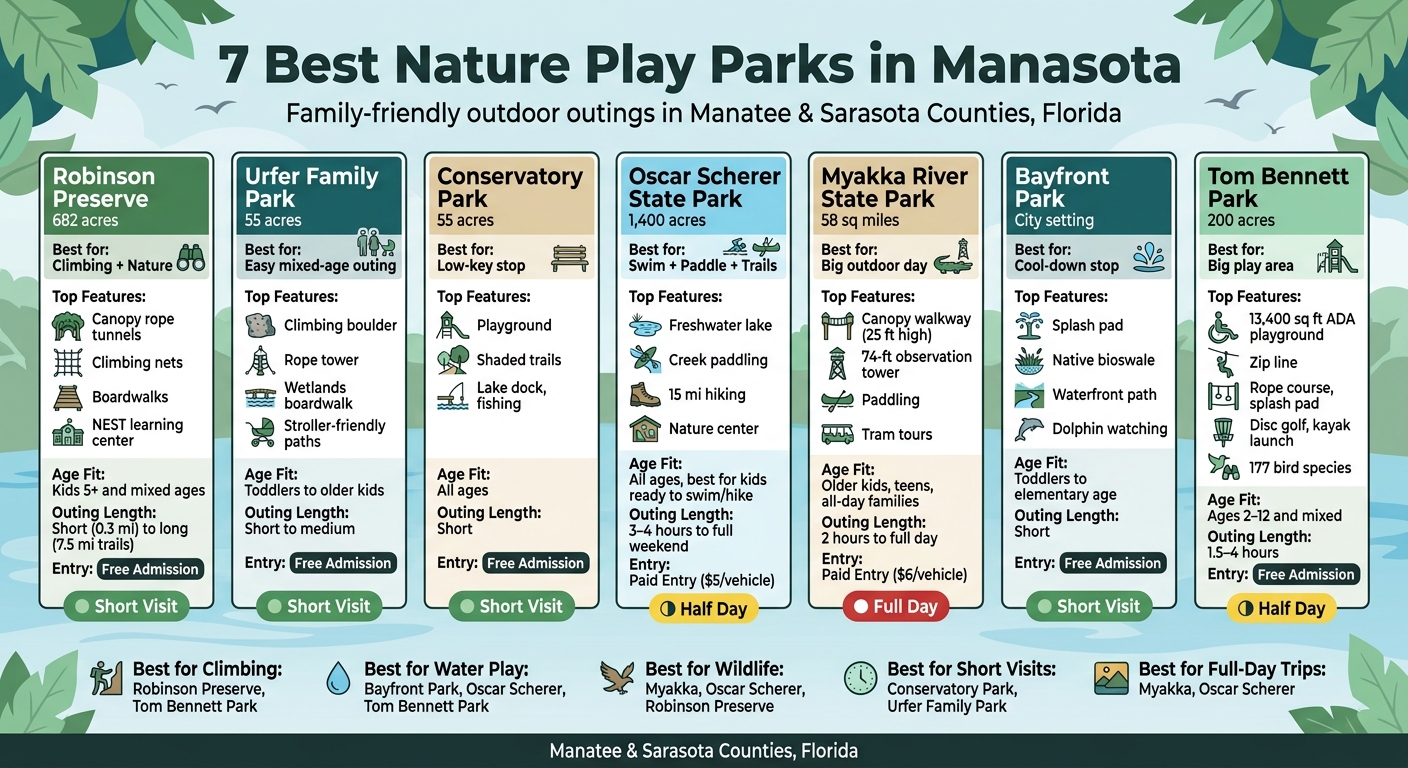
7 Best Nature Play Parks in Manasota: Quick Comparison Guide
Quick Comparison
| Park | Best for | Main draw | Good fit |
|---|---|---|---|
| Robinson Preserve | Climbing + nature | Canopy play area, boardwalks, bird views | Kids 5+ and mixed ages |
| Urfer Family Park | Easy mixed-age outing | Boulder, rope play, wetland boardwalk | Toddlers to older kids |
| Conservatory Park | Low-key stop | Playground, trails, lake dock | Short family visits |
| Oscar Scherer State Park | Swim + paddle + trails | Freshwater lake, creek paddling | Families wanting half-day or longer |
| Myakka River State Park | Big outdoor day | Canopy walkway, tower, wildlife, paddling | Older kids, teens, all-day trips |
| Bayfront Park | Cool-down stop | Splash pad, waterfront path | Toddlers to elementary age |
| Tom Bennett Park | Big play area | Zip line, rope course, splash pad | Ages 2–12 and mixed outings |
The main point: if you want the most range, start with Robinson Preserve, Oscar Scherer, or Myakka. If you want something simpler, go with Urfer, Conservatory, Bayfront, or Tom Bennett.
sbb-itb-354efe9
What Makes a Good Nature Play Park
The best nature play parks do more than set up swings and call it a day. They turn the landscape itself into part of the fun. That means kids don’t just play next to nature. They play in it and with it, through features built into the setting instead of a standard equipment lineup.
Habitats like mangroves, salt marshes, hammocks, and freshwater lakes bring in wildlife and give each park its own feel. One spot might feel shady and tucked away. Another might open up around water and birds. That variety changes the play experience in a way plastic structures usually can’t.
Interpretive signs, observation towers, and gathering spaces also matter. They help kids make sense of what they’re seeing, so a visit becomes more than just time outdoors. A child spots a bird, looks at a sign, climbs a tower, and starts to connect that small moment to the bigger ecosystem.
The practical side counts too. Restrooms, stroller-friendly paths, boardwalks, and accessible pavilions make the park easier for families to use and enjoy. Those details shape the seven parks below. With that in mind, the first stop is Robinson Preserve NEST and Canopy Zone.
1. Robinson Preserve NEST and Canopy Zone
Robinson Preserve blends coastal habitat, elevated play, and wildlife learning in one easy stop. The preserve covers 682 acres of restored coastal marshland, and the NEST with the Canopy Zone brings together habitat, climbing, and nature-based learning in one spot. Admission and parking are free, and the area is open daily from sunrise to sunset.
Nature-based play features
The Canopy Zone is a compact, two-story nature play structure built for kids who like to climb, crawl, and look out over the landscape. It includes boardwalks, rope bridges, climbing nets, cargo-net tunnels, suspended rope tunnels, zigzag platforms, and a spiral slide that brings kids back to ground level. There’s also a net tube with elevated views across the preserve. On hot days, the treetop shade helps keep the play area cooler.
Educational or wildlife elements
The learning side of the site is just as strong as the play side. The NEST - the Mosaic Center for Nature, Exploration, Science, and Technology - is a pine-and-cypress treehouse with 360-degree windows and hands-on programming. It hosts hands-on programming on Saturdays from 9 a.m. to 12 p.m. The 0.3-mile NEST Trail loops around a banyan tree and includes mounted binoculars for spotting wading birds.
Family amenities
For families, the setup is simple and convenient. Restrooms, benches, water fountains, and bike racks are placed along the boardwalk near the NEST. Enter through the South Entrance off 9th Avenue Northwest.
Best fit for age range and outing length
The boardwalk loop works well for all ages and abilities, while the climbing features are best for children 5 and up. If you want a short visit, the NEST Trail is just 0.3 miles. If the kids still have energy to burn, the preserve also has 7.5 miles of trails for a longer outing.
2. Urfer Family Park
After marsh play by the coast, Urfer turns things inland. Here, the draw is wetlands, walking trails, and old ranch land.
Urfer Family Park covers 55 acres of former ranch land in Sarasota. Admission is free, parking is free, and the park is open daily from 6 a.m. to 10 p.m.
Nature-based play features
The playground's main feature is a large climbing boulder that helps kids work on balance and coordination. There’s also a rope tower and bigger climbing structures that give older kids more of a challenge. Underfoot, the playground uses shock-absorbing recycled rubber.
Step past the main play area and the park starts to feel more natural. A trail with natural surfaces winds through pine flatwoods, with sections of sand, grass, and pine needles underfoot.
Educational or wildlife elements
A boardwalk system takes children right over seasonal wetlands, where they can spot lily pads, dragonflies, and basking turtles at close range. It’s one of those spots where a short walk can turn into a mini wildlife search without much effort.
The park also has gopher tortoises, pileated woodpeckers, red-shouldered hawks, and foxes. Educational signs along the trails give kids and adults more context about the local ecosystem. So the visit isn’t just about climbing and walking. Kids can play, cross the wetlands boardwalk, and pick up bits of nature knowledge along the way.
The restored C.B. Wilson House and the 1925 Svenhelm Barn add a link to Sarasota's ranching past. Self-guided tours of the Wilson House are available on select days.
Family amenities
Urfer is set up well for families who don’t all want the same thing. Separate play zones serve toddlers, school-age kids, older children, and adults.
You’ll also find:
- Covered pavilions with outlets and charcoal grills
- Restrooms and drinking fountains
- Wide paved paths that work well for strollers and scooters
If you're planning a birthday party, it’s smart to reserve a pavilion early through Sarasota County Parks.
Best fit for age range and outing length
Urfer works well for a mixed-age outing. Toddlers get a safe area of their own, while older kids and adults can spread out and explore 1.4 miles of trails.
For a bigger, wilder outing, the next stop is Oscar Scherer State Park.
3. Conservatory Park
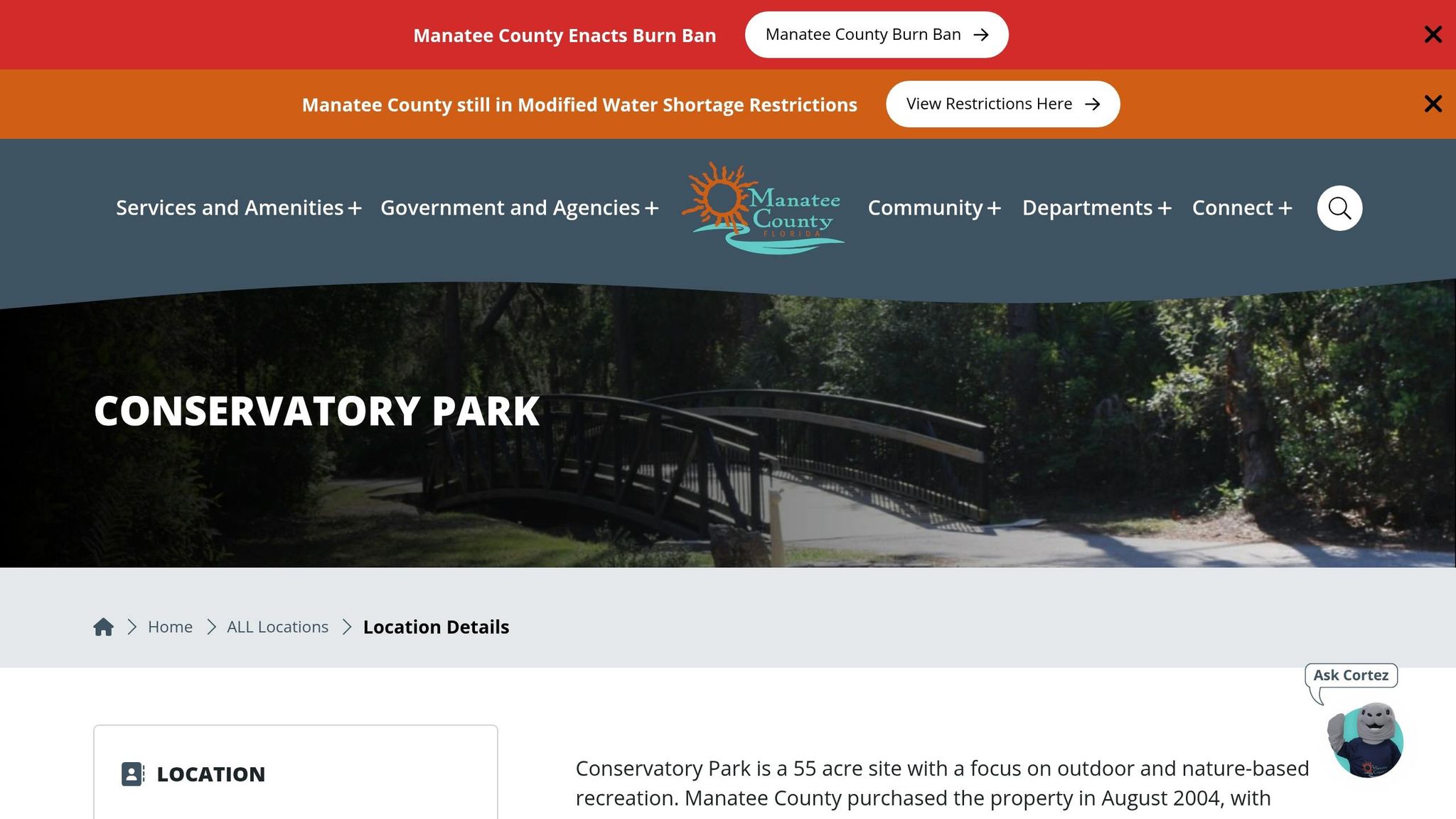
Conservatory Park is a small Sarasota spot made for an easy, low-key outing. The 55-acre park gives families a simple mix of nature, movement, and quiet lake views.
Nature-based play features
The playground is right next to the main pavilion, which makes it easy to settle in and keep an eye on kids at play. There’s also a fitness trail with exercise stations, so the park offers more than just swings and slides. If your family likes to wander a bit, the shaded trails are easy to walk and good for a short nature break.
Educational or wildlife elements
The lake area adds a nice change of pace. A lakeside dock and wooden patio are set up for fishing and birdwatching, and a small stone seating area can work well for outdoor learning or a quiet snack stop. Along the trails, educational signs help kids understand the local habitat while they walk.
Family amenities
The park is open from sunrise to sunset. It also has the basics families tend to need:
- Restrooms
- Drinking fountains
- Benches
- Two ADA-accessible pavilions
The small pavilion seats 16 across 2 tables, while the main pavilion seats 32 across 4 tables. Rental rates are $50.00 + tax for the small pavilion and $60.00 + tax for the large pavilion, which includes electricity. One thing to plan for ahead of time: grilling is strictly prohibited, so it’s best to pack a picnic.
Best fit for age range and outing length
Conservatory Park is a good match for mixed-age families. Younger kids can stick with the playground, while older kids and adults can spend time on the fitness trail or by the lake.
If you want something a bit more rugged after this stop, head next to Oscar Scherer State Park.
4. Oscar Scherer State Park

Oscar Scherer moves things inland, away from the beach scene and into scrub habitat, creek paddling, and freshwater swimming. The 1,400-acre park in Osprey gives families a mix of water, trails, and wildlife all in one place.
Nature-based play features
Lake Osprey is a 3-acre freshwater lake with a sandy beach. It’s also Sarasota County’s only freshwater swimming lake. If your kids like to poke around underwater, bring snorkel gear.
South Creek adds a different kind of water time. Families can paddle through a tidal blackwater stream and look for alligators, otters, and wading birds along mangrove-lined banks. Canoe and kayak rentals cost about $15 per hour or $60 for a full day.
On land, the park has 15 miles of hiking trails and 10 miles of biking trails, with short 0.25-mile options for little kids and longer routes for older ones. The 0.5-mile Florida Scrub-Jay Trail is a good pick if you want a decent shot at seeing Florida’s endemic scrub-jays. The park also has gopher tortoises and more than 200 bird species.
The Nature Center works well as a quiet break between outdoor stops. It has dioramas, a touch table, and a wildlife search activity for kids. It’s usually open Saturdays and Sundays from 10 a.m. to 2 p.m..
Family amenities
Vehicle entry is $5. The park also includes:
- Two playgrounds
- Accessible restrooms
- Cold-water showers at the Lake Osprey bathhouse
- Rentable picnic pavilions with grills
Families looking for an easier route can use the 0.5-mile Lester Finley Barrier-Free Trail, which includes a fishing dock. The paved Legacy Trail also runs through the park, which makes biking easier for kids who do better on a flat surface.
Best fit for age range and outing length
Oscar Scherer works for all ages, but it tends to be a better fit for families with kids who are ready to swim, paddle, or hike with a bit of independence. Toddlers can stay near the Lake Osprey Trail and the playgrounds, while older kids and teens can handle longer trails or spend more time on the water.
A day visit usually takes 3 to 4 hours. If you camp or book glamping, it can easily turn into a full weekend trip. One thing to know before you go: the scrub habitat doesn’t offer much shade, so cooler months are the most comfortable time to visit.
5. Myakka River State Park

Myakka River State Park makes Oscar Scherer feel small. It covers 58 square miles of wetlands, prairies, and pinelands, and it protects one of only two designated Wild and Scenic Rivers in Florida. That extra room changes the whole outing. Instead of one short stop, this park can easily fill an entire day.
Nature-based play features
The star of the park for many families is the Myakka Canopy Walkway. It’s a 100-foot-long suspension bridge set 25 feet above the ground. For kids, that’s the kind of thing that feels like a mini adventure the second they step onto it. At the end, the 74-foot observation tower opens up broad views across the Myakka basin.
If you have younger kids, the William S. Boylston Nature Trail is a much easier pace. It’s a simple 0.8-mile loop. Families who want water time can head to the Myakka Outpost to rent canoes or kayaks and paddle on the Myakka River or Upper Myakka Lake.
Educational or wildlife elements
This is one of those parks where wildlife doesn’t feel distant. Alligator sightings are common, especially around Upper Myakka Lake, Alligator Point, and the first bridge on Park Road. The park also has more than 100 bird species, including roseate spoonbills and bald eagles.
For families who want help spotting more than they’d find on their own, narrated tram and boat tours offer guided backcountry trips. There’s also a ranger-led option for kids during summer. Junior Ranger Saturdays take place on the second Saturday of summer months from 10 a.m. to noon, with activities, games, and crafts.
Family amenities
The Myakka Outpost gives families a handy base, with bike rentals, canoe rentals, a gift shop, and the Pink Gator Café. Restrooms and picnic pavilions are spread through the park, which helps a lot on a long visit.
One thing to plan for: as of early 2026, the park is under a non-potable water notice, so you’ll need to bring your own drinking water.
Best fit for age range and outing length
Myakka can work for almost any age group. The main difference is how much ground your family wants to cover. Toddlers usually do best along the main park road, which is stroller-friendly and has a low speed limit. Older kids and teens may be up for longer trails or the 4.4-mile hike to Deep Hole, a natural sinkhole where alligators gather during dry spells. Access is limited to 30 permits per day, first-come, first-served.
Timing can be flexible too:
- A short visit can take about 2 hours
- A full-day trip can include paddling, a tram tour, and a picnic
Vehicle entry is $6 per vehicle for 2 to 8 people, and tram tours cost $22 for adults and $12 for children ages 3–12. The park opens at 8 a.m. every day and closes at sunset. Weekends can get crowded, so it’s smart to arrive early.
6. Bayfront Park and Children's Splash Pad Playground

Bayfront Park brings together waterfront views, splash-pad fun, and native landscaping. It’s a good example of how nature play can fit right into an urban shoreline, not just parks deep in the woods or large state sites.
Nature-based play features
The splash pad gives children a hands-on way to control water flow. During the redesign, the splash pad was lifted about 7 feet so it lines up with the playground and improves access, creating one connected accessible play area. Restored animal sculptures from the original Steigerwaldt-Jockey Children's Fountain are also worked into the landscaping.
Educational or wildlife elements
A bioswale planted with native Florida species, including cabbage palm, railroad vine, and mangrove spider lily, adds a built-in learning feature. Signs explain how the stormwater system works, which gives families something extra to talk about while kids play. The plants also draw butterflies, birds, and other local insects. From the shoreline path, families can watch for dolphins too.
Family amenities
Families have access to drinking fountains, picnic tables, a canoe/kayak launch, and restrooms. Banyan trees near the waterfront provide shade and give kids another place to climb and move around.
Best fit for age range and outing length
This park works well for toddlers through elementary-age children. The interactive splash pad and climbing features make it a smart pick for a short cool-down stop, especially on a hot Florida day. If you want to stay longer, the walking path makes that easy.
For a quieter neighborhood option, the next stop is Tom Bennett Park.
7. Tom Bennett Park
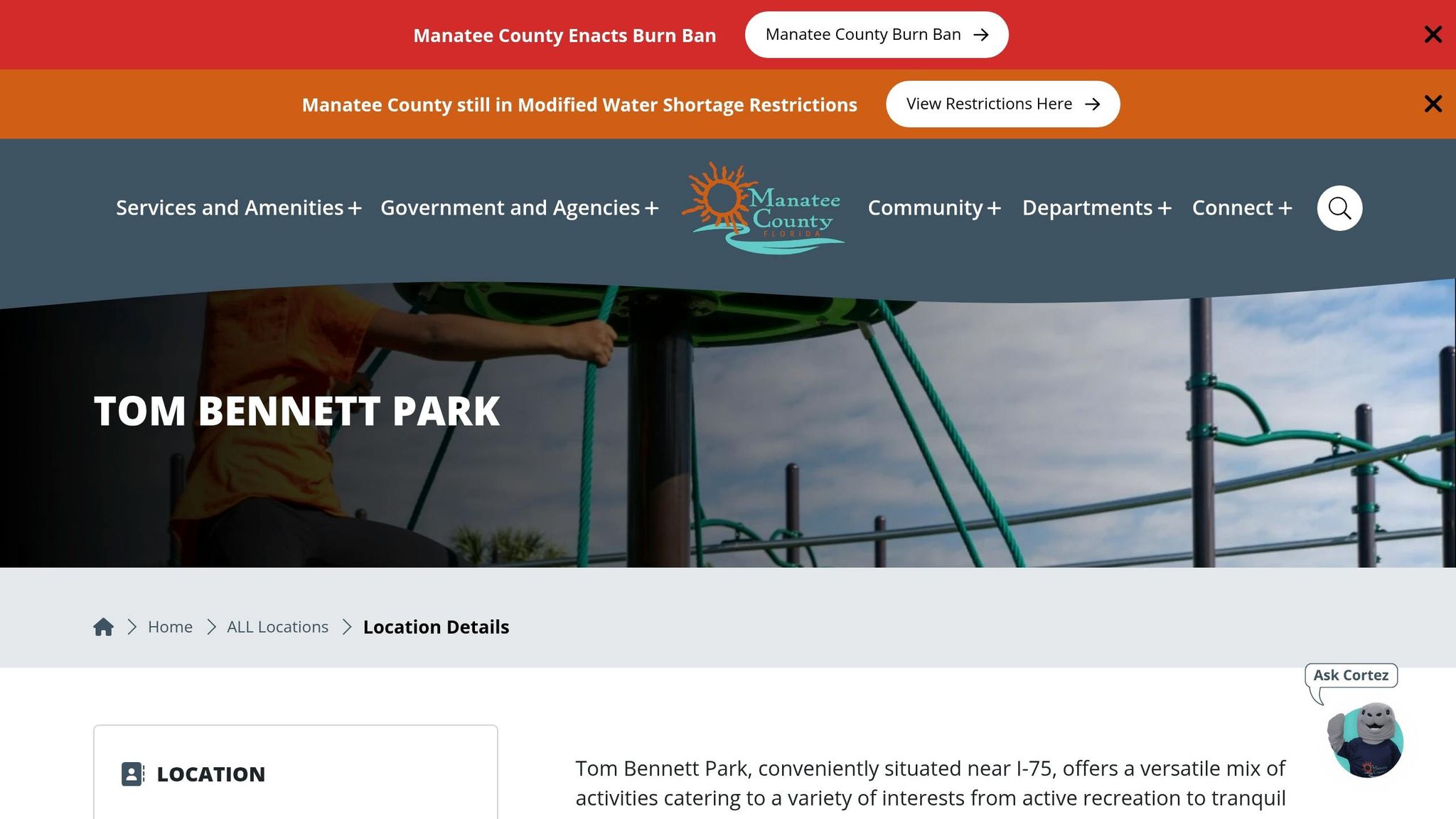
Tom Bennett Park spans 200 acres of restored wetlands and uplands in Bradenton. It’s a spot where nature, play, and easy access all come together. Families can use the trails, watch wildlife around the ponds, or stop by the fishing pier. And because admission is free, it works well as a last park to cover before getting into the comparison table.
Nature-based play features
The park’s main attraction is the Kiwanis Playground, a 13,400-square-foot, fully ADA-accessible play area with a rope challenge course, a zip line, a ground-level merry-go-round, and rubber surfacing throughout. There’s also a splash pad, which adds water play right in the middle of the restored wetland setting.
If your kids still have energy to burn, there’s more to do. Older children can head to the 18-hole disc golf course, and families who want time on the water can use the canoe and kayak launch at the 1st Avenue East entrance for access to the Manatee River and nearby mangrove wetlands.
The nice thing here is range. One child can be climbing and zipping around while another is happy looking at turtles by the water.
Educational or wildlife elements
This park also pays off when kids slow down and pay attention. Birdwatchers have recorded 177 species here, including Bald Eagles, Limpkins, and Wood Ducks. The fishing pier near the "Big Lake" by I-75 is a steady place to watch wading birds.
Near the splash pad, there’s also a Communication Board that uses symbols to help non-verbal children express needs and emotions. That kind of detail can make a big difference for families with mixed ages and different ways of communicating.
Family amenities
You’ll find the basics covered on-site:
- Restrooms
- Water fountains
- Picnic tables with grills
- A rentable pavilion with seating for 32
- A paved trail that works well for strollers and wheelchairs
- A fenced playground area
The pavilion rents for $60.00 plus tax.
Best fit for age range and outing length
The playground is built for kids ages 2–12, but the disc golf course, kayak launch, and birding areas make it easy to turn a short playground stop into a longer outing. Most families will want 1.5 to 4 hours, depending on how much they plan to do.
For the most direct access to the playground, splash pad, and restrooms, use the Kay Road entrance. For a side-by-side look at how it compares with the other parks, check the table below.
Park Comparison Table
Use this table to compare each park's style of nature play, what kids can learn there, and the basics families usually care about first. Each row highlights the details that can make planning a day out a lot easier.
| Park | Nature Play + Amenities |
|---|---|
| Robinson Preserve NEST and Canopy Zone | Canopy Zone with rope tunnels, climbing nets, and elevated views; NEST learning space, restrooms, and picnic pavilions |
| Urfer Family Park | Climbing boulder, rope tower, toddler play area, wetlands boardwalks, restrooms, and picnic facilities |
| Conservatory Park | Playground near a pavilion, shaded trails, lake dock, and restrooms |
| Oscar Scherer State Park | Freshwater lake, South Creek paddling, hiking and biking trails, nature center, and playgrounds |
| Myakka River State Park | Canopy walkway, observation tower, river and lake paddling, tram and boat tours, restrooms, and picnic pavilions |
| Bayfront Park and Children's Splash Pad Playground | Interactive splash pad, native bioswale plantings, waterfront path, climbing features, and restrooms |
| Tom Bennett Park | Rope challenge course, zip line, splash pad, disc golf, kayak launch, fishing pier, and ADA-accessible restrooms |
Conclusion
Manasota has a nature-play spot for just about any kind of family outing. The table makes it easy to line up each park with your family’s time, energy, and age range.
If you’re keeping it short, Conservatory Park and Urfer Family Park are the easiest picks. They work well when you want some outdoor time without turning it into a big all-day plan. For older kids, Robinson Preserve brings more action, with climb-and-crawl areas that call for a bit more energy. And if your crew wants to move more, it makes sense to step up from neighborhood parks to Robinson Preserve or Oscar Scherer State Park.
For a longer outing, Robinson Preserve and Oscar Scherer State Park give you the broadest mix of trails, wildlife, and water access.
Choose the park that matches your time, your kids’ ages, and how active you want the day to be. Use the comparison table to check the details, and look up current trail conditions before heading out.
FAQs
Which park is best for toddlers?
Urfer Family Park is the best pick for toddlers. It has separate play areas for younger and older kids, with toddler-friendly slides and sensory stations under shaded canopies.
The wide, paved sidewalks around the playground also make it a nice spot for stroller walks.
Which parks are best for a full-day trip?
For a full-day nature outing, Myakka River State Park and Robinson Preserve are two of the best picks.
Myakka River State Park covers 58 square miles and gives you plenty of room to spread out. You can walk the canopy walkway, rent a boat, and even grab a meal with on-site dining. It’s the kind of place where you can spend hours and still feel like you’ve only scratched the surface.
Robinson Preserve offers a different kind of day outdoors. It spans 682 acres and includes trails, mangrove waterways, and the NEST education center. There’s also a nearby treetop playground, which makes it an easy choice if you’re out with kids or just want a spot that mixes nature with a bit of play.
Which parks have water play?
For water play, Oscar Scherer State Park is the best fit. Lake Osprey has a designated beach for swimming and snorkeling, which makes it a strong pick if you want to get in the water instead of just staying near it.
The other parks lean more toward different kinds of water recreation. Robinson Preserve is a good choice for kayaking, canoeing, and paddle boarding. Lake Manatee State Park has a beach for swimming. And Heron’s Nest Nature Park is better suited for fishing and boating.